MCQ
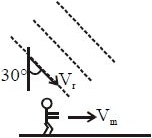
A person running horizontally observes that rain is falling on his head vertically with speed $10\,m/s$. He stops and observes that rain is coming at an angle $30^o$ with vertical. Find the speed of rain w.r.t. ground
  • A
    $20\,m/s$
  • $\frac{{20}}{{\sqrt 3 }}m/s$
  • C
    $10\sqrt 3\,m/s$
  • D
    $\frac{{10}}{{\sqrt 3 }}m/s$

Answer

Correct option: B.
$\frac{{20}}{{\sqrt 3 }}m/s$
b
Given $\mathrm{V}_{\mathrm{r}} \cos 30^{\circ}=10 \mathrm{m} / \mathrm{s}$

$\mathrm{V}_{\mathrm{r}}=\frac{20}{\sqrt{3}} \mathrm{m} / \mathrm{s}$

Need a full question paper?

Generate a complete, print-ready paper with questions like this in minutes — across 16+ boards, with answer keys.

Start Generating Free

Similar questions

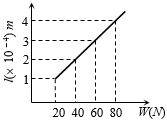
The adjacent graph shows the extension $(\Delta l)$ of a wire of length $1m$ suspended from the top of a roof at one end with a load $W$ connected to the other end. If the cross sectional area of the wire is ${10^{ - 6}}{m^2},$ calculate the young’s modulus of the material of the wire
A cricket ball is hit at ${30^o}$ with the horizontal with kinetic energy $K$. The kinetic energy at the highest point is
A ball is dropped from a height and falls due to gravity and wind simultaneously imparts it a uniform horizontal acceleration. Which one of the following figures best represents its path?
The length of second's hand in watch is $1 \,cm.$ The change in velocity of its tip in $15$ seconds is
If you set up the seventh harmonic on a string fixed at both ends, how many nodes and antinodes are set up in it
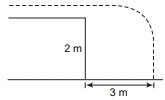
Water is flowing from a horizontal pipe fixed at a height of $2\,m$ from the ground. If it falls at a horizontal distance of $3\,m$ as shown in figure, the speed of water when it leaves the pipe is $............\,ms^{-1}$ (take $g=9.8\,ms ^{-2}$ )
A car travels half the distance with constant velocity of $40\, kmph$ and the remaining half with a constant velocity of $60 \,kmph$. The average velocity of the car in $kmph$ is
A couple produces a:
Two spherical planets $P$ and $Q$ have the same unfirom density $\rho$, masses $M_p$ and $M_Q$, an surface areas $A$ and $4 A$, respectively. A spherical planet $R$ also has unfirom density $\rho$ and its mass is $\left(M_p+M_Q\right)$. The escape velocities from the planets $P, Q$ and $R$, are $V_P, V_Q$ and $V$ respectivley. Then

$(A)$ $V_Q>V_R>V_P$

$(B)$ $V_R>V_Q>V_P$

$(C)$ $V _{ R } / V _{ P }=3$

$(D)$ $V_p / N_Q=\frac{1}{2}$

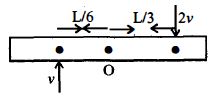
A thin uniform bar of length $L$ and mass $8\,m$ lies on a smooth horizontal table. Two point masses $m$ and $2\,m$ moving in the same horizontal plane from opposite sides of the bar with speeds $2v$ and $v$ respectively. The masses stick to the bar after collision at a distance $\frac{L}{3}$ and $\frac{L}{6}$ respectively from the centre of the bar. If the bar starts rotating about its center of mass as a result of collision, the angular speed of the bar will be