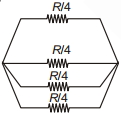
A piece of wire is cut into four equal parts and the pieces are bundled together side by side to form a thicker wire. Compared with that of the original wire, the resistance of the bundle is ..........
Easy


Download our appand get started for free
Experience the future of education. Simply download our apps or reach out to us for more information. Let's shape the future of learning together!No signup needed.*
Similar Questions
- 1If $n, e, \tau$ and $m$ are representing electron density, charge, relaxation time and mass of an electron respectively, then the resistance of a wire of length / and cross-sectional area $A$ is given byView Solution
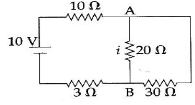
- 2In the electrical circuit shown in the figure, the current $i$ through the side $AB$ isView Solution
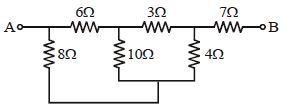
- 3The equivalent resistance between the points $A$ and $B$ is :-View Solution
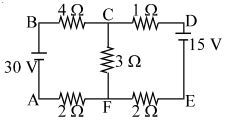
- 4The figure shows a network of five resistances and two batteries The current through the $15\,V$ battery is .............. $A$View Solution
- 5The current through a wire depends on time as $i = (2+3t)\, mA$. The charge crossing through a section of the wire in $1\, min$ is .............. $\mathrm{C}$View Solution
- 6View SolutionWhich is a wrong statement
- 7All wires have same resistance and equivalent resistance between $A$ and $B$ is $R$. Now keys are closed, then the equivalent resistance will becomeView Solution
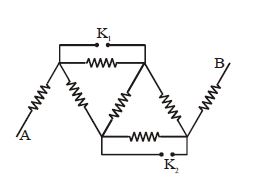
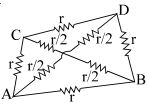
- 8The figure shows a tetrahedron, each side of which has a resistance $r$ If a battery is connected between any two points of the tetrahedron, then identify the correct statement $(s)$.View Solution
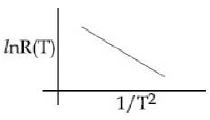
- 9View SolutionIn an experiment, the resistance of a material is plotted as a function of temperature (in some range). As shown in the figure, it is a straight line. One may conclude that:
- 10A potentiometer is used for the comparison of $e.m.f.$ of two cells ${E_1}$ and ${E_2}$. For cell ${E_1}$ the no deflection point is obtained at $20\,cm$ and for ${E_2}$ the no deflection point is obtained at $30\,cm$. The ratio of their $e.m.f.$'s will beView Solution