MCQ
A plane electromagnetic wave with a single frequency moves in vacuum in the positive x direction. Its amplitude is uniform over the yz plane its wavelength:
- AIncrease
- BDecrease
- CSame
- DNone
Explanation:
The same amount of energy passes through equal areas parallel to the yz plane as the wave travels in the +x direction, so the amplitude and the intensity, which is proportional to the square of the amplitude, do not change.
Generate a complete, print-ready paper with questions like this in minutes — across 16+ boards, with answer keys.
Two long conductors, separated by a distance d carry current I1 and I2 in the same direction. They exert a force F on each other. Now the current in one of them is increased to two times and its directions is reversed. The distance is also increased to 3d. The new value of the force between them is
|
(a) –2F |
(b) F/3 |
(c) 2F/3 |
(d) – F/3 |
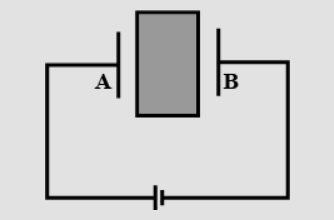
Three point charges are placed at the corners of an equilateral triangle. Assuming only electrostatic forces are acting
|
(a) The system can never be in equilibrium |
|
(b) The system will be in equilibrium if the charges rotate about the centre of the triangle |
|
(c) The system will be in equilibrium if the charges have different magnitudes and different signs |
|
(d) The system will be in equilibrium if the charges have the same magnitudes but different signs |
A short magnetic needle is pivoted in a uniform magnetic field of strength 1 T. When another magnetic field of strength  is applied to the needle in a perpendicular direction, the needle deflects through an angle q, where q is
|
(a) 30o |
(b) 45o |
(c) 90o | (d) 60o |
The equivalent capacitance in the circuit between A and B will be

|
(a) 1 μF |
(b) 2 μF |
(c) 3 μF |
(d) |
Which of the following is true
|
(a) Diamagnetism is temperature dependent |
|
(b) Paramagnetism is temperature dependent |
|
(c) Paramagnetism is temperature independent |
|
(d) None of these |
The dispersive power is maximum for the material
|
(a) Flint glass |
(b) Crown glass |
(c) Mixture of both |
(d) None of the above |
