MCQ
A plane wave front falls on a convex lens. The emergent wave front is:
- APlane
- BCylindrical
- CSpherical diverging
- DSpherical converging
Explanation:
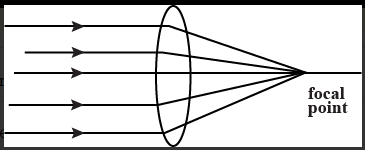
A convex lens is thicker at the middle. When a light ray is incident parallel
to principle axis it is refracted towards the focal point. Similarly when a plane wave front is incident on a convex lens the light is refracted towards a point on the focal plane.
As the light is getting focused at a point it is converging and the emerging wave front is a spherical converging.
Generate a complete, print-ready paper with questions like this in minutes — across 16+ boards, with answer keys.
Which can pass through 20 cm thickness of the steel
|
(a) α - particles |
(b) β - particles |
(c) γ- rays |
(d) Ultraviolet rays |
Radius of first Bohr orbit is r. What is the radius of 2nd Bohr orbit?
| (a) 8r | (b) 2r | (c) 4r |
(d) 2
|
A photon and an electron have equal energy E.  is proportional to
|
(a) |
(b) 1/ |
|
(c) 1/E |
(d) Does not depend upon E |
'Mirage' is a phenomenon due to
|
(a) Reflection of light |
(b) Refraction of light |
|
(c) Total internal reflection of light |
(d) Diffraction of light |
A circular coil of radius R carries an electric current. The magnetic field due to the coil at a point on the axis of the coil located at a distance r from the centre of the coil, such that r >> R, varies as
|
(a) |
(b) |
(c) |
(d) |


