Questions · Page 1 of 4

M.C.Q (1 Marks)

🎯

Test yourself on this topic

50 questions · timed · auto-graded

MCQ 11 Mark
The resolving power of a telescope can be increased by increasing:
  • A
    Wavelength of light.
  • B
    Diameter of objective.
  • C
    Length of the tube.
  • D
    Focal length of eyepiece.
Answer
  1. Diameter of objective.

Explanation:

The resolving power of a telescope can be given as:

Resolving power $=\frac{1}{\text{d}(\theta)}=\frac{1}{1.22\lambda/ \text{D}}=\frac{\text{D}}{1.22}$ (wavelength)

So, resolving power can be increased by decreasing the wavelength and increasing the diameter of objective.

View full question & answer
MCQ 21 Mark
The colour of bright fringes nearest to the central achromatic fringe in the interference pattern with white light will be:
  • A
    Violet
  • B
    Red
  • C
    Green
  • D
    Yellow
Answer
  1. Violet

Explanation:

To observe an interference pattern

$\frac{\text{dy}}{\text{D}}​=\text{n}\lambda$

$\text{y}=\frac{\text{nD}\lambda}{\text{d}}​$

i.e, for the bright fringes nearest the central achromatic fringe, wavelength must be minimum and in white light wavelength is minimum for violet.

View full question & answer
MCQ 31 Mark
Why do polarized sun glasses block out some reflected light (glare), but do not block out light that has not been reflected?
  • A
    Some reflected light is at least partially polarized.
  • B
    Some reflected light changes frequency.
  • C
    Some reflected light is at least partially diffracted.
  • D
    Some reflected light splits into multiple photons.
Answer
  1. Some reflected light is at least partially polarized.

Explanation:

When ordinary (unpolarised) light is reflected from a surface, it gets partial polarisation, it means some of the electric vectors in some planes are cut-off. When this partially polarized light is incident on polarized glasses, glass acts as an analyser and therefore block out some reflected light.

View full question & answer
MCQ 41 Mark
If one of the two slits of Young's double-slit experiment is painted so that it transmits half the light intensity as the second slit, then:
  • A
    Fringe system will altogether disappear.
  • B
    Bright fringes will become brighter and the dark fringes will become darker.
  • C
    Both dark and bright fringes will become darker.
  • D
    Dark fringes will become less dark and bright fringes will become less bright.
Answer
  1. Dark fringes will become less dark and bright fringes will become less bright.

Explanation:

As the intensity from second slit decreases the bright fringe becomes darker due to constructive interference and dark fringe becomes bright due to destructive interference.

View full question & answer
MCQ 51 Mark
A very thin film in reflected white light appears:
  • A
    Violet
  • B
    White
  • C
    Black
  • D
    Red
Answer
  1. Black

Explanation:

When the film is thin, t → 0, path diff. = $\frac{\lambda}{2}$. Therefore, in reflected light, the film appears black.

View full question & answer
MCQ 61 Mark
According to Huygens, the ether medium pervading entire universe is:
  • A
    Less elastic and more dense
  • B
    Highly elastic and less dense
  • C
    Not elastic
  • D
    Much heavier
Answer
  1. Highly elastic and less dense

Explanation:

Huygen considered, light needs a medium to propagate called ether which is highly elastic and less denser.

View full question & answer
MCQ 71 Mark
Corpuscular theory of light was advanced by:
  • A
    Huygen
  • B
    Newton
  • C
    Maxwell
  • D
    Hertz
Answer
  1. Newton

Explanation:

The corpuscular theory was largely developed by Sir Isaac newton. Newton's theory remained in force for more than 100 years and took precedence over Huygen's wave front theory, partly because of Newton’s great prestige.

When the corpuscular theory failed to adequately explain the diffraction, interference and polarization of light it was abandoned in favour of Huygens' wave theory.

View full question & answer
MCQ 81 Mark
The following cannot be explained by wave nature of light:
  • A
    Interference
  • B
    Photo electric effect
  • C
    Diffraction
  • D
    Refraction
Answer
  1. Photo electric effect

Explanation:

Photo electric effect

According to wave physics energy of a wave depends upon an amplitude of a wave it means that there light of any frequency can make electrons come out from metal but it did not happen, light of certain fixed frequency can make electron come out from metal. So the photoelectric effect can only be explained by particle nature of light not wave.

View full question & answer
MCQ 91 Mark
If L is the coherent length and c the velocity of light, the coherent time is:
  • A
    $\text{cL}$
  • B
    $\frac{\text{L}}{\text{c}}$
  • C
    $\frac{\text{c}}{\text{L}}$
  • D
    $\frac{1}{\text{Lc}}$
Answer
  1. $\frac{\text{L}}{\text{c}}$

Explanation:

$\text{Coherent time} =\frac{\text{Coherence length}}{\text{Velocity of light}}​=\frac{\text{L}}{\text{c}}​$

View full question & answer
MCQ 101 Mark
Which of the following cannot be polarised?
  • A
    Radio waves
  • B
    $\beta$ rays
  • C
    Infrared rays
  • D
    $\gamma$ rays
Answer
  1. $\beta$ rays

Explanation:

$\beta$ are stream of particles comprising of electrons moving with very high velocity, hence it cannot be polarized, while others can as they are electromagnetic waves.

View full question & answer
MCQ 111 Mark
Four light waves are represented by

  1. $\text{y}=\text{a}_1\sin\omega\text{t}$

  2. $\text{y}=\text{a}_2\sin(\omega\text{t}+\in)$

  3. $\text{y}=\text{a}_1\sin2\omega\text{t}$

  4. $\text{y}=\text{a}_2\sin2(\omega\text{t}+\in)$

Interference fringes may be observed due to superposition of:

    • A
      (i) and (ii)
    • B
      (i) and (iii)
    • C
      (ii) and (iv)
    • D
      (iii) and (iv)
    Answer
    1. (i) and (ii)
    1. (iii) and (iv)

    Explanation:

    The waves are travelling with the same frequencies and varying by constant phase difference. 

    View full question & answer
    MCQ 121 Mark
    According to Maxwell , most of the optical properties of light depend on:
    • A
      Magnetic vector
    • B
      Electric vector
    • C
      Both Electric and Magnetic vectors
    • D
      Can not be decided
    Answer
    1. Electric vector

    Explanation:

    The experiments on stationary light waves establish that most of the optical properties of light depends on the electric vector, which is also known as light vector.

    View full question & answer
    MCQ 131 Mark
    To increase both the resolving power and magnifying power of a telescope:
    • A
      Both the focal length and aperture of the objective has to be increased.
    • B
      The focal length of the objective has to be increased.
    • C
      The aperture of the objective has to be increased.
    • D
      The wavelength of light has to be decreased.
    Answer
    1. The wavelength of light has to be decreased.

    Explanation:

    Resolving power, $\text{R}=\frac{\text{a}}{1.22\lambda}$

    where, a is diameter of objective $\lambda$ is wavelength of light magnifying power

    $\text{m}=\frac{\text{-f}_0}{\text{f}_\text{e}}\Big(1+\frac{\text{f}_\text{e}}{\text{D}}\Big)$

    so, decreasing the wavelength of light increases the resolving power and magnifying power of telescope.

    View full question & answer
    MCQ 141 Mark
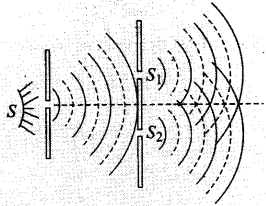
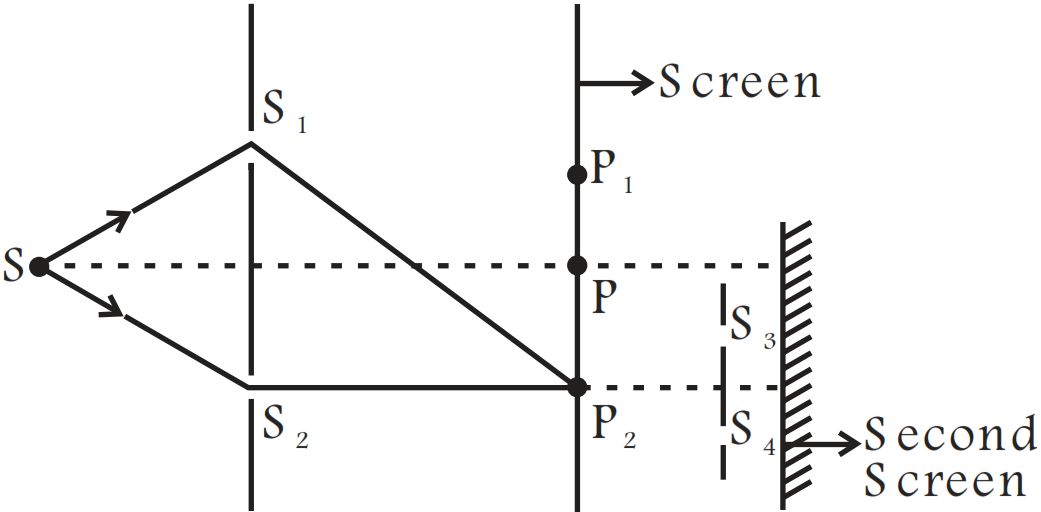
    Figure shows a standard two slit arrangement with slits S1, S2. P1, P2 are the two minima points on either side of P (Fig). At P2 on the screen, there is a hole and behind P2 is a second 2- slit arrangement with slits S3, S4 and a second screen behind them.

    • A
      There would be no interference pattern on the second screen but it would be lighted.
    • B
      The second screen would be totally dark.
    • C
      There would be a single bright point on the second screen.
    • D
      There would be a regular two slit pattern on the second screen.
    Answer
    1. There would be a regular two slit pattern on the second screen.

    Solution:

    Key concept:

    Wave front,

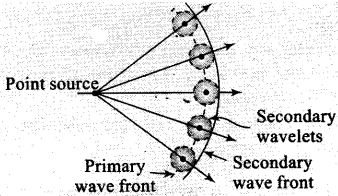
    Every point on the given wave front acts as a source of new disturbance called secondary wavelets which travel in all directions with the .velocity of light in the medium.

    A surface touching these secondary wavelets tangentially in the forward direction at any instant gives the new wave front at that instant. This is called secondary wave front.In the given question, there is a hole at point which is a maxima point. From Huygen’s principle, wave will propagate from the sources S1 and S2. Each point on the screen will act as secondary sources of wavelets.

    The wave front emitted bu a narrow source is divided in two parts by reflection, refraction or diffraction. The coherent soutces so obtained are imaginary.

    ​​​​​​​

    View full question & answer
    MCQ 151 Mark
    Choose the correct option about light.
    • A
      Light requires a material medium to travel from one place to another.
    • B
      Light does not require a material medium to propagate.
    • C
      Light has mass but it is negligible.
    • D
      Light waves are longitudinal wave.
    Answer
    1. Light does not require a material medium to propagate.

    Explanation:

    Light does not need medium to travel. Its an electromagnetic wave. All electromagnetic waves travel independent of medium.

    View full question & answer
    MCQ 161 Mark
    Constructive and destructive interference occur in:
    • A
      Cosmic rays
    • B
      Light raus
    • C
      Sound waves
    • D
      All of these
    Answer
    1. All of these

    Explanation:

    Interference (constructive and destructive) is one of the basic properties of a wave, therefore it will occur in all the given waves, no matter they are electromagnetic or mechanical, transverse or longitudinal.

    View full question & answer
    MCQ 171 Mark
    Huygens principle of secondary waves:
    • A
      Allow us to find the focal length of a thick convex lens.
    • B
      Give us the magnifying power of the microscope.
    • C
      Is a geometrical method to find, the position of a wave front.
    • D
      Is used to determine the velocity of light.
    Answer
    1. Is a geometrical method to find, the position of a wave front.

    Explanation:

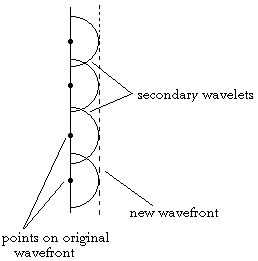
    Huygens's Principle states that every point on a wavefront is a source of secondary wavelets, which spread forward at the same speed.

    Thus is enables to find the position of wavefront.

    View full question & answer
    MCQ 181 Mark
    Evidence for the expanding universe is given by _______ of light spectrum received from them.
    • A
      Red shift
    • B
      Blue shift
    • C
      Green shift
    • D
      Orange shift
    Answer
    1. Red shift

    Explanation:

    In physics red shift happens when light or other electromagnetic radiation from an object is increased to a wavelength or shifted to the red end of spectrum. A red shift occurs whenever a light source moves away from the observer.

    A special instance of this in the cosmological red shift, which is due to the expansion of the universe, and sufficiently distant light source shows red shift corresponding to the rate of increase in their distance from earth.

    View full question & answer
    MCQ 191 Mark
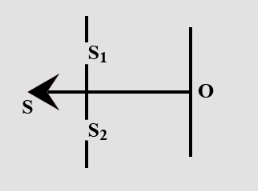
    In the set up shown, the two slits S1​ and S2​ are not equidistant from the slit S. The central fringe at O is then:

    • A
      Always bright
    • B
      Always dark
    • C
      Either dark or bright depending on the position of S
    • D
      Neither dark nor bright
    Answer
    1. Either dark or bright depending on the position of S

    Explanation:

    As the two slits S1​ and S2​ are not equidistant from the slit s the distance traversed by light through S1​ and S2​ may not differ by an integral multiple of wavelength. Thus it need not be bright . similarly it need not be dark.

    View full question & answer
    MCQ 201 Mark
    For light diverging from a point source:
    • A
      The wavefront is spherical.
    • B
      The intensity decreases in proportion to the distance squared.
    • C
      The wavefront is parabolic.
    • D
      The intensity at the wavefront does not depend on the distance.
    Answer
    1. The wavefront is spherical.
    2. The intensity decreases in proportion to the distance squared.

    Solution:

    Type of wavefront Intensity Amplitude
    $\text{I}\propto\frac{1}{\text{r}^2}$ $\text{A}\propto\frac{1}{\text{r}}$
    $\text{I}\propto\frac{1}{\text{r}}$ $\text{A}\propto\frac{1}{\sqrt{\text{r}}}$
    $\text{I}\propto\text{r}^0$ $\text{A}\propto\text{r}^0$

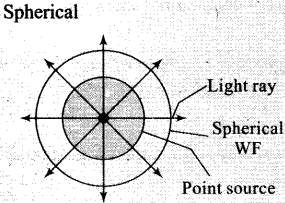
    Due to the point source light propagates in all directions symmetrically and hence, wevefront will be spherical as shown in the diagram.

    As intensity of the source will be,

    $\text{I}\propto\frac{1}{\text{r}^2}$

    where, r is radius of the wavefront at any time

    Hence the intensity decreases in proportion to the distance squared.

    View full question & answer
    MCQ 211 Mark
    Who first proposed that light was wave-like in character?
    • A
      Huygens
    • B
      Newton
    • C
      Young
    • D
      Maxwell
    Answer
    1. Huygens

    Explanation:

    In 1678, Dutch physcist, christian Huygens beived that light was made up of waves vibrating up and down perpendicular to the direction of the light travels, and therefore formulated a way of visualising wave propagation. This became known as Huygens Principe.

    View full question & answer
    MCQ 221 Mark
    Two coherent sources of different intensities send waves which interfere. The ratio of maximum intensity to the minimum intensity is 25. The intensities of the sources are in the ratio:
    • A
      25 : 1
    • B
      5 : 1
    • C
      9 : 4
    • D
      625 : 1
    Answer
    1. 9 : 4

    Explanation:

    Ratio of maximum intensity and minimum intensity is given by

    $\frac{\text{I}_\text{max}}{\text{I}_\text{min}}=\frac{(\sqrt{\text{I}_1}+\sqrt{\text{I}_2})^2}{(\sqrt{\text{I}_1}-\sqrt{\text{I}_2})^2}=\frac{25}{1}$

    $\Rightarrow\sqrt{\text{I}_1}=3 \ \text{and}\ \sqrt{\text{I}_2}=2$

    $\Rightarrow\text{I}_1=9\ \text{and}\ \text{I}_2=4$

    Then,

    $\frac{\text{I}_1}{\text{I}_2}=\frac{9}{4}$

    View full question & answer
    MCQ 231 Mark
    Newton postulated his corpuscular theory of light on the basis of:
    • A
      Newton's rings.
    • B
      Rectilinear propagation of light.
    • C
      Colour through thin films.
    • D
      Dispersion of white light into colours.
    Answer
    1. Rectilinear propagation of light.

    Explanation:

    According to Isaac Newton the geometric nature of reflection and refraction of light could only be explained if light was made of particles, referred to as corpuscles that travel in straight line.

    View full question & answer
    MCQ 241 Mark
    A Young's double slit experiment is performed with white light:
    • A
      The central fringe will be white.
    • B
      There will not be a completely dark fringe.
    • C
      The fringe next to the central will be red.
    • D
      The fringe next to the central will be violet.
    Answer
    1. The central fringe will be white.

    2. There will not be a completely dark fringe.

    1. The fringe next to the central will be violet.

    Explanation:

    The superposition of all the colours at the central maxima gives the central band a white colour. As we go from the centre to corner, the fringe colour goes from violet to red. There will not be a completely dark fringe, as complete destructive interference does not take place.

    View full question & answer
    MCQ 251 Mark
    Dichorism means:
    • A
      Selective absorption of unpolarised light.
    • B
      Selective absorption of dispersed light.
    • C
      Selective absorption of scattered light.
    • D
      Selective absorption of one of the polarised component.
    Answer
    1. Selective absorption of one of the polarised component.

    Explanation:

    Dichromism is the selective absorption of one orthogonal polarization component of an incident beam over the other. this phenomenon is due to anisotropy of the material, with one polarization component experiencing preferential absorption.

    View full question & answer
    MCQ 261 Mark
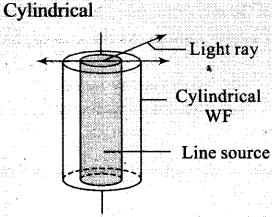
    1: Primary waves can travel in all directions in an ether
    2: Secondary waves can travel only in backward in an ether
    • A
      1 is true, 2 is false
    • B
      Both 1 and 2 are true
    • C
      1 is false, 2 is true
    • D
      Both 1 and 2 are false
    Answer
    1. 1 is true, 2 is false

    Explanation:

    Primary wave can travel in all directions in ether.

    Secondary waves can travel in forward direction in ether

    The wavefronts gradually spread in all the directions. So at every point, we have a wave coming out. The primary wavefront is formed and again from the primary wavefront, a secondary waveform is formed and so on. The disturbance does not last for a long time.

    View full question & answer
    MCQ 271 Mark
    The inverse square law of intensity $\Big(\text{i.e., the intensity}\propto\frac{1}{\text{r}^2}\Big)$ is valid for a:
    • A
      Point source.
    • B
      Line source.
    • C
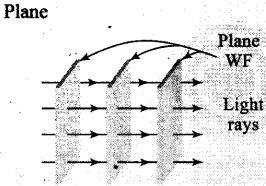
      Plane source.
    • D
      Cylindrical source.
    Answer
    1. Point source.

    Explanation:

    Intensity of a point source obeys the inverse square law.

    Intensity of light at distance r from the point source is given by

    $\text{I}=\frac{\text{S}}{(4\pi\text{r}^2)}$

    Where S is the source strength.

    View full question & answer
    MCQ 281 Mark
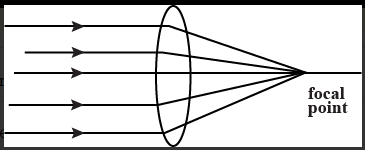
    A plane wave front falls on a convex lens. The emergent wave front is:
    • A
      Plane
    • B
      Cylindrical
    • C
      Spherical diverging
    • D
      Spherical converging
    Answer
    1. Spherical converging

    Explanation:

    A convex lens is thicker at the middle. When a light ray is incident parallel
    to principle axis it is refracted towards the focal point. Similarly when a plane wave front is incident on a convex lens the light is refracted towards a point on the focal plane.

    As the light is getting focused at a point it is converging and the emerging wave front is a spherical converging.

    View full question & answer
    MCQ 291 Mark
    Huygens's concept of secondary wave:
    • A
      Allows us to find the focal length of a thick lens.
    • B
      Is a geometrical method to a find a wavefront.
    • C
      Is used to determine the velocity of light.
    • D
      Is used to explain polarisation.
    Answer
    1. Is a geometrical method to a find a wavefront.

    Explanation:

    Huygens principle states that "Every point on a wave-front may be considered a source of secondary spherical wavelets which spread out in the forward direction at the speed of light. The new wave-front is the tangential surface to all of these secondary wavelets."

    Thus it is geometrical method to find the wavefront.

    View full question & answer
    MCQ 301 Mark
    Huygens' wave theory is used:
    • A
      To determine the velocity of light.
    • B
      To find the position of the wave front.
    • C
      To determine the wavelength of light.
    • D
      To find the focal length of a lens.
    Answer
    1. To find the position of the wave front.

    Explanation:

    Huygen proposed a hypothesis for the geometrical construction of the position of a common wavefront at any instant during the propogation of waves in a medium.

    View full question & answer
    MCQ 311 Mark
    Light transmitted by nicol prism is:
    • A
      Unpolarised
    • B
      Plane polarised
    • C
      Circular polarised
    • D
      Elliptically polarised
    Answer
    1. Plane polarised

    Explanation:

    Nicol prism is a polariser in which the O-ray is eliminated by total internal reflection and the light transmitted through it, is E-ray which is completely plane polarised light.

    View full question & answer
    MCQ 321 Mark
    Consider a ray of light incident from air onto a slab of glass (refractive index n) of width d, at an angle θ. The phase difference between the ray reflected by the top surface of the glass and the bottom surface is:
    • A
      $\frac{4\pi\text{d}}{\lambda}\Big(1-\frac{1}{\text{n}^2}\sin^2\theta\Big)^{\frac{1}{2}}+\pi$
    • B
      $\frac{4\pi\text{d}}{\lambda}\Big(1-\frac{1}{\text{n}^2}\sin^2\theta\Big)^{\frac{1}{2}}$
    • C
      $\frac{4\pi\text{d}}{\lambda}\Big(1-\frac{1}{\text{n}^2}\sin^2\theta\Big)^{\frac{1}{2}}+\frac{\pi}{2}$
    • D
      $\frac{4\pi\text{d}}{\lambda}\Big(1-\frac{1}{\text{n}^2}\sin^2\theta\Big)^{\frac{1}{2}}+2\pi.$
    Answer
    1. $\frac{4\pi\text{d}}{\lambda}\Big(1-\frac{1}{\text{n}^2}\sin^2\theta\Big)^{\frac{1}{2}}+\pi$

    Solution:

    None of the option is correct
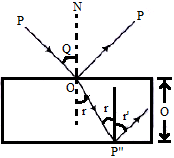
    Consider the diagram, the ray (P) is incident at an angle $\theta$ and gets reflected in the direction P' and refracted in the direction P. Due to reflection from the glass medium, there is a phase change of $\pi$.

    According to snell's law, we have $\text{n}=\frac{\sin\theta}{\sin\text{r}}$

    $\Rightarrow\sin\text{r}=\frac{\sin\theta}{\text{n}}$

    $\Rightarrow\ \cos\text{r}=\sqrt{1-\sin2\text{r}}$

    $\Rightarrow\ \cos\text{r}=\sqrt{1-\frac{\sin^2\theta}{\text{n}^2}}$

    The time taken to travel along OP" is given by

    $\Delta\text{t}=\frac{\text{OP}''}{\text{v}}$

    $=\frac{\frac{\text{d}}{\cos\text{r}}}{\frac{\text{c}}{\text{n}}}\ \Big[\because\ \text{PO}''=\frac{\text{d}}{\cos\text{r}}\text{ and }\text{v}=\frac{\text{c}}{\text{n}}\Big]$

    $=\frac{\text{nd}}{\text{c}\cos\text{r}}$

    $=\frac{\text{nd}}{\text{c}\Big(1-\frac{\sin^2\theta}{\text{n}^2}\Big)^{\frac{1}{2}}}\ \ \bigg[\because\ \cos\text{r}=\sqrt{1-\frac{\sin^2\theta}{\text{n}^2}}\bigg]$

    $=\frac{\text{nTd}}{\lambda}\Big(1-\frac{\sin^2\theta}{\text{n}^2}\Big)^\frac{-1}{2}$

    Now, the phase difference $(\Delta\phi)$ is given by

    $\frac{2\pi}{\text{T}}\times\Delta\text{t}\times\frac{2\pi}{\text{T}}\times=\frac{\text{nTd}}{\lambda}\Big(1-\frac{\sin^2\theta}{\text{n}^2}\Big)^\frac{-1}{2}$

    $=\frac{2\pi\text{nd}}{\lambda}\Big(1-\frac{\sin^2\theta}{\text{n}^2}\Big)^\frac{-1}{2}$

    Therefore, the net phase difference $=\Delta\phi+\pi$

    $=\frac{2\pi\text{nd}}{\lambda}\Big(1-\frac{\sin^2\theta}{\text{n}^2}\Big)^\frac{-1}{2}+\pi$
    View full question & answer
    MCQ 331 Mark
    Polarisation of light establishes:
    • A
      Corpuscular theory of light
    • B
      Quantum nature of light
    • C
      Transverse nature of light
    • D
      All of the above
    Answer
    1. Transverse nature of light

    Explanation:

    Polarisation of light establishes that light are transverse in nature, otherwise it was believed that they are longitudinal waves, like the sound waves.

    View full question & answer
    MCQ 341 Mark
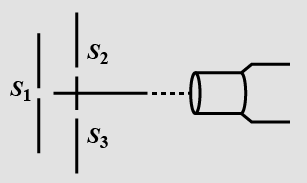
    A student is asked to measure the wavelength of monochromatic light. He sets up the apparatus as shown. S1​,S2​,S3​ are narrow parallel slits. L is radiant lamps and M is a micrometer eyepiece. The student fails to observe interference fringes. We would advice him to:

    • A
      Increase the width of S1
    • B
      Decrease the distance between S2​ and S3​.
    • C
      Replace L with a white light lamp.
    • D
      Make S2​ and S3​ wider.
    Answer
    1. Decrease the distance between S2​ and S3​.

    Explanation:

    The fringe width of a double slit interference pattern is given by 

    $\beta=\frac{\text{D}\lambda}{\text{d}}​$

    where D is the distance between screen and the plane containing slits d is distance between the slits S2​ and S3​.

    To make the fringe pattern visible, the fringe width must be increased, for which d should be decreased.

    View full question & answer
    MCQ 351 Mark
    If the path difference between the slits S1​ and S2​ is $\lambda$, the central fringe will have an intensity of:
    • A
      0
    • B
      a2
    • C
      2a2
    • D
      4a2
    Answer
    1. 0

    Explanation:

    Path difference at the central fringe will be the same as the path difference at the slits i.e. $\lambda$.

    Hence, the waves reaching the central fringe will be 180° out of phase and will result in destructive interference. Hence, the intensity of the central fringe will be 0.

    View full question & answer
    MCQ 361 Mark
    A person wishes to distinguish between two pillars located at a distance of 11km. What should be the minimum distance between these pillars (resolving power of normal human eye is 1')?
    • A
      1m
    • B
      3.2m
    • C
      0.5m
    • D
      5m
    Answer
    1. 3.2m

    Explanation:

    Resolving power is given by the distance between two objects to be distinguished per unit distance of objects from the object distinguishing them.

    Hence, $\theta=\frac{\text{d}}{\text{D}}​$

    Hence, $\theta\text{D}=\frac{1}{60}\times\frac{\pi}{180}​​\times110000$

    = 3.2m

    View full question & answer
    MCQ 371 Mark
    The slits in a Young's double slit experiment have equal width and the source is placed symmetrically with respect to the slits. The intensity at the central fringe is I0. If one of the slits is closed, the intensity at this point will be:
    • A
      $\text{I}_0$
    • B
      $\frac{\text{I}_0}{4}$
    • C
      $\frac{\text{I}_0}{2}$
    • D
      $4\text{I}_0$
    Answer
    1. $\frac{\text{I}_0}{4}$

    Explanation:

    Total intensity coming from the source is Iwhich is present at the central maxima. In case of two slits, the intensity is getting distributed between the two slits and for a single slit, the amplitude of light coming from the slit is reduced to half which leads to $\frac{1}{4}\text{th}$ of intensity.

    View full question & answer
    MCQ 381 Mark
    Soap bubble looks coloured due to:
    • A
      Dispersion
    • B
      Reflection
    • C
      Interference
    • D
      None of these
    Answer
    1. Interference

    Explanation:

    Colours are seen due to interference between waves reflected from the top and bottom of soap bubble.

    View full question & answer
    MCQ 391 Mark
    Albert Einstein used corpuscular theory to explain:
    • A
      E = mc2
    • B
      The photoelectric effect
    • C
      Quantisation of charge
    • D
      Magic of light
    Answer
    1. The photoelectric effect

    Explanation:

    The photoelectric effect.

    In 1905, Albert Einstein published a paper in advancing hypothesis that the light energy I'd being carried in discrete quantized packets to explain experimental data from photoelectric effect. This model contributed the development of quantum mechanics.

    Photoelectric effect refers to the emission, or rejection of electrons grim the surface of generally a metal in response to the incident light. 

    View full question & answer
    MCQ 401 Mark
    The size of corpuscles are ________ for different colours.
    • A
      Same
    • B
      Different
    • C
      Either (a) or (b)
    • D
      None of these
    Answer
    1. Different

    Explanation:

    The corpuscles can be of different sizes. The different colors of light are due to the different sizes of the corpuscles.

    View full question & answer
    MCQ 411 Mark
    Which experiment seemed to make it clear that light propogates as a wave?
    • A
      Milikan's oil drop experiment
    • B
      The Michelson-Morley experiment
    • C
      Young's double-slit experiment
    • D
      Lenz's proof of Lenz's law
    Answer
    1. Young's double-slit experiment

    Explanation:

    Young's double slit experiment 

    The double slit experiment is a demonstration that light and matter can display characteristics of both classically defined waves and particles. Moreover it displays the fundamentally probabislistic nature of quantum mechanical phenomena.

    View full question & answer
    MCQ 421 Mark
    An electron microscope is superior to an optical microscope in terms of:
    • A
      Having better resolving power
    • B
      Being easy to handle
    • C
      Low cost
    • D
      Quickness of observation
    Answer
    1. Having better resolving power

    Explanation:

    The biggest advantage of an electron microscope over optical microscope is that they have a higher resolution and are therefore capable of a higher magnification ( up to 2 million times ). 

    However, optical microscopes show a useful magnification up to 1000−2000 times. This is a limit imposed by the wavelength of light. Electron microscopes, therefore, allow for the visualization of structures that would normally be not visible by optical microscopy.
    View full question & answer
    MCQ 431 Mark
    Which of the following is wrong for interference fringes?
    • A
      Fringes are due to limited portion of wave front.
    • B
      All bright fringes are equally bright.
    • C
      Distance between two consecutive fringes is constant.
    • D
      Fringes are due to the use of coherent sources.
    Answer
    1. Fringes are due to limited portion of wave front.

    Explanation:

    Statements B,C and D are correct whereas the statement "Fringes are due to limited portion of the wave front" is incorrect.

    Interference fringes are formed due to the whole portion of wave front.

    View full question & answer
    MCQ 441 Mark
    Wavefront of a wave has direction with wave motion:
    • A
      Parallel
    • B
      Perpendicular
    • C
      Opposite
    • D
      At an angle of $\theta$
    Answer
    1. Perpendicular

    Explanation:

    Direction of wave is perpendicular to the wavefront.

    View full question & answer
    MCQ 451 Mark
    Light travels in a ________ path:
    • A
      Rectilinear
    • B
      Zig zag
    • C
      Circular
    • D
      Helical
    Answer
    1. Rectilinear

    Explanation:

    Light travels in straight line unless it passes through a change in medium.

    View full question & answer
    MCQ 461 Mark
    The resolving power of human eye is:
    • A
      ≈1′
    • B
      ≈10
    • C
      ≈10"
    • D
      ≈5"
    Answer
    1. ≈1′

    Explanation:

    As we know the visibility of the human eye is limited up to a distance. 

    It is known to us that the normal pupil size of any human being is 4mm. This measurement sets a minimum resolution approximately 1' to 2′.

    When we want to pull small objects closer to our eyes, we aim to see them properly. But it is often seen that after crossing a certain distance the particles become unclear no matter how much closer it is to our eyes.

    This signifies that there is a minimum distance of comfortable viewing. This distance is roughly calculated as 25cm. 

    View full question & answer
    MCQ 471 Mark
    By corpuscular theory of light, the phenomenon which can be explained is ____________.
    • A
      refraction
    • B
      diffraction
    • C
      interference
    • D
      polarisation
    Answer
    1. refraction

    Explanation:

    According to newton, when corpuscles approach the refracting surface, they are attracted near the surface. When they enter the denser medium from a rarer medium, their speed increases and hence change their direction.

    View full question & answer
    MCQ 481 Mark
    The limit of resolution of eye is approximately:
    • A
      10
    • B
      1′
    • C
      1mm
    • D
      1cm
    Answer
    1. 1′

    Explanation:

    The resolution of the human eye is the smallest object our eye can see. This is limited by the diffraction limit, which is approximated by the angular size ratio of the object's size versus the distance to the object.

    The normal pupil size of a human eye is 4mm, which sets a minimum angular resolution of the eye and to able to see the small objects we bring them as close to our eyes as possible, but there is a minimum distance for comfortable viewing which is roughly at 25cm.

    But quoted figure for the smallest resolvable size is 0.1mm, showing that the diffraction limit is a crucial factor in visual resolving power.

    View full question & answer
    MCQ 491 Mark
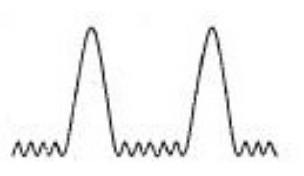
    The figure shows diffraction pattern of two nearby points. The two points are:

    • A
      Not resolved
    • B
      Just resolved
    • C
      Clearly resolved
    • D
      None
    Answer
    1. Clearly resolved

    Explanation:

    Since there are a number of crests in between the peaks of the two points, they clearly do not immerse into each other at all, thus they are clearly resolved.

    View full question & answer
    MCQ 501 Mark
    In Young's interference experiment, the central bright fringe can be identified due to the fact that it:
    • A
      Has greater intensity than other fringes which are bright.
    • B
      Is wider than the other bright fringes.
    • C
      Is narrower than the other bright fringes.
    • D
      Can be obtained by using white light instead of monochromatic light.
    Answer
    1. Can be obtained by using white light instead of monochromatic light.

    Explanation:

    When we use white light, the central bright will have light from all wavelengths as none of them cancel out. Hence central bright fringe appears white.

    For other bright fringes, depending on the wavelength of light constructive interference will not take place for certain wavelengths. Hence they will not be white, rather will be coloured, hence differentiated from central fringe.

    View full question & answer
    M.C.Q (1 Marks) - Physics STD 12 Science Questions - Vidyadip