MCQ
A plane wave front falls on a convex lens. The emergent wave front is:
- APlane
- BCylindrical
- CSpherical diverging
- DSpherical converging
Explanation:
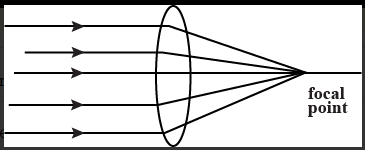
A convex lens is thicker at the middle. When a light ray is incident parallel
to principle axis it is refracted towards the focal point. Similarly when a plane wave front is incident on a convex lens the light is refracted towards a point on the focal plane.
As the light is getting focused at a point it is converging and the emerging wave front is a spherical converging.
Generate a complete, print-ready paper with questions like this in minutes — across 16+ boards, with answer keys.
In a moving coil galvanometer, the deflection of the coil θ is related to the electrical current i by the relation
|
(a) i ∝ tanθ |
(b) i ∝ θ |
(c) i ∝ |
(d) i ∝ |
The voltage V and current I graph for a conductor at two different temperatures  and
and  are shown in the figure. The relation between and is

|
(a) |
(b) |
(c) |
(d) |
An X-ray machine has an accelerating potential difference of 25,000 volts. By calculation the shortest wavelength will be obtained as (h = 6.63  ; e =
; e = coulomb)
|
(a) 0.25 Å |
(b) 0.50 Å |
(c) 1.00 Å |
(d) 2.50 Å |
The device that does not work on the principle of mutual induction is
|
(a) Induction coil |
(b) Motor |
(c) Tesla coil |
(d) Transformer |
The magnetic susceptibility does not depend upon the temperature in
|
(a) Ferrite substances |
(b) Ferromagnetic substances |
|
(c) Diamagnetic substances |
(d) Paramagnetic substances |
The kinetic energy of an electron revolving around a nucleus will be
| (a) Four times of P.E. | (b) Double of P.E. | (c) Equal to P.E. | (d) Half of its P.E. |


