Question types

Wave Optics question types

389 questions across 8 question groups — pick any mix to generate a Physics paper with step-by-step answer keys.

389
Questions
8
Question groups
5
Question types
Sample Questions

Wave Optics questions

One sample from each question group in this chapter. Select any group above to see the full set with answer keys.

Q 1M.C.Q [1M]1 Mark
The resolving power of a telescope can be increased by increasing:
  • A
    Wavelength of light.
  • B
    Diameter of objective.
  • C
    Length of the tube.
  • D
    Focal length of eyepiece.
View full solution
Q 2M.C.Q [1M]1 Mark
In Young's experiment, the distance between the slits is reduced to half and the distance between the slit and screen is doubled, then the fringe width
  • A
    Will not change
  • B
    Will become doubled
  • C
    Will be half
  • Will become four times

Answer: D.

View full solution
Q 3M.C.Q [1M]1 Mark
Newton postulated his corpuscular theory of light on the basis of:
  • A
    Newton's rings.
  • B
    Rectilinear propagation of light.
  • C
    Colour through thin films.
  • D
    Dispersion of white light into colours.
View full solution
Q 4M.C.Q [1M]1 Mark
A thin transparent sheet is placed in front of a Young's double slit. The fringe-width will:
  • A
    Increase.
  • B
    Decrease.
  • C
    Remain same.
  • D
    Become nonuniform.
View full solution
Q 5M.C.Q [1M]1 Mark
Which of the following phenomena can be demonstrated by light. But not with sound waves in an air column? 
  • A
    Reflection
  • B
    Diffraction
  • C
    Refraction
  • D
    Polarization
View full solution
For question two statements are given-one labelled Assertion (A) and the other labelled Reason (R). Select the correct answer to these questions from the codes (a), (b), (c) and (d) as given below.
  1. Both A and R are true and R is the correct explanation of A.
  2. Both A and R are true but R is NOT the correct explanation of A.
  3. A is true but R is false.
  4. A is false and R is also false.
Assertion (A): In Young's double slit experiment, the fringes become indistinct ifone of the slits is covered with cellophane paper.
Reason (R): The cellophane paper decrease the wavelength of light.
View full solution
For question two statements are given-one labelled Assertion (A) and the other labelled Reason (R). Select the correct answer to these questions from the codes (a), (b), (c) and (d) as given below.
  1. Both A and R are true and R is the correct explanation of A.
  2. Both A and R are true but R is NOT the correct explanation of A.
  3. A is true but R is false.
  4. A is false and R is also false.
Assertion (A): One of the condition for interference is that the two source should be very narrow.
Reason (R): One broad source is equal to large number of narrow sources.
View full solution
For question two statements are given-one labelled Assertion (A) and the other labelled Reason (R). Select the correct answer to these questions from the codes (a), (b), (c) and (d) as given below.
  1. Both A and R are true and R is the correct explanation of A.
  2. Both A and R are true but R is NOT the correct explanation of A.
  3. A is true but R is false.
  4. A is false and R is also false.
Assertion (A): For best contrast between maxima and minima in the interference pattern of Young's double slit experiment, the intensity of light emerging out of the two slits should be equal.
Reason (R): The intensity of interference pattern is proportional to square of amplitude.
View full solution
For question two statements are given-one labelled Assertion (A) and the other labelled Reason (R). Select the correct answer to these questions from the codes (a), (b), (c) and (d) as given below.
  1. Both A and R are true and R is the correct explanation of A.
  2. Both A and R are true but R is NOT the correct explanation of A.
  3. A is true but R is false.
  4. A is false and R is also false.
Assertion (A): We cannot get diffraction pattern from a wide slit illuminated by monochromatic light.
Reason (R): In diffraction pattern, all the bright bands are not of the same intensity.
View full solution
For question two statements are given-one labelled Assertion (A) and the other labelled Reason (R). Select the correct answer to these questions from the codes (a), (b), (c) and (d) as given below.
  1. Both A and R are true and R is the correct explanation of A.
  2. Both A and R are true but R is NOT the correct explanation of A.
  3. A is true but R is false.
  4. A is false and R is also false.
Assertion (A): When a tiny circular obstacle is placed in the path of light from a distant source, a bright spot is seen at the centre of the shadow of the obstacle.
Reason (R): Wave diffracted from the edges of circular obstacle interfere constructively at the centre of the shadow resulting in the formation of bright spot.
View full solution
Answer the following question:
When a tiny circular obstacle is placed in the path of light from a distant source, a bright spot is seen at the centre of the shadow of the obstacle. Explain why?
View full solution
Answer the following question:
When a low flying aircraft passes overhead, we sometimes notice a slight shaking of the picture on our TV screen. Suggest a possible explanation.
View full solution
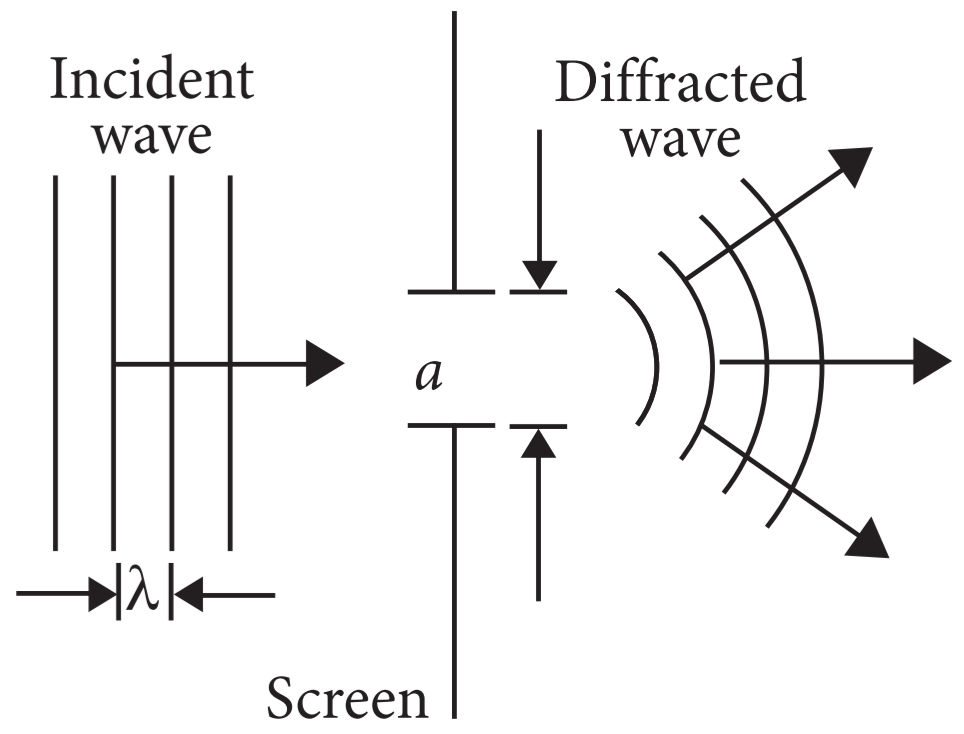
In deriving the single slit diffraction pattern, it was stated that the intensity is zero at angles of $\text{n}\lambda/\text{a}.$ Justify this by suitably dividing the slit to bring out the cancellation.
View full solution
Answer the following question:
Ray optics is based on the assumption that light travels in a straight line. Diffraction effects (observed when light propagates through small apertures/slits or around small obstacles) disprove this assumption. Yet the ray optics assumption is so commonly used in understanding location and several other properties of images in optical instruments. What is the justification?
View full solution
In a double-slit experiment the angular width of a fringe is found to be 0.2° on a screen placed 1 m away. The wavelength of light used is 600 nm. What will be the angular width of the fringe if the entire experimental apparatus is immersed in water? Take refractive index of water to be 4/3.
View full solution
A parallel beam of light of wavelength 500 nm falls on a narrow slit and the resulting diffraction pattern is observed on a screen 1 m away. It is observed that the first minimum is at a distance of 2.5 mm from the centre of the screen. Find the width of the slit.
View full solution
Answer the following question:
As you have learnt in the text, the principle of linear superposition of wave displacement is basic to understanding intensity distributions in diffraction and interference patterns. What is the justification of this principle?
View full solution
Q 213 Marks Question3 Marks
You have learnt in the text how Huygens’ principle leads to the laws of reflection and refraction. Use the same principle to deduce directly that a point object placed in front of a plane mirror produces a virtual image whose distance from the mirror is equal to the object distance from the mirror.
View full solution
Q 223 Marks Question3 Marks
What is the shape of the wavefront in each of the following cases:
  1. Light diverging from a point source.
  2. Light emerging out of a convex lens when a point source is placed at its focus.
  3. The portion of the wavefront of light from a distant star intercepted by the Earth.
View full solution
Q 233 Marks Question3 Marks
Light of wavelength 5000 Å falls on a plane reflecting surface. What are the wavelength and frequency of the reflected light? For what angle of incidence is the reflected ray normal to the incident ray?
View full solution
Q 243 Marks Question3 Marks
A beam of light consisting of two wavelengths, 650 nm and 520 nm, is used to obtain interference fringes in a Young’s double-slit experiment.
  1. Find the distance of the third bright fringe on the screen from the central maximum for wavelength 650 nm.
  2. What is the least distance from the central maximum where the bright fringes due to both the wavelengths coincide?
View full solution
Q 253 Marks Question3 Marks
Answer the following question:
Two students are separated by a 7 m partition wall in a room 10 m high. If both light and sound waves can bend around obstacles, how is it that the students are unable to see each other even though they can converse easily.
View full solution
For a single slit of width "a", the first minimum of the interference pattem of a monochromatic light of wavelength$\lambda$. Occurs at an angle of$\frac{\lambda}{\text{a}}$. At the same angle of$\frac{\lambda}{\text{a}},$ we get a maximum for two narrow slits separated by a distance "a". Explain.
View full solution
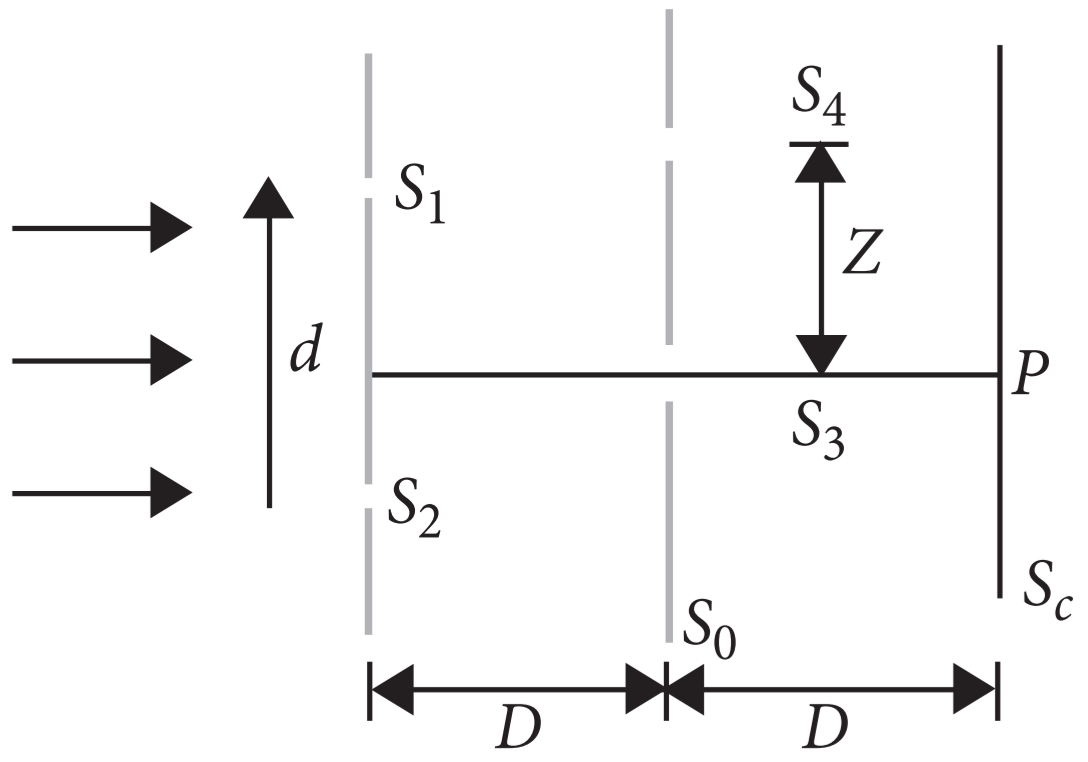
Consider the situation shown in figure. The two slits S1 and S1 placed symmetrically around the central line are illuminated by monochromatic light of wavelength $\lambda$. The separation between the slits is d. The light transmitted by the slits falls on a screen S0 place at a distance D from the slits. The slits S3 is at the central line and the slit S4 is at a distance from S3. Another screen Sc is placed a further distance D away from Sc.

  1. Find the path difference if $\text{z}=\frac{\lambda\text{D}}{2\text{d}}$.

  1. $\lambda$

  2. $\frac{\lambda}{2}$

  3. $\frac{3}{2\lambda}$

  4. $2\lambda$

  1. Find the ratio of the maximum to minimum intensity observed on Sc if $\text{z}=\frac{\lambda\text{D}}{\text{d}}$

  1. 4
  2. 2
  3. $\infty$

  4. 1
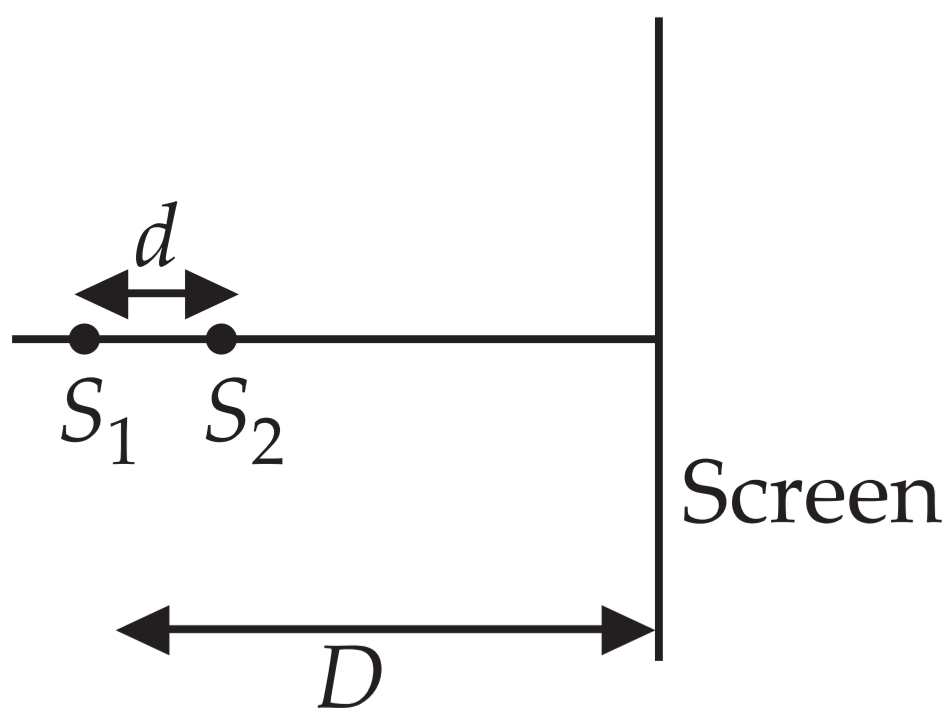
  1. Two coherent point sources S1 and S2 are separated by a small distanced as shown in figure. The fringes obtained on the screen will be:

  1. Concentric circles.
  2. Points.
  3. Straight lines.
  4. Semi-circles.
  1. ln the case of light waves from two coherent sources S1 and S2, there will be constructive interference at an arbitrary point P, if the path difference S1P - S2P is:
  1. $\Big(\text{n}+\frac{1}{2}\Big)\lambda$

  2. $\text{n}\lambda$

  3. $\Big(\text{n}-\frac{1}{2}\Big)\lambda$

  4. $\frac{\lambda}{2}$

  1. Two monochromatic light waves of amplitudes 3A and 2A interfering at a point have a phase difference of 60º. The intensity at that point will be proportional to:
  1. 5A2
  2. 13A2
  3. 7A2
  4. 19A2
View full solution
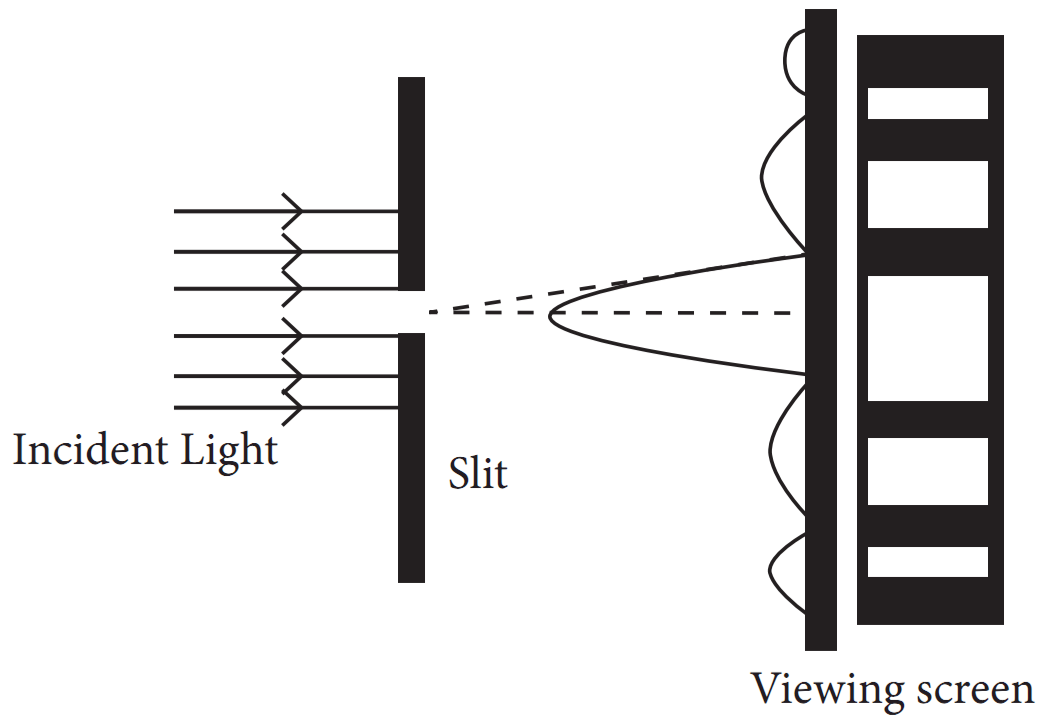
When light from a monochromatic source is incident on a single narrow slit, it gets diffracted and a pattern of ahem ate bright and dark fringes is obtained on screen, called "Diffraction Pattern" of single slit. ln diffraction pattern of single slit, it is found that.

  1. Central bright fringe is of maximum intensity and the intensity of any secondary bright fringe decreases with increase in its order.
  2. Central bright fringe is twice as wide as any other secondary bright or dark fringe.

  1. A single slit of width 0.1mm is illuminated by a parallel beam oftight of wavelength $6000\mathring{\text{A}}$ and diffraction bands are observed on a screen 0.5m from the slit. The distance of the third dark band from the central bright band is:

  1. 3mm
  2. 1.5mm
  3. 9mm
  4. 4.5mm
  1. ln Fraunhofer diffraction pattern, slit width is 0.2mm and screen is at 2m away from the lens. If wavelength of tight used is $5000\mathring{\text{A}}$ then the distance between the first minimum on either side the central maximum is:
  1. 10-1m
  2. 10-2m
  3. 2 × 10⁻²m
  4. 2 × 10⁻¹m
  1. Light of wavelength 600nm is incident normally on a slit of width 0.2mm. The angular width of central maxima in the diffraction pattern is (measured from minimum to minimum).
  1. 6 × 10⁻³rad
  2. 4 × 10⁻³rad
  3. 2.4 × 10⁻³rad
  4. 4.5 × 10⁻³rad
  1. A diffraction pattem is obtained by using a beam of red light. What will happen, if the red light is replaced by the blue light?
  1. Bands disappear
  2. Bands become broader and farther apart
  3. No change will take place
  4. Diffraction bands become narrower and crowded together.
  1. To observe diffraction, the size of the obstacle.
  1. Should be $\frac{\lambda}{2}$, where $\lambda$, is the wavelength.

  2. Should be of the order of wavelength.
  3. Has no relation to wavelength.
  4. Should be much larger than the wavelength.
View full solution
Distance between two successive bright or dark fringes is called fringe width.
$\beta=\text{Y}_\text{n+1}-\text{Y}_\text{n}=\frac{(\text{n}+1)\lambda\text{D}}{\text{d}}-\frac{\text{n}\lambda\text{D}}{\text{d}}=\frac{\lambda\text{D}}{\text{d}}$
Fringe width is independent of the order of the maxima. If whole apparatus is immersed in liquid of refractive index $\mu$ then $\beta=\frac{\lambda\text{D}}{\mu\text{d}}$ (fringe width decreases). Angular fringe width $(\theta)$ is the angular separation between two consecutive maxima or minima
$\theta=\frac{\beta}{\text{D}}=\frac{\lambda}{\text{d}}$
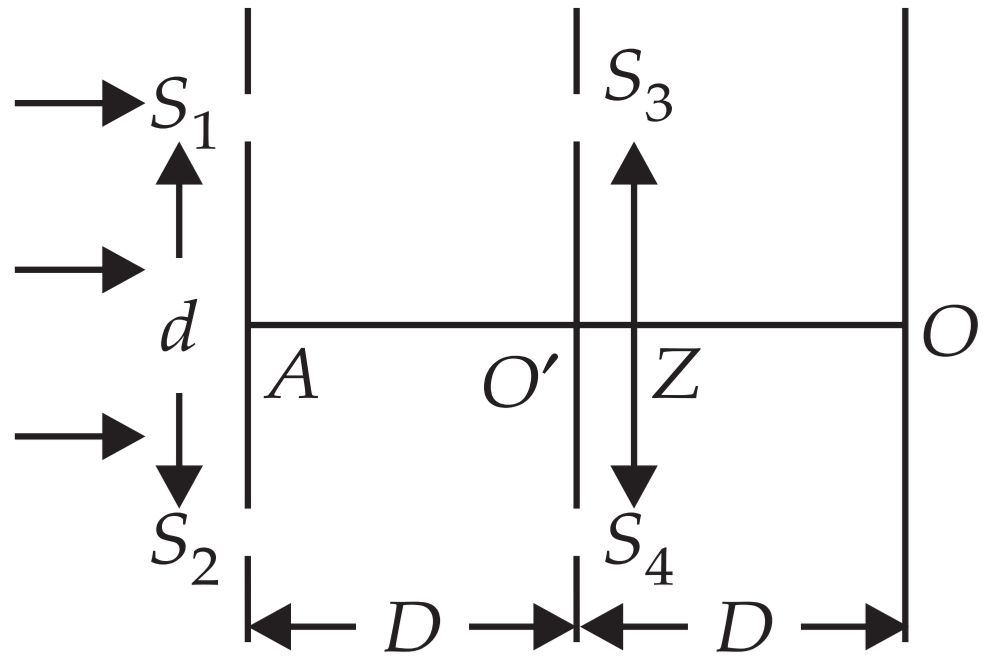
ln the arrangement shown in figure, slit S3 and S4 are having a variable separation Z. Point O on the screen is at the common perpendicular bisector of S1S2 and S3S4.

  1. The maximum number of possible interference maxima for slit separation equal to twice the wavelength in Young's double-slit experiment, is:
  1. Infinite
  2. Five
  3. Three
  4. Zero
  1. ln Young's double - slit experiment if yellow light is replaced by blue light, the interference fringes become.
  1. Wider
  2. Brighter
  3. Narrower
  4. Darker
  1. ln Young's double slit experiment, if the separation between the slits is halved and the distance between the slits and the screen is doubled, then the fringe width compared to the unchanged one will be.
  1. Unchanged
  2. Halved
  3. Doubled
  4. Quadrupled
  1. When the complete Young's double slit experiment is immersed in water, the fringes.
  1. Remain unaltered.
  2. Become wider.
  3. Become narrower.
  4. Disappear.
  1. ln a two slit experiment with white light, a white fringe is observed on a screen kept behind the slits. When the screen is moved away by 0.05m, this white fringe.
  1. Does not move at all.
  2. Gets displaced from its earlier position.
  3. Becomes coloured.
  4. Disappears.
View full solution
The phenomenon of bending ofli ght around the sharp corners and the spreading of light within the geometrical shadow of the opaque obstacles is called diffraction of light. The light thus deviates from its linear path. The deviation becomes much more pronounced, when the dimensions of the aperture or the obstacle are comparable to the wavelength of light.

  1. Light seems to propagate in rectilinear path because.
  1. Its spread is very large.
  2. Its wavelength is very small.
  3. Reflected from the upper surface of atmosphere.
  4. It is not absorbed by atmosphere.
  1. ln diffraction from a single slit the angular width of the central maxima does not depends on:
  1. $\lambda$ of light used.
  2. Width of slit.
  3. Distance of slits from the screen.
  4. Ratio of $\lambda$ and slit width.
  1. For a diffraction from a single slit, the intensity of the central point is:
  1. Infinite.
  2. Finite and same magnitude as the surrounding maxima.
  3. Finite but much larger than the surrounding maxima.
  4. Finite and substantially smaller than the surrounding maxima.
  1. Resolving power of telescope increases when:
  1. Wavelength of light decreases.
  2. Wavelength of light increases.
  3. Focal length of eye-piece increases.
  4. Focal length of eye-piece decreases.
  1. ln a single diffraction pattern observed on a screen placed at D metre di stance from the slit of width d metre, the ratio of the width of the central maxima to the width of other secondary maxima is:
  1. 2 : 1
  2. 1 : 2
  3. 1 : 1
  4. 3 : 1
View full solution
In Young’s double-slit experiment using monochromatic light of wavelength λ, the intensity of light at a point on the screen where path difference is λ, is K units. What is the intensity of light at a point where path difference is λ/3?
View full solution
Monochromatic light of wavelength 589 nm is incident from air on a water surface. What are the wavelength, frequency and speed of (a) reflected, and (b) refracted light? Refractive index of water is 1.33.
View full solution
Let us list some of the factors, which could possibly influence the speed of wave propagation:
  1. Nature of the source.
  2. Direction of propagation.
  3. Motion of the source and/or observer.
  4. Wavelength.
  5. Intensity of the wave.
On which of these factors, if any, does
  1. The speed of light in vacuum,
  2. The speed of light in a medium (say, glass or water), depend?
View full solution
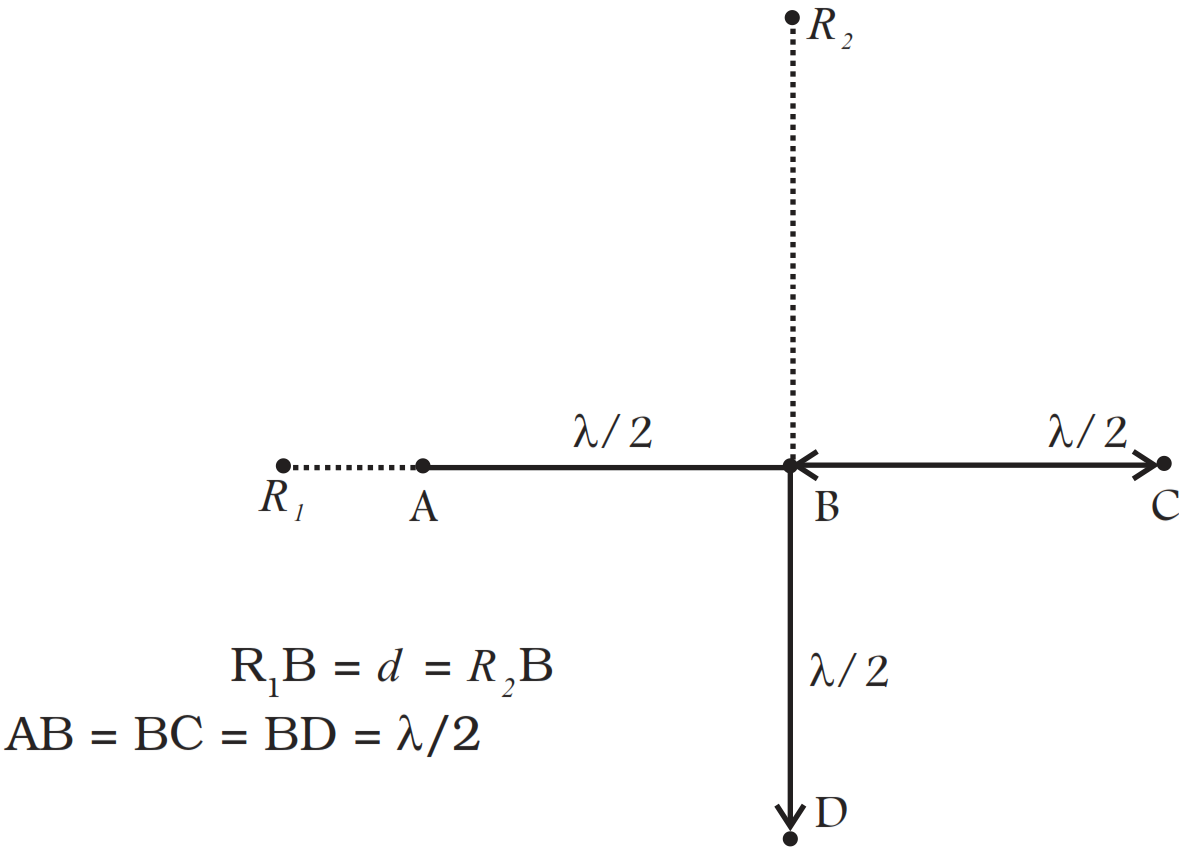
Four identical monochromatic sources A,B,C,D as shown in the (Fig.) produce waves of the same wavelength λ and are coherent. Two receiver R1 and R2 are at great but equal distaces from B.

  1. Which of the two receivers picks up the larger signal?
  2. Which of the two receivers picks up the larger signal when B is turned off?
  3. Which of the two receivers picks up the larger signal when D is turned off?
  4. Which of the two receivers can distinguish which of the sources B or D has been turned off?
View full solution

Generate a Wave Optics paper free

Pick question groups from the list above, set marks and difficulty, and export a branded PDF with step-by-step answer keys. First 3 chapters free — no signup.

Download App