MCQ
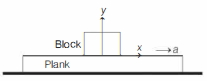
A plank is moving in a horizontal direction with a constant acceleration $\alpha \hat{ i }$. A uniform rough cubical block of side $l$ rests on the plank and is at rest relative to the plank. Let the centre of mass of the block be at $(0, l / 2)$ at a given instant. If $\alpha =g / 10$, then the normal reaction exerted by the plank on the block at that instant acts at
  • A
    $(0,0)$
  • $(-l / 20,0)$
  • C
    $(-l / 10,0)$
  • D
    $(l / 10,0)$

Answer

Correct option: B.
$(-l / 20,0)$
b
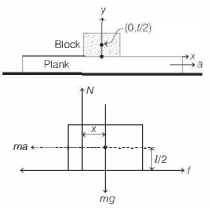
$(b)$ Given situation is Forces acting on the block are

In above diagram, ma=pseudo force due to acceleration of plank,

$f=$ force of static friction, $m g=$ weight of block and $N=$ normal reaction.

Here, we must note that due to motion of plank, normal reaction force does not passes through centre of mass.

If line of action of normal force at a distance $x$ from centre, then for equilibrium of block, net torque about centre of mass must be zero.

$\Rightarrow \quad \tau_{\substack{\text { Normal } \\ \text { reaction }}}=\tau_{\text {Friction }}$

$m g$ and $m a$ does not produces any torque about centre of mass as their line of action passes through centre of mass.

$\Rightarrow N \cdot x=f \cdot l / 2$

$\Rightarrow m g x=m a \frac{l}{2}$

${[\because N=m g \text { and } f=m a]}$

$\Rightarrow x=\left(\frac{a}{g}\right) \frac{l}{2}$

$\text { or } x=\frac{1}{10} \cdot \frac{l}{2} \quad\left[\because a=\frac{g}{10}\right]$

$\text { or } x=\frac{l}{20}$

So, coordinates of point from which reaction passes are $\left(-\frac{l}{20}, 0\right)$.
Need a full question paper?

Generate a complete, print-ready paper with questions like this in minutes — across 16+ boards, with answer keys.

Start Generating Free

Similar questions

The trajectory of an object is defined as x = (t - 4)2, what is the velocity at t = 5?
A person is moving with a velocity of 10ms-1 towards North. A car moving with a velocity of 20ms-1 towards South crosses the person. The velocity of car relative to the person is:
Which of the sets given below may represent the magnitudes of three vectors adding to zero?
  1. 2, 4, 8
  2. 4, 8, 16
  3. 1, 2, 1
  4. 0.5, 1, 2
The temperature of a body falls from $62^oC\, to\, 50^oC$ in $10$ minutes. If the temperature of the surroundings is $26^oC$, the temperature in next $10$ minutes will become  ...... $^oC$
The metallic bob of a simple pendulum has the relative density $\rho$. The time period of this pendulum is $T$. If the metallic bob is immersed in water, then the new time period is given by
If work done in increasing the size of a soap film from $10\;cm \times 6\;cm$ to $10\;cm \times 11\;cm$ is $2 \times {10^{ - 4}}\,J,$ then the surface tension is
A particle moving with uniform acceleration travels $24\, m$ and $64\, m$ in the first two consecutive intervals of $4\, sec$ each. Its initial velocity is.......$m/sec$
A bottle has an opening of radius $a$ and length $b$. A cork of length band radius $\left( {a + \Delta a} \right)$ where $\left( {\Delta a <  < a} \right)$ is compressed to fit into the opening completely (see figure). If the bulk modulus of cork is $B$ and frictional coefficient between the bottle and cork is $\mu $ then the force needed to push the cork into the bottle is
The maximum tension which an inextensible ring of mass $0.1\, kg/m$ can bear is $10\,N$. The maximum velocity in $m/s$ with which it can be rotated is ........ $m/s.$
The energy of a given sample of an ideal gas depends only on its: