Question types

6. system of particles and rotational motion question types

1,280 questions across 1 question group — pick any mix to generate a Physics paper with step-by-step answer keys.

1,280
Questions
1
Question groups
5
Question types
Sample Questions

6. system of particles and rotational motion questions

One sample from each question group in this chapter. Select any group above to see the full set with answer keys.

The moment of inertia of a thin rod about an axis passing through its mid point and perpendicular to the rod is $2400 \mathrm{~g} \mathrm{~cm}^2$. The length of the $400 \mathrm{~g}$ rod is nearly:
  • A
    $17.5 \mathrm{~cm}$
  • B
    $20.7 \mathrm{~cm}$
  • C
    $72.0 \mathrm{~cm}$
  • $8.5 \mathrm{~cm}$

Answer: D.

View full solution
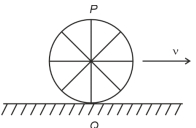
A wheel of a bullock cart is rolling on a level road as shown in the figure below. If its linear speed is $v$ in the direction shown, which one of the following options is correct ( $P$ and $Q$ are any highest and lowest points on the wheel, respectively)?
  • Point $P$ moves faster than point $Q$
  • B
    Both the points $P$ and $Q$ move with equal speed
  • C
    Point $P$ has zero speed
  • D
    Point $P$ moves slower than point $Q$

Answer: A.

View full solution
The ratio of radius of gyration of a solid sphere of mass $M$ and radius $R$ about its own axis to the radius of gyration of the thin hollow sphere of same mass and radius about its axis is :-
  • A
    $5: 2$
  • $\sqrt{3}: \sqrt{5}$
  • C
    $5: 3$
  • D
    $2: 5$

Answer: B.

View full solution
Two objects of mass $10\,kg$ and $20\,kg$ respectively are connected to the two ends of a rigid rod of length $10\,m$ with negligible mass. The distance of the center of mass of the system from the $10\,kg$ mass is :
  • $\frac{20}{3}\,m$
  • B
    $10\,m$
  • C
    $5\,m$
  • D
    $\frac{10}{3}\,m$

Answer: A.

View full solution
Given below are two statements : one is labelled as Assertion $(A)$ and the other is labelled as Reason $(R)$,

Assertion $(A)$ :When a fire cracker (rocket) explodes in mid air, its fragments fly in such a way that they continue moving in the same path, which the fire cracker would have followed, had it not exploded

Reason $(R)$:Explosion of cracker (rocket) occurs due to internal forces only and no external force acts for this explosion.

In the light of the above statements, choose the most appropriate answer from the options given below :

  • A
    Both $(A)$ and $(R)$ are correct and $(R)$ is the correct explanation of $(A)$
  • B
    Both $(A)$ and $(R)$ are correct but $(R)$ is not the correct explanation of $(A)$
  • C
    $(A)$ is correct but $(R)$ is not correct
  • $(A)$ is not correct but $(R)$ is correct

Answer: D.

View full solution

Generate a 6. system of particles and rotational motion paper free

Pick question groups from the list above, set marks and difficulty, and export a branded PDF with step-by-step answer keys. First 3 chapters free — no signup.

Download App