Question
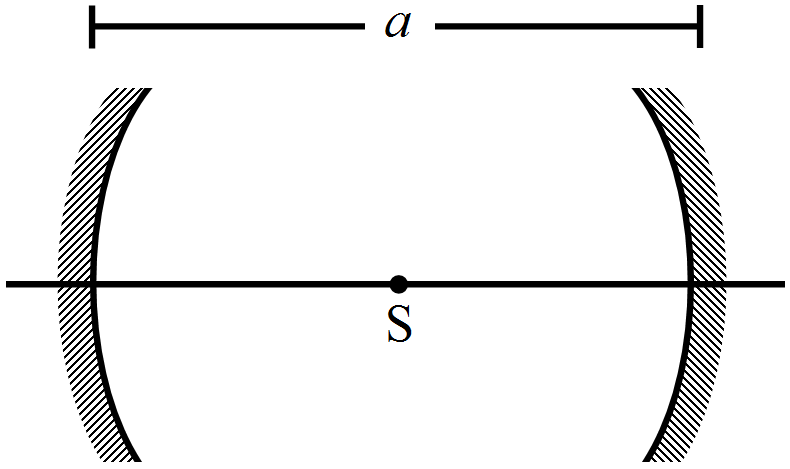
A point source S is placed midway between two converging mirrors having equal focal length f. Find the values of d for which only one image is formed.
Answer


Both the mirrors have equal focal length f.

They will produce one image under two conditions.

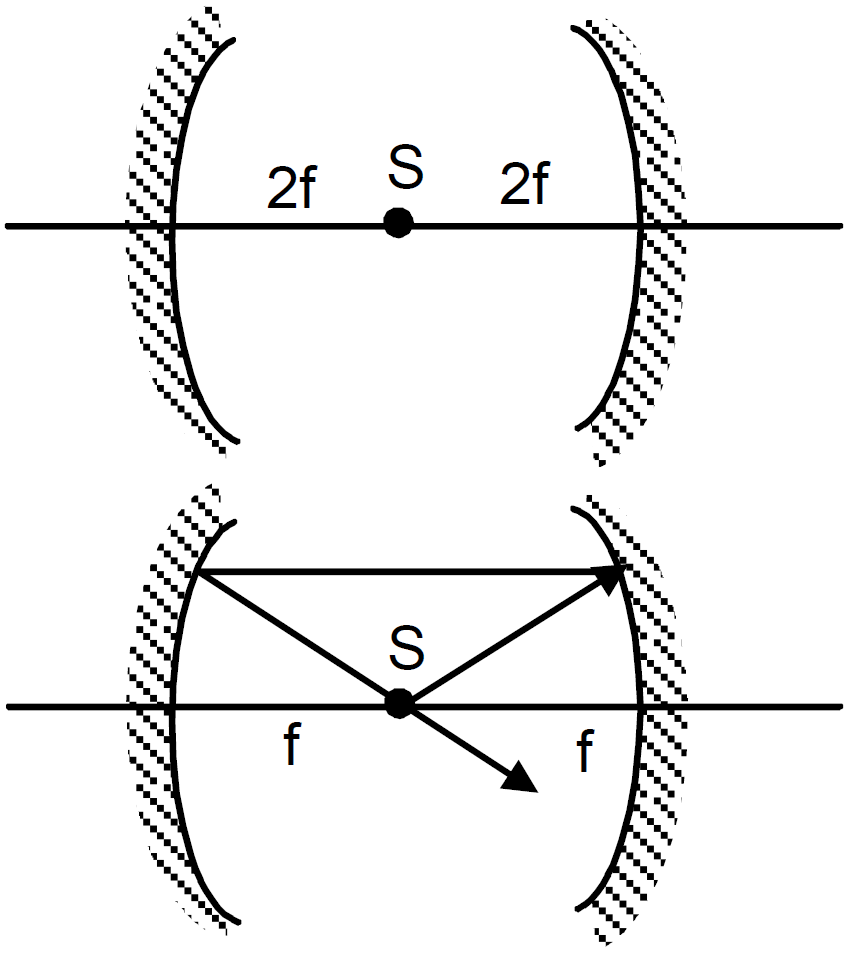
Case I: When the source is at distance ‘2f’ from each mirror i.e. the source is at centre of curvature of the mirrors, the image will be produced at the same point S. So, d = 2f + 2f = 4f.

Case II: When the source S is at distance ‘f’ from each mirror, the rays from the source after reflecting from one mirror will become parallel and so these parallel rays after the reflection from the other mirror the object itself. So, only sine image is formed.

Here, d = f + f = 2f

Need a full question paper?

Generate a complete, print-ready paper with questions like this in minutes — across 16+ boards, with answer keys.
Start Generating Free

Similar questions

3 A man stands on a rotating platform, with his arms stretched horizontally holding a 5kg weight in each hand. The angular speed of the platform is 30 revolutions per minute. The man then brings his arms close to his body with the distance of each weight from the axis changing from 90cm to 20cm. The moment of inertia of the man together with the platform may be taken to be constant and equal to 7.6kgm2.
  1. What is his new angular speed? (Neglect friction).
  2. Is kinetic energy conserved in the process? If not, from where does the change come about?
Explain why
A spinning cricket ball in air does not follow a parabolic trajectory.
Two wires are kept tight between the same pair of supports. The tensions in the wires are in the ratio 2 : 1, the radii are in the ratio 3 : 1 and the densities are in the ratio 1 :2. Find the ratio of their fundamental frequencies.
Explain why.
There is no atmosphere on moon.
A sphere of a radius 10cm weighs 1kg, calculate the moment of inertia.
  1. About the diameter.
  2. About the tangent.
A hollow tube has a length l1 inner radius R1 and outer radius R2. The material has a thermal conductivity K. Find the heat flowing through the walls of the tube if.
  1. The flat ends are maintained at temperatures T1 and T2(T2 > T1)
  2. The inside of the tube is maintained at temperature T1 and the outside is maintained at T2.
Two billiard balls each of mass 0.05kg moving in opposite directions with speed 6ms-1 collide and rebound with the same speed. What is the impulse imparted to each ball due to the other?
A beam of monochromatic light of wavelength $\lambda$ ejects photoelectrons from a cesium surface $\big(\Phi=1.9\text{eV}\big).$ These photoelectrons are made to collide with hydrogen atoms in ground state. Find the maximum value of $\lambda$ for which (a) hydrogen atoms may be ionized, (b) hydrogen atoms may get excited from the ground state to the first excited state and (c) the excited hydrogen atoms may emit visible light.
An object falling through a fluid is observed to have acceleration given by a = g - bv where g = gravitational acceleration and b is constant. After a long time of release, it is observed to fall with constant speed. What must be the value of constant speed?
Consider one mole of perfect gas in a cylinder of unit cross section with a piston attached (Fig.) A spring (spring constant k) is attached (unstretched length L) to the piston and to the bottom of the cylinder. Initially the spring is unstretched and the gas is in equilibrium. A certain amount of heat Q is supplied to the gas causing an increase of volume from Vo to V1.

  1. What is the initial pressure of the system.
  2. What is the final pressure of the system.
  3. Uing the first law of thermodynamics, write down a relation between Q, Pa, V, Vo and k.