MCQ
A potential difference is applied across the ends of a metallic wire. If the potential difference is doubled, then the drift velocity
  • Will be doubled
  • B
    Will be halved
  • C
    Will be quadrupled
  • D
    Will remain unchanged

Answer

Correct option: A.
Will be doubled
a
$\begin{array}{l}
I = neA{v_d}\\
V = IR
\end{array}$

Need a full question paper?

Generate a complete, print-ready paper with questions like this in minutes — across 16+ boards, with answer keys.
Start Generating Free

Similar questions

A sphere of radius 1 cm has potential of 8000 V, then energy density near its surface will be
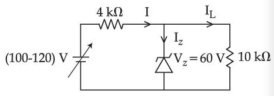
In the circuit shown below, maximum zener diode current will be $.....mA$
Light waves producing interference have their amplitudes in the ratio 3 : 2. The intensity ratio of maximum and minimum of interference fringes is
A hollow convex lens of glass will behave like a
If in $a$ coil rate of change of area is $\frac{{5\,metr{e^2}}}{{milli\,second}}$ and current become $1\, amp$ form $2$ $amp$ in $2 × 10^{-3} sec$. If magnetic field is $1$ Tesla then self inductance of the coil is......$H$
The activity of a radioactive sample
The wavelength of sodium light in air is $5890 \mathring A$. The velocity of light in air is $3 \times 10^8 ms^{-1}$. The wavelength of light in a glass of refractive index 1.6 would be close to
Two point charges +9e and +e are at 16 cm away from each other. Where should another charge q be placed between them so that the system remains in equilibrium
The magnetic potential due to a magnetic dipole at a point on its axis situated at a distance of $20 \mathrm{~cm}$ from its center is $1.5 \times 10^{-5} \  \mathrm{Tm}$. The magnetic moment of the dipole is___________ $\mathrm{Am}^2$. (Given : $\frac{\mu_0}{4 \pi}=10^{-7} \  \mathrm{TmA}^{-1}$ )
A thin infinite sheet charge and an infinite line charge of respective charge densities $+\sigma$ and $+\lambda$ are placed parallel at $5\,m$ distance from each other. Points $P$ and $Q$, are at $\frac{3}{\pi} m$ and $\frac{4}{\pi} m$ perpendicular distance from line charge towards sheet charge, respectively. $E_P$ and $E_Q$ are the magnitudes of resultant electric field intensities at point $P$ and $Q$, respectively. If $\frac{E_p}{E_Q}=\frac{4}{a}$ for $2|\sigma|=|\lambda|$. Then the value of $a$ is ...........