MCQ
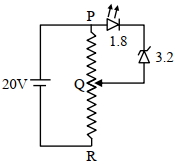
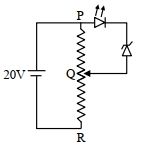
A potential divider circuit is connected with a dc source of $20 \mathrm{~V}$, a light emitting diode of glow in voltage $1.8 \mathrm{~V}$ and a zener diode of breakdown voltage of $3.2 \mathrm{~V}$. The length (PR) of the resistive wire is $20 \mathrm{~cm}$. The minimum length of $P Q$ to just glow the LED is ............. cm.
  • A
    $2$
  • B
    $3$
  • C
    $4$
  • $5$

Answer

Correct option: D.
$5$
d
(Image)

$PR=20cm$

$\mathrm{~V}_{\mathrm{PQ}}=\frac{1}{4} \times \mathrm{R}_{\mathrm{PR}}$

$\ell_{\min }(\mathrm{PQ})=\frac{1}{4} \times 20$

$=5 \mathrm{~cm}$

Need a full question paper?

Generate a complete, print-ready paper with questions like this in minutes — across 16+ boards, with answer keys.

Start Generating Free

Similar questions

A series $LR$ circuit is connected to an ac source of frequency $\omega $ and the inductive reactance is equal to $2R$. A capacitance of capacitive reactance equal to $R$ is added in series with $L$ and $R$. The ratio of the new power factor to the old one is
Assertion : X-rays cannot be diffracted by means of grating.
Reason : X-rays does not obey Bragg's law.
If the half life of a radioactive sample is 10 hours, its mean life is
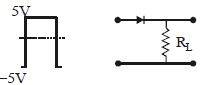
If in a $p-n$ junction diode, a square input signal of $10\, V$ is applied as shown. Then the output signal across $R_L$ will be
An elementary particle of mass $m$ and charge $ + e$ is projected with velocity $v$ at a much more massive particle of charge $Ze,$ where $Z > 0.$What is the closest possible approach of the incident particle
Mark the correct options:
A lamp is hanging at a height $40\, cm$ from the centre of a table. If its height is increased by $10\, cm $ the illuminance on the table will decrease by.....$\%$
There is a relation between the radius $(R)$ of the nucleus of an atom and the mass number $(A)$ of the atom :
A point object O is placed on the principal axis of a convex lens of focal length 20 cm at a distance of 40 cm to the left of it. The diameter of the lens is 10 cm. If the eye is placed 60 cm to the right of the lens at a distance h below the principal axis, then the maximum value of h to see the image will be
A particle of charge $q$ and mass $m$ is subjected to an electric field $E = E _{0}\left(1- ax ^{2}\right)$ in the $x-$direction, where $a$ and $E _{0}$ are constants. Initially the particle was at rest at $x=0 .$ Other than the initial position the kinetic energy of the particle becomes zero when the distance of the particle from the origin is