A potentiometer consists of a wire of length $4\, m$ and resistance $10\,\Omega $. It is connected to a cell of $e.m.f.$ $2\, V$. The potential difference per unit length of the wire will be ............. $V/m$
AIPMT 1999, Easy


Download our appand get started for free
Experience the future of education. Simply download our apps or reach out to us for more information. Let's shape the future of learning together!No signup needed.*
Similar Questions
- 1View SolutionWhen a potential difference is applied across the ends of a linear metallic conductor
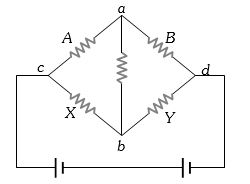
- 2In the Wheatstone's bridge (shown in figure) $X = Y$ and $A > B$. The direction of the current between ab will beView Solution
- 3The resistance of a bulb filmanet is $100\,\Omega$ at a temperature of $100\,^o C$. If its temperature coefficient of resistance be $0.005$ per $^o C$, its resistance will become $200\,\Omega$ at a temperature of ................ $^oC$View Solution
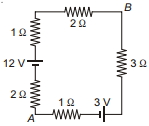
- 4Potential difference $V_B-V_A$ in the network shown is ............. $V$View Solution
- 5A steady current $i$ is flowing through a conductor of uniform cross-section. Any segment of the conductor hasView Solution
- 6A steady current $I$ is set up in a wire whose cross-sectional area decreases in the direction of the flow of the current. Then, as we examine the narrowing region,View Solution
- 7The length of the resistance wire is increased by $10\%$. What is the corresponding change in the resistance of wire ................ $\%$View Solution
- 8View SolutionOhm's law fails in
- 9View SolutionThe brightness of a bulb will be reduced, if a resistance is connected in
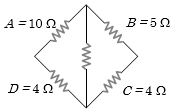
- 10In a typical Wheatstone network, the resistances in cyclic order are $A = 10 \,\Omega $, $B = 5 \,\Omega $, $C = 4 \,\Omega $ and $D = 4 \,\Omega $ for the bridge to be balancedView Solution