Ohm's law fails in
Easy
Download our app for free and get started
(d)
Ohm's law is not applicable for diode, thyristor as well as $PN$ junction

Download our appand get started for free
Experience the future of education. Simply download our apps or reach out to us for more information. Let's shape the future of learning together!No signup needed.*
Similar Questions
- 1Two identical cells each of emf $1.5\,V$ are connected in series across a $10\,\Omega$ resistance. An ideal voltmeter connected across $10\,\Omega$ resistance reads $1.5\,V$. The internal resistance of each cell is $......\Omega$.View Solution
- 2The power rating of an electric motor which draws a current of $3.75\, amperes$ when operated at $200\, V$ is aboutView Solution
- 3If the length of the filament of a heater is reduced by $10\%$, the power of the heater willView Solution
- 4Two cells of $e.m.f.$ $E_1$ and $E_2$ are joined in series and the balancing length of the potentiometer wire is $625$ $cm$. If the terminals of $E_1$ are reversed, the balancing length obtained is $125 \,cm$. Given $E_2 > E_1$, the ratio $E_1: E_2$ will beView Solution
- 5An electric bulb of $100\, watt$ is connected to a supply of electricity of $220\, V$. Resistance of the filament is ............. $\Omega$View Solution
- 6The thermo $e.m.f.$ of a thermo-couple is $25\,\mu V{/^o}C$ at room temperature. A galvanometer of $40\, ohm$ resistance, capable of detecting current as low as ${10^{ - 5}}\,A,$ is connected with the thermocouple. The smallest temperature difference that can be detected by this system is ................ $^oC$View Solution
- 7Two identical cells send the same current in $2\,\Omega $ resistance, whether connected in series or in parallel. The internal resistance of the cell should be ............... $\Omega$View Solution
- 8An electric bulb is rated $220\, volt$ and $100\, watt$. Power consumed by it when operated on $110\, volt$ is ............. $watt$View Solution
- 9Equivalent resistance between the adjacent corners of a regular $n$-sided polygon of uniform wire of resistance $R$ would be:View Solution
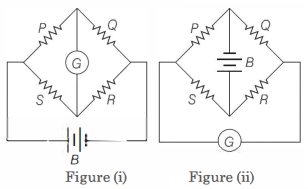
- 10Figure $(i)$ below shows a Wheatstone's bridge in which $P, Q, R$ and $S$ are fixed resistances, $G$ is a galvanometer and $B$ is a battery. For this particular case, the galvanometer shows zero deflection. Now, only the positions of $B$ and $G$ are interchanged, as shown in figure $(ii)$. The new deflection of the galvanometerView Solution