MCQ
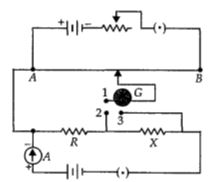
A potentiometer circuit is set up as shown. The potential gradient, across the potentiometer wire, is $k$ $volt/cm$ and the ammeter, present in the circuit, reads $1.0\,\, A$ when two way key is switched off. The balance points, when the key between the terminals $(i)$  $1$ and $2$  $(ii)$ $1$ and $3,$ is plugged in, are found to be at lengths $l_1$ and $l_2$ respectively. The magnitudes, of the resistors $R$ and $X,$ in $ohms$, are then, equal, respectively, to 
  • A
    $k(l_2 -l_1)\,Ω , kl_2\,Ω$
  • $kl_1 \,Ω , k(l_2 - l_1)\,Ω$
  • C
    $\;{\rm{k}}\left( {l_2 - l_1} \right)\,\Omega {\rm{\;}},{\rm{\;\;k}}l_1{\rm{\;}}\,\Omega {\rm{\;\;\;\;\;\;\;\;\;\;\;\;\;\;\;\;\;}}$
  • D
    $kl_1 \,Ω , kl_2\, Ω$

Answer

Correct option: B.
$kl_1 \,Ω , k(l_2 - l_1)\,Ω$
b
When the two way key is switched off, then The current flowing in the resistors $R$ and $X$ is

$I=1\, \mathrm{A}$        .......$(i)$

When the key between the terminals $1$ and $2$ is plugged in, then

Potential difference across $R=I R=k l_{1}$       ......$(ii)$

where $k$ is the potential gradient across the potentiometer wire

When the key between the terminals $1$ and $3$ is plugged in, then

Potential difference across $(R+X)=I(R+X)=k l_{2}$      ....$(iii)$

From equation $(ii),$ we get

$R=\frac{k l_{1}}{I}=\frac{k l_{1}}{1}=k l_{1} \Omega$      .......$(iv)$

From equation $(iii),$ we get

$R + X = \frac{{k{l_2}}}{I} = \frac{{k{l_2}}}{1} = k{l_2}\,\Omega \quad {\rm{ (Using }}({\rm{i}}))$

$X = k{l_2} - R$

$ = k{l_2} - k{l_1}{\rm{ }}\,\,\,\,\,\,\,\,\,\,\,{\rm{(Using}}\left( {iv} \right){\rm{)}}$

$=k\left(l_{2}-l_{1}\right) \,\Omega$

Need a full question paper?

Generate a complete, print-ready paper with questions like this in minutes — across 16+ boards, with answer keys.

Start Generating Free

Similar questions

Potential difference across the terminals of the battery shown in figure is (r = internal resistance of battery)
The ratio of the magnetic field at the centre of a current carrying coil of the radius $a$ and at a distance ‘$a$’ from centre of the coil and perpendicular to the axis of coil is
Cathode rays are
The density of a rod gradually decreases from one end to the other. It is pivoted at an end so that it can move about a vertical axis through the pivot. A horizontal force $F$ is applied on the free end in a direction perpendicular to the rod. The quantities, that do not depend on which end of the rod is pivoted, are:
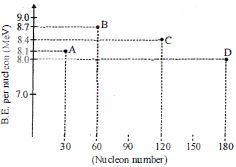
The positions of four different nuclei in the binding energy curve are shown in figure. The process that might not proceed spontaneously is
A star producing light of wavelength $6000 Å$ moves away from the earth with a speed of $5\, km/sec$. Due to Doppler effect the shift in wavelength will be......$\mathop A\limits^o $ $(c = 3 \times {10^8}m/\sec )$
Bob of a simple pendulum of length $l$ is made of iron . The pendulum is oscillating over a horizontal coil carrying direct current. If the time period of the pendulum is $T$ then
A plano-convex lens of unknown material and unknown focal length is given. With the help of a Spherometer we can measure the,
A $200\, W$ sodium street lamp emits yellow light of wavelength $0.6\, \mu m$. Assuming it to be $25\%$ efficient in converting electrical energy to light, the number of photon of yellow light it emits per second is
The number of neutrons in an atom of ${90^{Th}}^{230}$ is: