A potentiometer having the potential gradient of $2\, mV/cm$ is used to measure the difference of potential across a resistance of $10 \,\Omega$. If a length of $50\, cm$ of the potentiometer wire is required to get the null point, the current passing through the $10 \,\Omega$ resistor is (in $mA$)
Medium
Download our app for free and get started
(d) $V = xl \Rightarrow iR = xl$
$ \Rightarrow \,\,\,i \times 10 = \left( {\frac{{2 \times {{10}^{ - 3}}}}{{{{10}^{ - 2}}}}} \right) \times 50 \times {10^{ - 2}} = 0.1$
$ \Rightarrow \,\,\,\,i = 10 \times {10^{ - 3}}A = 10\,mA$.
$ \Rightarrow \,\,\,i \times 10 = \left( {\frac{{2 \times {{10}^{ - 3}}}}{{{{10}^{ - 2}}}}} \right) \times 50 \times {10^{ - 2}} = 0.1$
$ \Rightarrow \,\,\,\,i = 10 \times {10^{ - 3}}A = 10\,mA$.

Download our appand get started for free
Experience the future of education. Simply download our apps or reach out to us for more information. Let's shape the future of learning together!No signup needed.*
Similar Questions
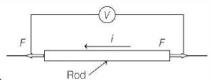
- 1As shown in the schematic below, a rod of uniform cross-sectional area $A$ and length $l$ is carrying a constant current $i$ through it and voltage across the rod is measured using an ideal voltmeter. The rod is stretched by the application of a force $F$. Which of the following graphs would show the variation in the voltage across the rod as function of the strain $\varepsilon$ when the strain is small. Neglect Joule heating.View Solution
- 2A new flashlight cell of $e.m.f.$ $1.5\, volts$ gives a current of $15\, amps$, when connected directly to an ammeter of resistance $0.04\,\Omega $. The internal resistance of cell is ........... $\Omega$View Solution
- 3A student obtained following observations in an experiment of meter bridge to find the unknown resistance of the circuit The most accurate value of unknown resistance is ............ $\Omega$View Solution
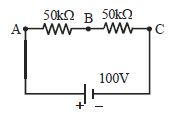
S.No. $R$ $l$ $100-l$ $S = \left( {\frac{{100 - l}}{l}} \right)R$ $1$ $20\,\Omega $ $43$ $57$ $26.51\,\Omega $ $2$ $30\,\Omega $ $51$ $49$ $28.82\,\Omega $ $3$ $40\,\Omega $ $59$ $41$ $27.80\,\Omega $ $4$ $60\,\Omega $ $70$ $30$ $25.71\,\Omega $ - 4In the adjacent shown circuit, a voltmeter of internal resistance $R$, when connected across $B$ and $C$ reads $\frac{{100}}{3}\,V$. Neglecting the internal resistance of the battery, the value of $R$ is ................. $k \Omega$View Solution
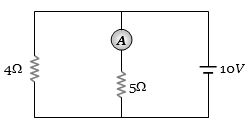
- 5In the circuit, the reading of the ammeter is ................. $A$ (assume internal resistance of the battery be zero)View Solution
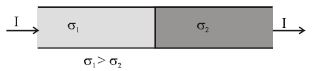
- 6Current $I$ is flowing through the two materials having electrical conductivities $\sigma_1$ and $\sigma_2$ respectively $(\sigma_1 > \sigma_2 )$ as shown in the figure. The total amount of charge at the junction of the materials isView Solution
- 7Two resistors of resistance, $100\,\Omega$ and $200\,\Omega$ are connected in parallel in an electrical circuit. The ratio of the thermal energy developed in $100\,\Omega$ to that in $200\,\Omega$ in a given time is:View Solution
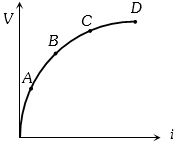
- 8Variation of current passing through a conductor as the voltage applied across its ends as varied is shown in the adjoining diagram. If the resistance $(R)$ is determined at the points $A$, $B$, $C$ and $D$, we will find thatView Solution
- 9The resistance of a rectangular block of copper of dimensions $2 \,mm \times 2 \,mm \times 5 \,m$ between two square faces is $0.02 \,\Omega$. What is the resistivity of copper?View Solution
- 10A metal wire of specific resistance $64 \times {10^{ - 6}}\,ohm - cm$ and length $198\, cm$ has a resistance of $7\, ohm$, the radius of the wire will be ............. $cm$View Solution