There is a current of $40$ ampere in a wire of ${10^{ - 6}}\,{m^2}$ area of cross-section. If the number of free electron per ${m^3}$ is ${10^{29}}$, then the drift velocity will be
Easy


Download our appand get started for free
Experience the future of education. Simply download our apps or reach out to us for more information. Let's shape the future of learning together!No signup needed.*
Similar Questions
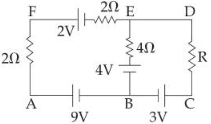
- 1In the electric network shown, when no current flows through the $4\, \Omega $ resistor in the arm $EB$, the potential difference between the points $A$ and $D$ will be ............... $V$View Solution
- 2Infinite number of cells having $emf$ and internal resistance $\left( {E,r} \right)$, $\left( {\frac{E}{n},\frac{r}{n}} \right)$, $\left( {\frac{E}{{{n^2}}},\frac{r}{{{n^2}}}} \right)$, $\left( {\frac{E}{{{n^3}}},\frac{r}{{{n^3}}}} \right)$..... are connected in series in same manner across an external resistance of $\frac{{nr}}{{n + 1}}$ . Current flowing through the external resistor isView Solution
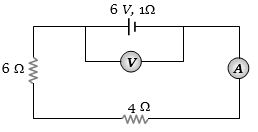
- 3View SolutionIn the circuit shown here, the readings of the ammeter and voltmeter are
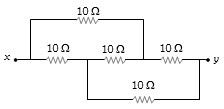
- 4The equivalent resistance between $x$ and $y$ in the circuit shown is ............. $\Omega$View Solution
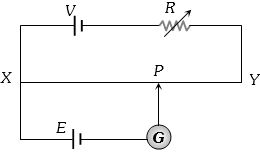
- 5A potentiometer circuit shown in the figure is set up to measure $e.m.f.$ of a cell $E$. As the point $P$ moves from $X$ to $Y$ the galvanometer $G$ shows deflection always in one direction, but the deflection decreases continuously until $Y$ is reached. In order to obtain balance point between $X$ and $Y$ it is necessary toView Solution
- 6A thermocouple of negligible resistance produces an $e.m.f.$ of $40\,\mu V{/^o}C$ in the linear range of temperature. A galvanometer of resistance $10\; ohm$ whose sensitivity is $1\;\mu A/div$, is employed with the thermocouple. The smallest value of temperature difference that can be detected by the system will beView Solution
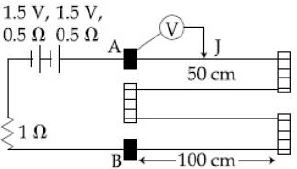
- 7In the circuit shown, a four wire potentiometer is made of a $400\, cm$ long wire, which extends between $A$ and $B$. The resistance per unit length of the potentiometer wire is $r = 0.01\, \Omega /cm$. If an ideal voltmeter is connected as shown with jockey $J$ at $50\, cm$ from end $A$, the expected reading of the voltmeter will be: ............... $V$View Solution
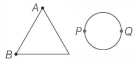
- 8A uniform metallic wire of length $L$ is mounted in two configurations. In configuration $1$ (triangle), it is an equilateral triangle and a voltage $V$ is applied to corners $A$ and $B$. In configuration $2$ (circle), it is bent in the form of a circle and the potential $V$ is applied at diametrically opposite points $P$ and $Q$. The ratio of the power dissipated in configuration $1$ to configuration $2$ isView Solution
- 9Masses of $3$ wires of same metal are in the ratio $1 : 2 : 3$ and their lengths are in the ratio $3 : 2 : 1$. The electrical resistances are in ratioView Solution
- 10For a wire $\frac{R}{l}=\frac{1}{2}$ and length of wire is $l=5\, cm .$ If potential difference $1\, V$ is applied across it, current through wire will be: $( R =$ Resistance $)$ (in $A$)View Solution