MCQ
A potentiometer wire is $100\,\, cm$ long and a constant potential difference is maintained across it. Two cells are connected in series first to support one another and then in opposite direction. The balance points are obtained at $50\,\, cm$ and $10\,\, cm$ from the positive end of the wire in the two cases. The ratio of emf's is 
  • A
    $5:4$
  • B
    $3:4$
  • $3:2$
  • D
    $5:1$

Answer

Correct option: C.
$3:2$
c
Suppose two cells have emfs $\varepsilon_{1}$ and $\varepsilon_{2}$

$\left(\text { also } \varepsilon_{1}>\varepsilon_{2}\right)$

Potential difference per unit length of the potentiometer wire $=k$ (say)

When $\varepsilon_{1}$ and $\varepsilon_{2}$ are in series and supporteach other then

$\varepsilon_{1}+\varepsilon_{2}=50\, \times k$       .....$(i)$

When $\varepsilon_{1}$ and $\varepsilon_{2}$ are in opposite direction

$\varepsilon_{1}-\varepsilon_{2}=10 \times k$     ....$(ii)$

On adding eqn. $(i)$ and eqn. $(ii)$

$2 \varepsilon_{1}=60\, k \Rightarrow \varepsilon_{1}=30 \,k$ and $\varepsilon_{2}=50\, k-30 \,k=20\, k$

$\therefore \quad \frac{\varepsilon_{1}}{\varepsilon_{2}}=\frac{30 \,k}{20 \,k}=\frac{3}{2}$

Need a full question paper?

Generate a complete, print-ready paper with questions like this in minutes — across 16+ boards, with answer keys.

Start Generating Free

Similar questions

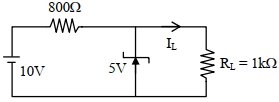
In the given circuit- the value of current $I _{ L }$ will be $mA$.

(When $R _{ L }=1 \,k\, \Omega$ )

A stream of photons having energy $3 \,eV$ each impinges on a potassium surface. The work function of potassium is $2.3 \,eV$. The emerging photo-electrons are slowed down by a copper plate placed $5 \,mm$ away. If the potential difference between the two metal plates is $1 \,V$, the maximum distance the electrons can move away from the potassium surface before being turned back is .......... $mm$
In $Y.D.S.E$ how many maxima can be obtained on the screen if wave length of light used is $200\,nm$ and $d = 700\,nm$
In a $YDSE$, the central bright fringe can be identified :
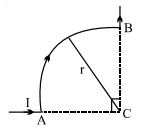
A wire carrying $I$ is shaped as shown. Section $AB$ is a quarter circle of radius $r.$ The magnetic field at $C$ is directed
Lenz’s law applies to
Assuming the nitrogen molecule is moving with $r.m.s.$ velocity at $400\, K$, the de$-$Broglie wavelength of nitrogen molecule is close to$......\mathring {A}$

(Given : nitrogen molecule weight :

$4.64 \times 10^{-26}\, kg ,$ Boltzman constant :

$1.38 \times 10^{-23}\, J / K ,$ Planck constant :

$\left.6.63 \times 10^{-34}\, J . s \right)$

An ammeter $A$ of finite resistance, and a resistor $R$ are joined in series to an ideal cell $C$. $A$ potentiometer $P$ is joined in parallel to $R$. The ammeter reading is $I_0$ and the potentiometer reading is $V_0$. $P$ is now replaced by a voltmeter of finite resistance. The ammeter reading now is $I$ and the voltmeter reading is $V$.
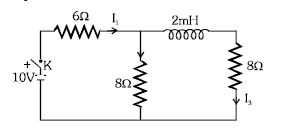
In the circuit shown in figure what is the value of $I_1$ just after pressing the key $K$ ?
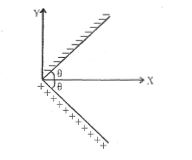
The given diagram shows two semi infinite line of charges having equal (in magnitude) linear charge density but with opposite sign. The electric field at any point on $x$ axis for $(x > 0)$ is along the unit vector