A potentiometer wire of length $100\, cm$ has a resistance of $10\,\Omega $. It is connected in series with a resistance and a cell of $emf$ $2\, V$ and of negligible internal resistance. A source of $emf$ $10\,mV$ is balanced against a length of $40\, cm$ of the potentiometer wire. What is the value of external resistance ? .................. $\Omega$
Diffcult
Download our app for free and get started
The current in the potentiometer wire $\mathrm{AC}$ is
$\mathrm{I}=\frac{2}{10+\mathrm{R}}$
The potential difference across the potentiometer wire is $\mathrm{V}=$ current $\times$ resistance
$=\frac{2}{10+\mathrm{R}} \times 10$
The length of the wire is $l=100 \mathrm{\,cm}$
So, the potential gradient along the wire is
$\mathrm{K}=\frac{\mathrm{V}}{\mathrm{t}}=\left(\frac{2}{10+\mathrm{R}}\right) \times \frac{10}{100}$ ...........$(i)$
The source of $\mathrm{emf}$ $10 \mathrm{\,mV}$ is balanced against a length of $40 \mathrm{\,cm}$ of the potentiometer wire
i.e. $10 \times 10^{-3}=\mathrm{k} \times 40$
or $10 \times 10^{-3}=\frac{2}{(10+\mathrm{R})} \times \frac{40}{10}$ (Using $(i)$)
or $\quad \mathrm{R}=790\, \Omega.$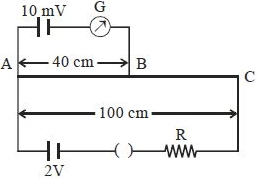

Download our appand get started for free
Experience the future of education. Simply download our apps or reach out to us for more information. Let's shape the future of learning together!No signup needed.*
Similar Questions
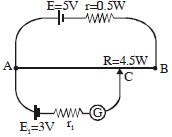
- 1In the given potentiometer circuit length of the wire $AB$ is $3\,m$ and resistance is $R=4.5\,\Omega $. The length $AC$ for no deflection in galvanometer is ............... $m$View Solution
- 2A $10\,m$ long potentiometer wire has a potential gradient of $0.0025\, V/cm$. Calculate the distance of null point when the wire is connected to a $1.025\,V$ standard cell ............... $\mathrm{m}$View Solution
- 3The resistance ofeach arm of the Wheatstone's bridge is $10\; ohm$. A resistance of $10 \;ohm$ is connected in series with a galvanometer then the equivalent resistance across the battery will beView Solution
- 4$A$ uniform copper wire carries a current $i$ amperes and has $p$ carriers per meter$^3$. The length of the wire is $\lambda$ meters and its cross-section area is $s$ meter $^2$. If the charge on a carrier is $q$ coulombs, the drift velocity in $ms^{-1}$ is given byView Solution
- 5If ${R_1}$ and ${R_2}$ are respectively the filament resistances of a $200$ $watt$ bulb and $100$ $watt$ bulb designed to operate on the same voltage, thenView Solution
- 6Two electric bulbs, rated at $(25\, W, 220\, V)$ and $(100\, W, 220\, V)$, are connected in series acroos a $220\, V$ voltage source. If the $25\, W$ and $100\, W$ bulbs draw powers $P_1$ and $P_2$ respectively, thenView Solution
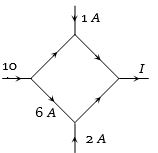
- 7The figure shows a network of currents. The magnitude of currents is shown here. The current $I$ will be ........... $A$View Solution
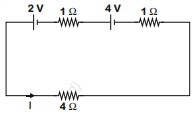
- 8For the circuit shown in the figure, the current $I$ will be .......$A$View Solution
- 9$n$ identical cells are joined in series with two cells $A$ and $B$ with reversed polarities. $emf$ of each cell is $E$ and internal resistance is $r$. Potential difference across cell $A$ and $B$ is : $(n > 4)$View Solution
- 10An electrical circuit consists of ten $100 \,\Omega$ resistors. Out of these $10$ resistors, a group of $n _1$ resistors are connected in parallel and another group of $n _2$ resistors are separately connected in parallel. These two groups are then connected in series and this combination is connected to a voltage source of $100 \,V$. If the net current though the circuit is $2.5 \,A$. The values of $n _1$ and $n _2$ areView Solution