MCQ
A projectile fired with initial velocity $u$ at some angle $\theta $ has a range $R$. If the initial velocity be doubled at the same angle of projection, then the range will be
  • A
    $2R$
  • B
    $R/2$
  • C
    $R$
  • $4R$

Answer

Correct option: D.
$4R$
d
(d) $R = \frac{{{u^2}\sin 2\theta }}{g}$

$\therefore R \propto {u^2}$. If initial velocity be doubled then range will become four times.

Need a full question paper?

Generate a complete, print-ready paper with questions like this in minutes — across 16+ boards, with answer keys.
Start Generating Free

Similar questions

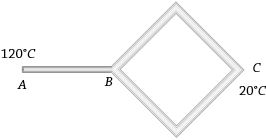
Five identical rods are joined as shown in figure. Point $A$ and $C$ are maintained at temperature $120^o C$ and $20^o C$ respectively. The temperature of junction $B$ will be....... $^oC$
A $50 \;kg$ girl wearing high heel shoes balances on a single heel. The heel is circular with a diameter $1.0 \;cm$. What is the pressure exerted by the heel on the horizontal floor ?
A sphere of mass $10\; kg$ and radius $0.5\; m$ rotates about a tangent. The moment of inertia of the sphere is
Reversibility is not possible because of:
A hemispherical bowl of radius $r$ is set rotating about its axis of symmetry in vertical. A small block kept in the bowl rotates with bowl without slipping on its surface. If the surface of the bowl is smooth and the angle made by the radius through the block with the vertical is $\theta$, then find the angular speed at which the ball is rotating.
A rod of length $2m$ rests on smooth horizontal floor. If the rod is heated from $0^o C$ to $20^o C$. Find the longitudinal strain developed? $(\alpha = 5 × 10^{-5}/^o C)$
The displacement $y(t) = A\,\sin \,(\omega t + \phi )$ of a pendulum for $\phi = \frac {2\pi }{3}$ is correctly represented by
Three harmonic waves having equal frequency $\mathrm{v}$ and same intensity $\mathrm{I}_{0}$, have phase angles $0 , \frac{\pi}{4}$ and $-\frac{\pi}{4}$ respectively. When they are superimposed the intensity of the resultant wave is close to
A particle at the end of a spring executes simple harmonic motion with a period ${t_1}$, while the corresponding period for another spring is ${t_2}$. If the period of oscillation with the two springs in series is $T$, then
The temperature of an object is observed to rise in a period. In this period:
  1. Heat is certainly supplied to it.
  2. Heat is certainly not supplied to it.
  3. Heat may have been supplied to it.
  4. Work may have been done on it.