MCQ
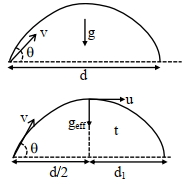
A projectile is fired from horizontal ground with speed $v$ and projection angle $\theta$. When the acceleration due to gravity is $g$, the range of the projectile is $d$. If at the highest point in its trajectory, the projectile enters a different region where the effective acceleration due to gravity is $g^{\prime}=\frac{g}{0.81}$, then the new range is $d^{\prime}=n d$. The value of $n$ is. . . . .
  • A
    $0.40$
  • $0.95$
  • C
    $0.70$
  • D
    $0.80$

Answer

Correct option: B.
$0.95$
b
(image)

$d=\frac{v^2 \sin 2 \theta}{g}$

(image)

$H _{\operatorname{mex}}=\frac{ v ^2 \sin ^2 \theta}{2 g } ; \frac{1}{2} g _{ aff } t ^2= H _{\max } \Rightarrow t ^2=\frac{2 H _{\max }}{ g _{ af }} ; t =\sqrt{\frac{ v ^2 \sin ^2 \theta \times 0.81}{g^2}} ; t =\frac{0.9 v \sin \theta}{ g }$

$t ^2=\frac{2 \times v ^2 \sin ^2 \theta}{2 g \left(\frac{ g }{0.81}\right)}$

$d ^{\prime}=\text { New range }=\frac{d}{2}+ d _1$

$d _1= v \cos \theta^{\circ} t$

$=\frac{ v ^2 \sin ^2 \theta \cos \theta \times 0.9}{ g } ; d ^{\prime}=\frac{ v ^2 \sin 2 \theta}{2 g }+\frac{ v ^2 \sin 2 \theta \times 0.9}{2 g }$

$=\frac{ v ^2 \sin 2 \theta}{ g }\left(\frac{1.0}{2}\right)=0.95 d$

$n =0.95$

Need a full question paper?

Generate a complete, print-ready paper with questions like this in minutes — across 16+ boards, with answer keys.

Start Generating Free

Similar questions

A horizontal platform with an object placed on it is executing $\text{S.H.M.}$ in the vertical direction. The amplitude of oscillation is $3.92 \times 10^{-3}m.$ At what time the object is not detached from the platform?
Energy equals of a mass of one microgram in kilo joules is:
Power supplied to a particle of mass $2\,kg$ varies with time as $P = \frac {3t^2}{2}\,W$ . Here $t$ is in seconds. If velocity of particle at $t = 0$ is $v = 0$ . The velocity of particle at time $t = 2\,sec$ . will be .............. $\mathrm{m}/ \mathrm{s}$
At what temperature is the root mean square velocity of gaseous hydrogen molecules is equal to that of oxygen molecules at $47°C$ ..... $K$
Consider two observers moving with respect to each other at a speed v along a straight line. They observe a bock of mass m moving a distancel on a rough surface. The following quantities will be same as observed by the two observers.
A coin, placed on a rotating turn-table slips, when it is placed at a distance of $9 \,cm$ from the centre. If the angular velocity of the turn-table is trippled, it will just slip, if its distance from the centre is ......... $cm$.
Which of the following pair does not have similar dimensions
$2\, kg$ of ice at $-20°C$ is mixed with $5\, kg$ of water at $20°C$ in an insulating vessel having a negligible heat capacity. Calculate the final mass of water remaining in the container. It is given that the specific heats of water and ice are $1\, kcal/kg\, per °C$ and $0.5\, kcal/kg/°C$ while the latent heat of fusion of ice is $80\, k\,cal/kg$ ........ $kg$
Water has maximum density at
The temperature at which the reading of a Fahrenheit thermometer will be double that of centigrade thermometer is ........ $^o$