MCQ
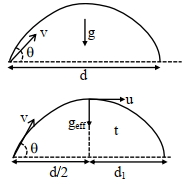
A projectile is fired from horizontal ground with speed $v$ and projection angle $\theta$. When the acceleration due to gravity is $g$, the range of the projectile is $d$. If at the highest point in its trajectory, the projectile enters a different region where the effective acceleration due to gravity is $g^{\prime}=\frac{g}{0.81}$, then the new range is $d^{\prime}=n d$. The value of $n$ is. . . . .
  • A
    $0.40$
  • $0.95$
  • C
    $0.70$
  • D
    $0.80$

Answer

Correct option: B.
$0.95$
b
(image)

$d=\frac{v^2 \sin 2 \theta}{g}$

(image)

$H _{\operatorname{mex}}=\frac{ v ^2 \sin ^2 \theta}{2 g } ; \frac{1}{2} g _{ aff } t ^2= H _{\max } \Rightarrow t ^2=\frac{2 H _{\max }}{ g _{ af }} ; t =\sqrt{\frac{ v ^2 \sin ^2 \theta \times 0.81}{g^2}} ; t =\frac{0.9 v \sin \theta}{ g }$

$t ^2=\frac{2 \times v ^2 \sin ^2 \theta}{2 g \left(\frac{ g }{0.81}\right)}$

$d ^{\prime}=\text { New range }=\frac{d}{2}+ d _1$

$d _1= v \cos \theta^{\circ} t$

$=\frac{ v ^2 \sin ^2 \theta \cos \theta \times 0.9}{ g } ; d ^{\prime}=\frac{ v ^2 \sin 2 \theta}{2 g }+\frac{ v ^2 \sin 2 \theta \times 0.9}{2 g }$

$=\frac{ v ^2 \sin 2 \theta}{ g }\left(\frac{1.0}{2}\right)=0.95 d$

$n =0.95$

Need a full question paper?

Generate a complete, print-ready paper with questions like this in minutes — across 16+ boards, with answer keys.

Start Generating Free

Similar questions

At $NTP$ water boils at $100°C.$ Deep down the mine, water will boil at a temperature
A particle of mass $10 \,g$ is undergoing $S.H.M.$ of amplitude $10 \,cm$ and period $0.1 \,s$. The maximum value of force on particle is about ............ $N$
Work done by $0.1$ mole of a gas at ${27^o}C$ to double its volume at constant pressure is ....... $cal$ ($R = 2 \,cal\, mol^{-1}$ $^oC^{-1}$)
The heart of a man pumps $5$ litres of blood through the arteries per minute at a pressure of $150 \,mm$ of mercury. If the density of mercury be $13.6 \times 10^3\, kg/m^3$ and $g=10\,m/s^2$ then the power (in watt) is 
When a photon stimulates the emission of another photon, the two photons have:
  1. Same energy.
  2. Same direction.
  3. Same phase.
  4. Same wavelength.
  5. All of the above
$C_v$ and $C_p$ denote the molar specific heat capacities of a gas at constant volume and constant pressure, respectively. Then
The ratio of the radius of gyration of a thin uniform disc about an axis passing through its centre and normal to its plane to the radius of gyration of the disc about its diameter is
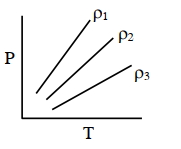
$P-T$ diagram of an ideal gas having three different densities $\rho_1, \rho_2, \rho_3$ (in three different cases) is shown in the figure. Which of the following is correct :
Two particles are executing S.H.M. The equation of their motion are ${y_1} = 10\sin \left( {\omega \,t + \frac{{\pi T}}{4}} \right),$ ${y_2} = 25\sin \,\left( {\omega \,t + \frac{{\sqrt 3 \pi T}}{4}} \right)$. What is the ratio of their amplitude
Which of the following statement is correct