MCQ
A projectile is projected with velocity $k v_e$ in vertically upward direction from the ground into the space. ( $v_e$ is escape velocity and $k<1$ ). If air resistance is considered to be negligible then the maximum height from the centre of earth to which it can go, will be $:(R=$ radius of earth $)$
  • A
    $\frac{R}{k^2+1}$
  • B
    $\frac{R}{k^2-1}$
  • $\frac{R}{1-k^2}$
  • D
    $\frac{R}{k+1}$

Answer

Correct option: C.
$\frac{R}{1-k^2}$
Kinetic energy $=$ Potential energy
$ \frac{1}{2} m\left(k v_e\right)^2=\frac{m g h}{1+\frac{h}{R}}$
$ \Rightarrow \frac{1}{2} m k^2 2 g R=\frac{m g h}{1+\frac{h}{R}} $
$ \Rightarrow h=\frac{R k^2}{1-k^2}$
Height of Projectile from the earth's surface $=h$Height from the centre
$r=R+h=R+\frac{R k^2}{1-k^2}$
By solving $r=\frac{R}{1-k^2}$

Need a full question paper?

Generate a complete, print-ready paper with questions like this in minutes — across 16+ boards, with answer keys.

Start Generating Free

Similar questions

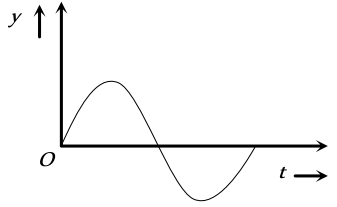
The displacement time graph of a particle executing S.H.M. is as shown in the figureImage
The corresponding force-time graph of the particle is
In an $X$-ray tube electrons bombarding the target produce $X$-rays of minimum wavelength $1 \mathring A$. What must be the energy of bombarding electrons
A body crosses the topmost point of a vertical circle with critica speed. Its centripetal acceleration, when the string is horizontal wil be
A man can see the object between $15 \mathrm{~cm}$ and $30 \mathrm{~cm}$. He uses the lens to see the far objects. Then due to the lens used, the near point will be at
The focal lengths of the objective and eye lenses of a telescope are respectively $200 \mathrm{~cm}$ and $5 \mathrm{~cm}$. The maximum magnifying power of the telescope will be
Maximum and minimum magnitudes of the resultant of two vectors of magnitudes $P$ and $Q$ are in the ratio $3: 1$. Which of the following relations is true
A block of metal is heated to a temperature much higher than the room temperature and allowed to cool in a room free from air currents. Which of the following curves correctly represents the rate of cooling
For an ac circuit $V=15 \sin \omega t$ and $I=20 \cos \omega t$ the average power consumed in this circuit is
If there were a smaller gravitational effect, which of the following forces do you think would alter in some respect
A source and an observer move away from each other with a velocity of $10 \mathrm{~m} / \mathrm{s}$ with respect to ground. If the observer finds the frequency of sound coming from the source as $1950 \mathrm{~Hz}$, then actual frequency of the source is (velocity of sound in air $=340 \mathrm{~m} / \mathrm{s}$ )