MCQ 11 Mark
If the density of a small planet is the same as that of earth, while the radius of the planet is 0.2 times that of the earth, the gravitational acceleration on the surface of that planet is
- ✓
$0.2 \mathrm{~g}$
- B
$0.4 \mathrm{~g}$
- C
$2 g$
- D
$4 g$
AnswerCorrect option: A. $0.2 \mathrm{~g}$
$ g=\frac{4}{3} \pi G R \rho \text { and } g^{\prime}=\frac{4}{3} \pi G R^{\prime} \rho$
$ \therefore \frac{g^{\prime}}{g}=\frac{R^{\prime}}{R}=0.2 \Rightarrow g^{\prime}=0.2\ g$
View full question & answer→MCQ 21 Mark
A person sitting in a chair in a satellite feels weightless because
- A
The earth does not attract the objects in a satellite
- B
The normal force by the chair on the person balances the earth's attraction
- ✓
- D
The person in satellite is not accelerated
View full question & answer→MCQ 31 Mark
A satellite moves round the earth in a circular orbit of radius $R$ making one revolution per day. A second satellite moving in a circular orbit, moves round the earth once in 8 days. The radius of the orbit of the second satellite is
Answer(b) Given that, $T_1=1$ day and $T_2=8$ days
$ \therefore \frac{T_2}{T_1}=\left(\frac{r_2}{r_1}\right)^{3 / 2} \Rightarrow \frac{r_2}{r_1}=\left(\frac{T_2}{T_1}\right)^{2 / 3}=\left(\frac{8}{1}\right)^{2 / 3}=4 $
$ \Rightarrow r_2=4 r_1=4 R$
View full question & answer→MCQ 41 Mark
In an elliptical orbit under gravitational force, in general
- A
Tangential velocity is constant
- B
Angular velocity is constant
- C
Radial velocity is constant
- ✓
Areal velocity is constant
AnswerCorrect option: D. Areal velocity is constant
View full question & answer→MCQ 51 Mark
In the previous question the orbital velocity of the planet will be minimum at
- A
$\mathrm{A}$
- B
$\mathrm{B}$
- ✓
$\mathrm{C}$
- D
$\mathrm{D}$
AnswerCorrect option: C. $\mathrm{C}$
(c) Because distance of point $C$ is maximum from the sun.
View full question & answer→MCQ 61 Mark
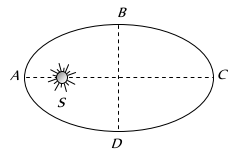
A planet is revolving around the sun as shown in elliptical path
- ✓
The time taken in travelling $DAB$ is less than that for $BCD$
- B
The time taken in travelling $DAB$ is greater than that for $\mathrm{BCD}$
- C
The time taken in travelling $\mathrm{CDA}$ is less than that for $\mathrm{ABC}$
- D
The time taken in travelling $\mathrm{CDA}$ is greater than that for $\mathrm{ABC}$
AnswerCorrect option: A. The time taken in travelling $DAB$ is less than that for $BCD$
During path $D A B$ planet is nearer to sun as comparison with path $B C D$. So time taken in travelling $D A B$ is less than that for $B C D$ because velocity of planet will be more in region $D A B$.
View full question & answer→MCQ 71 Mark
The distance of a planet from the sun is 5 times the distance between the earth and the sun. The time period of the planet is
- ✓
$5^{3 / 2}$ years
- B
$5^{2 / 3}$ years
- C
$5^{1 / 3}$ years
- D
$5^{1 / 2}$ years
AnswerCorrect option: A. $5^{3 / 2}$ years
View full question & answer→MCQ 81 Mark
A geo-stationary satellite is orbiting the earth at a height of $6 R$ above the surface of earth, $R$ being the radius of earth. The time period of another satellite at a height of $2.5 R$ from the surface of earth is
- A
$10 \mathrm{hr}$
- B
$(6 / \sqrt{2}) h r$
- C
$6 \mathrm{hr}$
- ✓
$6 \sqrt{2} h r$
AnswerCorrect option: D. $6 \sqrt{2} h r$
(d) Distances of the satellite from the centre are $7 R$ and $3.5 R$ respectively.
$\frac{T_2}{T_1}=\left(\frac{R_2}{R_1}\right)^{3 / 2} \Rightarrow T_2=24\left(\frac{3.5 R}{7 R}\right)^{3 / 2}=6 \sqrt{2} h r$
View full question & answer→MCQ 91 Mark
Suppose the law of gravitational attraction suddenly changes and becomes an inverse cube law i.e. $F \propto 1 / r^3$, but still remaining a central force. Then
- A
Keplers law of areas still holds
- B
Keplers law of period still holds
- C
Keplers law of areas and period still hold
- ✓
Neither the law of areas, nor the law of period still holds
AnswerCorrect option: D. Neither the law of areas, nor the law of period still holds
View full question & answer→MCQ 101 Mark
A mass of $6 \times 10^{24} \mathrm{~kg}$ is to be compressed in a sphere in such a way that the escape velocity from the sphere is $3 \times 10^8 \mathrm{~m} / \mathrm{s}$. Radius of the sphere should be $\left(G=6.67 \times 10^{-11} \mathrm{~N}-\mathrm{m}^2 / \mathrm{kg}^2\right)$
- A
$9 \mathrm{~km}$
- B
$9 \mathrm{~m}$
- C
$9 \mathrm{~cm}$
- ✓
$9 \mathrm{~mm}$
AnswerCorrect option: D. $9 \mathrm{~mm}$
$v_e=\sqrt{\frac{2 G M}{R}}=\sqrt{\frac{2 \times 6.67 \times 10^{-11} \times 6 \times 10^{24}}{R}}=3 \times 10^8$
By solving $R=9 mm$
View full question & answer→MCQ 111 Mark
A body weight $W$ newton at the surface of the earth. Its weight at a height equal to half the radius of the earth will be
- A
$\frac{W}{2}$
- B
$\frac{2 W}{3}$
- ✓
$\frac{4 W}{9}$
- D
$\frac{8 W}{27}$
AnswerCorrect option: C. $\frac{4 W}{9}$
(c) $g^{\prime}=g\left(\frac{R}{R+h}\right)^2=\frac{4}{9} g \quad \therefore W^{\prime}=\frac{4}{9} W$
View full question & answer→MCQ 121 Mark
The escape velocity of a rocket launched from the surface of the earth
- ✓
Does not depend on the mass of the rocket
- B
Does not depend on the mass of the earth
- C
Depends on the mass of the planet towards which it is moving
- D
Depends on the mass of the rocket
AnswerCorrect option: A. Does not depend on the mass of the rocket
View full question & answer→MCQ 131 Mark
Gas escapes from the surface of a planet because it acquires an escape velocity. The escape velocity will depend on which of the following factors : $1$. Mass of the planet $II$. Mass of the particle escaping III. Temperature of the planet $IV$. Radius of the planet Select the correct answer from the codes given below :
- A
$1$ and $11$
- B
$11$ and $ IV$
- ✓
$1$ and $IV$
- D
$I, III$ and $IV$
AnswerCorrect option: C. $1$ and $IV$
$1$ and $IV$
View full question & answer→MCQ 141 Mark
At the surface of a certain planet, acceleration due to gravity is onequarter of that on earth. If a brass ball is transported to this planet, then which one of the following statements is not correct
- ✓
The mass of the brass ball on this planet is a quarter of its mass as measured on earth
- B
The weight of the brass ball on this planet is a quarter of the weight as measured on earth
- C
The brass ball has the same mass on the other planet as on earth
- D
The brass ball has the same volume on the other planet as on earth
AnswerCorrect option: A. The mass of the brass ball on this planet is a quarter of its mass as measured on earth
(a) Mass of the ball always remain constant. It does not depend upon the acceleration due to gravity
View full question & answer→MCQ 151 Mark
If it is assumed that the spinning motion of earth increases, then the weight of a body on equator
Answer(a) $g^{\prime}=g-\omega^2 R$, when $\omega$ increases $g^{\prime}$ decreases.
View full question & answer→MCQ 161 Mark
If $g \propto \frac{1}{R^3}$ (instead of $\frac{1}{R^2}$ ), then the relation between time period of a satellite near earth's surface and radius $R$ will be
- A
$T^2 \propto R^3$
- ✓
$T \propto R^2$
- C
$T^2 \propto R$
- D
$T \propto R$
AnswerCorrect option: B. $T \propto R^2$
(b) Gravitational force provides the required centripetal force$m \omega^2 R=\frac{G M m}{R^3} \Rightarrow \frac{4 \pi^2}{T^2}=\frac{G M}{R^4} \Rightarrow T \propto R^2$
View full question & answer→MCQ 171 Mark
If the radius and acceleration due to gravity both are doubled, escape velocity of earth will become
- A
$11.2 \mathrm{~km} / \mathrm{s}$
- ✓
$22.4 \mathrm{~km} / \mathrm{s}$
- C
$5.6 \mathrm{~km} / \mathrm{s}$
- D
$44.8 \mathrm{~km} / \mathrm{s}$
AnswerCorrect option: B. $22.4 \mathrm{~km} / \mathrm{s}$
(b) $v=\sqrt{2 g R}$. If $g$ and $R$ both are doubled then $v$ will becomes two times i.e. $11.2 \times 2=22.4 km / s$
View full question & answer→MCQ 181 Mark
Reason of weightlessness in a satellite is
- A
- B
- ✓
Zero reaction force by satellite surface
- D
AnswerCorrect option: C. Zero reaction force by satellite surface
View full question & answer→MCQ 191 Mark
If satellite is shifted towards the earth. Then time period of satellite will be
Answer(b) $T^2 \propto r^3$
View full question & answer→MCQ 201 Mark
How many times is escape velocity $\left(V_e\right)$, of orbital velocity $\left(V_0\right)$ for a satellite revolving near earth
AnswerCorrect option: A. $\sqrt{2}$ times
View full question & answer→MCQ 211 Mark
Two identical satellites are at $R$ and $7 R$ away from earth surface, the wrong statement is ( $R=$ Radius of earth)
- A
Ratio of total energy will be $4$
- B
Ratio of kinetic energies will be $4$
- C
Ratio of potential energies will be $4$
- ✓
Ratio of total energy will be $4$ but ratio of potential and kinetic energies will be $2$
AnswerCorrect option: D. Ratio of total energy will be $4$ but ratio of potential and kinetic energies will be $2$
Orbital radius of satellites
$r_1=R+R=2 R$
$r_2=R+7 R=8 R$
$ U_1=\frac{-G M m}{r_1} \text { and } U_2=\frac{-G M m}{r_2} $
$ K_1=\frac{G M m}{2 r_1}\text { and } K_2=\frac{G M m}{2 r_2} $
$ E_1=\frac{G M m}{2 r_1} \text { and} E_2=\frac{G M m}{2 r_2} $
$ \therefore \frac{U_1}{U_2}=\frac{K_1}{K_2}=\frac{E_1}{E_2}=4$
View full question & answer→MCQ 221 Mark
Radius of earth is around $6000 \mathrm{~km}$. The weight of body at height of $6000 \mathrm{~km}$ from earth surface becomes
Answer(b) $g^{\prime}=g\left(\frac{R}{R+h}\right)^2 \Rightarrow$ when $h=R$ then $g^{\prime}=\frac{g}{4}$So the weight of the body at this height will become onefourth.
View full question & answer→MCQ 231 Mark
The gravitational force $F_g$ between two objects does not depend on
- ✓
- B
- C
- D
Distance between the masses
View full question & answer→MCQ 241 Mark
If acceleration due to gravity on the surface of a planet is two times that on surface of earth and its radius is double that of earth. Then escape velocity from the surface of that planet in comparison to earth will be
Answer(a) $v=\sqrt{2 g R}$. If acceleration due to gravity and radius of the planet, both are double that of earth then escape velocity will be two times. i.e. $v_p=2 v_e$
View full question & answer→MCQ 251 Mark
What will be the acceleration due to gravity at height $h$ if $h \gg R$. Where $R$ is radius of earth and $g$ is acceleration due to gravity on the surface of earth
- ✓
$\frac{g}{\left(1+\frac{h}{R}\right)^2}$
- B
$g\left(1-\frac{2 h}{R}\right)$
- C
$\frac{g}{\left(1-\frac{h}{R}\right)^2}$
- D
$g\left(1-\frac{h}{R}\right)$
AnswerCorrect option: A. $\frac{g}{\left(1+\frac{h}{R}\right)^2}$
(a) $g^{\prime}=g\left(\frac{R}{R+h}\right)^2=\frac{g}{\left(1+\frac{h}{R}\right)^2}$
View full question & answer→MCQ 261 Mark
If mass of a satellite is doubled and time period remain constant the ratio of orbit in the two cases will be
- A
$1: 2$
- ✓
$1: 1$
- C
$1: 3$
- D
AnswerCorrect option: B. $1: 1$
(b) Mass of satellite does not affects on orbital radius.
View full question & answer→MCQ 271 Mark
What is the intensity of gravitational field of the centre of a spherical shell
MCQ 281 Mark
At what height from the ground will the value of ' $g$ ' be the same as that in $10 \mathrm{~km}$ deep mine below the surface of earth
- ✓
$20 \mathrm{~km}$
- B
$10 \mathrm{~km}$
- C
$15 \mathrm{~km}$
- D
$5 \mathrm{~km}$
AnswerCorrect option: A. $20 \mathrm{~km}$
(a) Same change in the value of $g$ can be observed at a depth $x$ and height $2 x$given $d=x=10 \ km $
$\therefore h=2 x=20\ km$
View full question & answer→MCQ 291 Mark
A planet revolves around sun whose mean distance is $1.588$ times the mean distance between earth and sun. The revolution time of planet will be
- A
$1.25$ years
- B
$1.59$ years
- C
$0.89$ years
- ✓
$2$ years
AnswerCorrect option: D. $2$ years
$\frac{T_{\text {plant }}}{T_{\text {earth }}}=\left(\frac{r_{\text {plant }}}{r_{\text {earth }}}\right)^{3 / 2}=(1.588)^{3 / 2}=2$
$ \therefore T_{\text {planet }}=2$ year
View full question & answer→MCQ 301 Mark
A rocket is launched with velocity $10 \mathrm{~km} / \mathrm{s}$. If radius of earth is $R$, then maximum height attained by it will be
- A
$2 R$
- B
$3 R$
- ✓
$4 R$
- D
$5 R$
View full question & answer→MCQ 311 Mark
If mass of earth is $M$, radius is $R$ and gravitational constant is $G$, then work done to take $1 \mathrm{~kg}$ mass from earth surface to infinity will be
- A
$\sqrt{\frac{G M}{2 R}}$
- ✓
$\frac{G M}{R}$
- C
$\sqrt{\frac{2 G M}{R}}$
- D
$\frac{G M}{2 R}$
AnswerCorrect option: B. $\frac{G M}{R}$
(b) Potential energy of the $1 kg$ mass which is placed at the earth$\text { surface }=-\frac{G M}{R}$its potential energy at infinite $=0$$\therefore \text { Work done }=\text { change in potential energy }=\frac{G M}{R}$
View full question & answer→MCQ 321 Mark
Weight of $1 \mathrm{~kg}$ becomes $1 / 6$ on moon. If radius of moon is $1.768 \times 10^6 \mathrm{~m}$, then the mass of moon will be
- A
$1.99 \times 10^{30} \mathrm{~kg}$
- B
$7.56 \times 10^{22} \mathrm{~kg}$
- C
$5.98 \times 10^{24} \mathrm{~kg}$
- ✓
$7.65 \times 10^{22} \mathrm{~kg}$
AnswerCorrect option: D. $7.65 \times 10^{22} \mathrm{~kg}$
(d)$g_m=\frac{G M_m}{R_m^2}$ and $g_m=\frac{g_e}{6}=\frac{9.8}{6} m / s ^2=1.63 m / s ^2$
Substituting $R_m=1.768 \times 10^6 m , g_m=1.63 m / s ^2$ and $G=6.67 \times 10^{-11} N - m ^2 / kg ^2$
We get$M_m=7.65 \times 10^{22}\ kg$
View full question & answer→MCQ 331 Mark
Where will it be profitable to purchase 1 kilogram sugar
- A
- ✓
- C
At $45^{\circ}$ latitude
- D
At $40^{\circ}$ latitude
Answer(b) Weight is least at the equator.
View full question & answer→MCQ 341 Mark
In order to make the effective acceleration due to gravity equal to zero at the equator, the angular velocity of rotation of the earth about its axis should be $\left(g=10 \mathrm{~ms}^{-2}\right.$ and radius of earth is $6400 \ \mathrm{kms})$
- A
$0$ rad sec ${ }^{-1}$
- ✓
$\frac{1}{800} \mathrm{rad\ sec}^{-1}$
- C
$\frac{1}{80} \mathrm{rad\ sec}^{-1}$
- D
$\frac{1}{8} \mathrm{rad\ sec}^{-1}$
AnswerCorrect option: B. $\frac{1}{800} \mathrm{rad\ sec}^{-1}$
$g^{\prime}=g-\omega^2 R \cos ^2 \lambda$
For weightlessness at equator $\lambda=0$ and $g^{\prime}=0$
$\therefore 0=g-\omega^2 R \Rightarrow \omega=\sqrt{\frac{g}{R}}=\frac{1}{800} \frac{\mathrm{rad}}{\mathrm{s}}$
View full question & answer→MCQ 351 Mark
A projectile is projected with velocity $k v_e$ in vertically upward direction from the ground into the space. ( $v_e$ is escape velocity and $k<1$ ). If air resistance is considered to be negligible then the maximum height from the centre of earth to which it can go, will be $:(R=$ radius of earth $)$
- A
$\frac{R}{k^2+1}$
- B
$\frac{R}{k^2-1}$
- ✓
$\frac{R}{1-k^2}$
- D
$\frac{R}{k+1}$
AnswerCorrect option: C. $\frac{R}{1-k^2}$
Kinetic energy $=$ Potential energy
$ \frac{1}{2} m\left(k v_e\right)^2=\frac{m g h}{1+\frac{h}{R}}$
$ \Rightarrow \frac{1}{2} m k^2 2 g R=\frac{m g h}{1+\frac{h}{R}} $
$ \Rightarrow h=\frac{R k^2}{1-k^2}$
Height of Projectile from the earth's surface $=h$Height from the centre
$r=R+h=R+\frac{R k^2}{1-k^2}$
By solving $r=\frac{R}{1-k^2}$
View full question & answer→MCQ 361 Mark
A satellite is moving around the earth with speed $v$ in a circular orbit of radius $r$ : If the orbit radius is decreased by $1 \%$, its speed will
- A
Increase by $1 \%$
- ✓
Increase by $0.5 \%$
- C
Decrease by $1 \%$
- D
Decrease by $0.5 \%$
AnswerCorrect option: B. Increase by $0.5 \%$
$v \propto \frac{1}{\sqrt{r}} . $
$\% \text { increase in speed }=\frac{1}{2} \quad(\% \text { decrease in radius }) $
$ =\frac{1}{2}(1 \%)=0.5 \%$
i.e. speed will increase by $0.5 \%$
View full question & answer→MCQ 371 Mark
At what depth below the surface of the earth, acceleration due to gravity $g$ will be half its value $1600 \mathrm{~km}$ above the surface of the earth
- ✓
$4.2 \times 10^6 \mathrm{~m}$
- B
$3.19 \times 10^6 \mathrm{~m}$
- C
$1.59 \times 10^6 \mathrm{~m}$
- D
AnswerCorrect option: A. $4.2 \times 10^6 \mathrm{~m}$
Radius of earth $R=6400 km $
$\therefore h=\frac{R}{4}$Acceleration due to gravity at a height $h$$g_h=g\left(\frac{R}{R+h}\right)^2=g\left(\frac{R}{R+\frac{R}{4}}\right)^2=\frac{16}{25} g$
At depth ' $d$ value of acceleration due to gravity
$ g_d=\frac{1}{2} g_h \quad \text { (According to problem) }$
$\Rightarrow g_d=\frac{1}{2}\left(\frac{16}{25}\right) g \Rightarrow g\left(1-\frac{d}{R}\right)=\frac{1}{2}\left(\frac{16}{25}\right) g$
(According to problem)
By solving we get $d=4.3 \times 10^6 m$
View full question & answer→MCQ 381 Mark
If the density of the earth is doubled keeping its radius constant then acceleration due to gravity will be $\left(g=9.8 \mathrm{~m} / \mathrm{s}^2\right)$
- ✓
$19.6 \mathrm{~m} / \mathrm{s}^2$
- B
$9.8 \mathrm{~m} / \mathrm{s}^2$
- C
$4.9 \mathrm{~m} / \mathrm{s}^2$
- D
$2.45 \mathrm{~m} / \mathrm{s}^2$
AnswerCorrect option: A. $19.6 \mathrm{~m} / \mathrm{s}^2$
(a) $g \propto \rho$
View full question & answer→MCQ 391 Mark
If the mass of earth is $80$ times of that of a planet and diameter is double that of planet and ' $g$ ' on earth is $9.8 \mathrm{~m} / \mathrm{s}^2$, then the value of ' $g$ ' on that planet is
- A
$4.9 \mathrm{~m} / \mathrm{s}^2$
- B
$0.98 \mathrm{~m} / \mathrm{s}^2$
- ✓
$0.49 \mathrm{~m} / \mathrm{s}^2$
- D
$49 \mathrm{~m} / \mathrm{s}^2$
AnswerCorrect option: C. $0.49 \mathrm{~m} / \mathrm{s}^2$
$ g_p=g_e\left(\frac{M_p}{M_e}\right)\left(\frac{R_e}{R_p}\right)^2=9.8\left(\frac{1}{80}\right)(2)^2 $
$ =9.8 / 20=0.49 \ m / s ^2$
View full question & answer→MCQ 401 Mark
Two satellites $A$ and $B$ go round a planet in circular orbits having radii $4 R$ and $R$, respectively. If the speed of satellite $A$ is $3 v$, then speed of satellite $B$ is
- A
$\frac{3 v}{2}$
- B
$\frac{4 v}{2}$
- ✓
$6\ v$
- D
$12\ v$
AnswerCorrect option: C. $6\ v$
$ \frac{v_B}{v_A}=\sqrt{\frac{r_A}{r_B}}=\sqrt{\frac{4 R}{R}}=2 $
$ \Rightarrow v_B=2 \times v_A=2 \times 3 v=6\ v$
View full question & answer→MCQ 411 Mark
A satellite is to revolve round the earth in a circle of radius 8000 $\mathrm{km}$. The speed at which this satellite be projected into an orbit, will be
- A
$3 \mathrm{~km} / \mathrm{s}$
- B
$16 \mathrm{~km} / \mathrm{s}$
- ✓
$7.15 \mathrm{~km} / \mathrm{s}$
- D
$8 \mathrm{~km} / \mathrm{s}$
AnswerCorrect option: C. $7.15 \mathrm{~km} / \mathrm{s}$
(c) $v_0=\sqrt{\frac{G M}{r}}=\sqrt{\frac{g R^2}{r}}=\sqrt{\frac{10 \times\left(64 \times 10^5\right)^2}{8000 \times 10^3}}$
$=71.5 \times 10^2 \mathrm{~m} / \mathrm{s}=7.15 \mathrm{~km} / \mathrm{s}$
View full question & answer→MCQ 421 Mark
A body weight $500 \mathrm{~N}$ on the surface of the earth. How much would it weigh half way below the surface of the earth
- A
$125 \mathrm{~N}$
- ✓
$250 \mathrm{~N}$
- C
$500 \mathrm{~N}$
- D
$1000 \mathrm{~N}$
AnswerCorrect option: B. $250 \mathrm{~N}$
(b) Weight on surface of earth, $m g=500 N$and weight below the surface of earth at $d=\frac{R}{2}$
$m g^{\prime}=m g\left(1-\frac{d}{R}\right)=m g\left(1-\frac{1}{2}\right)=\frac{m g}{2}=250 N$
View full question & answer→MCQ 431 Mark
Distance of geostationary satellite from the surface of earth radius ( $R_e=6400 km$ ) in terms of $R_e$ is
- A
$13.76 R_e$
- B
$10.76 R_e$
- ✓
$6.56 R_e$
- D
$2.56 R_e$
AnswerCorrect option: C. $6.56 R_e$
View full question & answer→MCQ 441 Mark
What should be the angular speed of earth, so that body lying on equator may appear weightlessness$\left(g=10 \mathrm{~m} / \mathrm{s}^2, R=6400 \mathrm{~km}\right)$
- ✓
$\frac{1}{800} \mathrm{rad} / \mathrm{s}$
- B
$\frac{1}{400} \mathrm{rad} / \mathrm{s}$
- C
$\frac{1}{600} \mathrm{rad} / \mathrm{s}$
- D
$\frac{1}{100} \mathrm{rad} / \mathrm{s}$
AnswerCorrect option: A. $\frac{1}{800} \mathrm{rad} / \mathrm{s}$
(a) $g^{\prime}=g-\omega^2 R \cos ^2 \lambda$For weightlessness at equator $\lambda=0^{\circ}$ and $g^{\prime}=0$
$\therefore 0=g-\omega^2 R \Rightarrow \omega=\sqrt{\frac{g}{R}}=\frac{1}{800} \frac{ rad }{ sec }$
View full question & answer→MCQ 451 Mark
A particle falls towards earth from infinity. It's velocity on reaching the earth would be
- A
- ✓
$\sqrt{2 g R}$
- C
$2 \sqrt{g R}$
- D
AnswerCorrect option: B. $\sqrt{2 g R}$
(b) This should be equal to escape velocity i.e. $\sqrt{2 g R}$
View full question & answer→MCQ 461 Mark
According to Kepler's law the time period of a satellite varies with its radius as
AnswerCorrect option: A. $T^2 \propto R^3$
View full question & answer→MCQ 471 Mark
Which one of the following statements regarding artificial satellite of the earth is incorrect
AnswerCorrect option: A. The orbital velocity depends on the mass of the satellite
View full question & answer→MCQ 481 Mark
A satellite which is geostationary in a particular orbit is taken to another orbit. Its distance from the centre of earth in new orbit is $2$ times that of the earlier orbit. The time period in the second orbit is
- A
$4.8$ hours
- ✓
$48 \sqrt{2}$ hours
- C
$24$ hours
- D
$24 \sqrt{2}$ hours
AnswerCorrect option: B. $48 \sqrt{2}$ hours
$T \propto r^{3 / 2}$. If $r$ becomes double then time period will becomes $(2)$ times.
So new time period will be $24 \times 2 \sqrt{2}$ hr i.e. $T=48 \sqrt{2}$
View full question & answer→MCQ 491 Mark
Two satellites of masses $m_1$ and $m_2\left(m_1>m_2\right)$ are revolving round the earth in circular orbits of radius $r_1$ and $r_2\left(r_1>r_2\right)$ respectively. Which of the following statements is true regarding their speeds $v_1$ and $v_2$ ?
AnswerCorrect option: B. $v_1<v_2$
$v_1<v_2$
View full question & answer→MCQ 501 Mark
The escape velocity for a rocket from earth is $11.2 \mathrm{~km} / \mathrm{sec}$. Its value on a planet where acceleration due to gravity is double that on the earth and diameter of the planet is twice that of earth will be in $\mathrm{km} / \mathrm{sec}$
- A
$11.2$
- B
$5.6$
- ✓
$22.4$
- D
$53.6$
AnswerCorrect option: C. $22.4$
$ \frac{v_p}{v_e}=\sqrt{\frac{g_p}{g_e} \times \frac{R_p}{R_e}}=\sqrt{2 \times 2}=2 $
$ \Rightarrow v_p=2 \times v_e=2 \times 11.2=22.4\ km / s$
View full question & answer→