MCQ
A projectile is thrown with some initial velocity at an angle $\alpha$ to the horizontal. Its velocity when it is at the highest point is $(2 / 5)^{1 / 2}$ times the velocity when it is at height half of the maximum height. Find the angle of projection $\alpha$ with the horizontal.
  • A
    $30$
  • B
    $45$
  • $60$
  • D
    $37$

Answer

Correct option: C.
$60$
c
(c)

$(u \cos \alpha)=\sqrt{\frac{2}{5}} \sqrt{\left(u \cos \alpha^2\right)+\left\{(u \sin \alpha)^2-2 g h\right\}}$

Here, $h=\frac{H}{2}=\frac{u^2 \sin ^2 \alpha}{4 g}$

Solving this equation, we get $\alpha=60^{\circ}$

Need a full question paper?

Generate a complete, print-ready paper with questions like this in minutes — across 16+ boards, with answer keys.

Start Generating Free

Similar questions

In the equation $\left[X+\frac{a}{Y^2}\right][Y-b]= R T, X$ is pressure, $Y$ is volume, $R$ is universal gas constant and $T$ is temperature. The physical quantity equivalent to the ratio $\frac{a}{b}$ is
The equation of state of some gases can be expressed as $\left( {P + \frac{a}{{{V^2}}}} \right) = \frac{{b\theta }}{l}$ Where $P$ is the pressure, $V$ the volume, $\theta $ the absolute temperature and $a$ and $b$ are constants. The dimensional formula of $a$ is
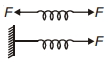
Figure shows two cases. In first case a spring (spring constant $K$ ) is pulled by two equal and opposite forces $F$ at both ends and in second case is pulled by a force $F$ at one end. Extensions $(x)$ in the springs will be
Velocity of transverse wave in stretched string doesn't depend on:
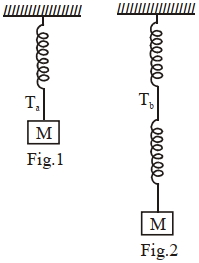
Consider two identical springs each of spring constant $k$ and negligible mass compared to the mass $M$ as shown. Fig. $1$ shows one of them and Fig. $2$ shows their series combination. The ratios of time period of oscillation of the two $SHM$ is $\frac{ T _{ b }}{ T _{ a }}=\sqrt{ x },$ where value of $x$ is

(Round off to the Nearest Integer)

$y = 2\, (cm)\, sin\,\left[ {\frac{{\pi t}}{2} + \phi } \right]$ what is the maximum acceleration of the particle doing the $S.H.M.$
Water falls from a height $500m$. What is the rise in temperature of water at bottom if whole energy remains in the water ........... $^\circ \mathrm{C}$
An object of mass $0.2 \mathrm{~kg}$ executes simple harmonic motion along $\mathrm{x}$ axis with frequency of $\left(\frac{25}{\pi}\right) \mathrm{Hz}$. At the position $\mathrm{x}=0.04 \mathrm{~m}$ the object has kinetic energy $0.5 \mathrm{~J}$ and potential energy $0.4 \mathrm{~J}$ The amplitude of oscillation is ............ cm.
A body, thrown upwards with some velocity reaches the maximum height of $50 m$. Another body with double the mass thrown up with double the initial velocity will reach a maximum height of $..........\,m$
A body weighs $144 \,N$ at the surface of earth. When it is taken to a height of $h=3 \,R$, where $R$ is radius of earth, it would weigh .......... $N$