Question
A proton and a deuteron are both accelerated through the same potential difference and enter in a magnetic field perpendicular to the direction of the field. If the deuteron follows a path of radius $R ,$ assuming the neutron and proton masses are nearly equal, the radius of the proton' s path will be

Answer

As charge on both proton and deuteron is same i.e. $'e'$

Energy acquired by both, $E=e V$ For Deuteron.

Kinetic energy, $\frac{1}{2} m V^{2}=e V$

[ $V$ is the potential difference]

$v = \sqrt {\frac{{2eV}}{{{m_d}}}} $

But $m_{d}=2 m$

Therefore, $v=\sqrt{\frac{2 e V}{2 m}}=\sqrt{\frac{e V}{m}}$

Radius of path, $R=\frac{m v}{e B}$

Substituting value of $'V'$ we get

$R = \frac{{2m\sqrt {\frac{{ev}}{m}} }}{{eB}}$

$\frac{R}{2}=\frac{m \sqrt{\frac{e v}{m}}}{e B}$  .... $(i)$

For proton :

$\frac{1}{2} m V^{2}=e V$

$v=\sqrt{\frac{2 e V}{m}}$

Radius of path,  $R' = \frac{{mV}}{{eB}} = \frac{{m\sqrt {\frac{{2eV}}{m}} }}{{eB}}$

$R = \sqrt 2  \times \frac{R}{2}$  [From eq. $(i)$ ]

$R' = \frac{R}{{\sqrt 2 }}$
Need a full question paper?

Generate a complete, print-ready paper with questions like this in minutes — across 16+ boards, with answer keys.

Start Generating Free

Similar questions

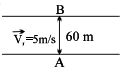
A man is crossing a river flowing with velocity of $5\,\, m/s$. He reaches a point directly across at a distance of $60\,\, m$ in $5 \,\,sec$. His velocity in still water should be ........ $m/s$
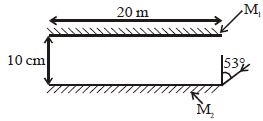
Two plane mirrors $M_1$ and $M_2$ have a length of $20\,m$ each and are $10\,cm$ apart. A ray of light is incident on one end of mirror $M_2$ at an angle of $53^o$. The number of reflections light undergoes before reaching the other end is
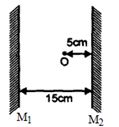
Two plane mirrors are parallel to each other and an object $O$ is placed between them. Then the distance of the first three images from the mirror $M_2$ ​ will be (in $cm$)
Two satellites, $A$ and $B,$ have masses $m$ and $2\,m$ respectively. $A$ is in a circular orbit of radius $R,$ and $B$ is in a circular orbit of radius $2R$ around the earth. The ratio of their kinetic energies, $K.E._A / K.E._B ,$ is
In a balanced Wheatstone’s network, the resistances in the arms $Q$ and $S$ are interchanged. As a result of this
A hollow sphere of mass $1 \,kg$ and radius $10 \,cm$ is free to rotate about its diameter. If a force of $30 \,N$ is applied tangentially to it, its angular acceleration is (in $rad / s ^2$ )
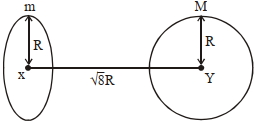
Find the gravitational force of attraction between the ring and sphere as shown in the diagram, where the plane of the ring is perpendicular to the line joining the centres. If $\sqrt{8}\, R$ is the distance between the centres of a $mng$ (of mass ' $m$ ) and a sphere (mass ' $M$ ) where both have equal radius $'R'.$
The average translational kinetic energy of ${O_2}$ (molar mass $32$) molecules at a particular temperature is $ 0.048\, eV.$ The translational kinetic energy of ${N_2}$ (molar mass $28$) molecules in $eV$ at the same temperature is
The magnetic induction at any point due to a long straight wire carrying a current is
Two spherical nuclei have mass numbers $216$ and $64$ with their radii $R_1$ and $R _2$ respectively. The ratio, $\frac{R_1}{R_2}$ is equal to