In a balanced Wheatstone’s network, the resistances in the arms $Q$ and $S$ are interchanged. As a result of this
Easy


Download our appand get started for free
Experience the future of education. Simply download our apps or reach out to us for more information. Let's shape the future of learning together!No signup needed.*
Similar Questions
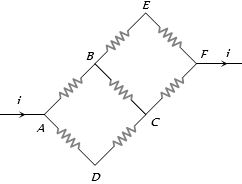
- 1In the adjoining circuit diagram each resistance is of $10$ $\Omega$. The current in the arm $AD$ will beView Solution
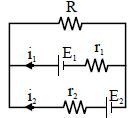
- 2View SolutionSee the electrical circuit shown in the adjoining figure. Which of the following equation is a correct equation for it
- 3View SolutionA constant voltage is applied between two ends of a metallic wire. If the length is halved and the radius of the wire is doubled, the rate of heat developed in the wire will be
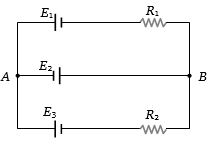
- 4In the circuit shown here, $E_1 = E_2 = E_3 = 2 V$ and $R_1 = R_2 = 4\,ohms$. The current flowing between points $A$ and $B$ through battery $E_2$ isView Solution
- 5Three copper wires of lengths and cross sectional areas are $(l,\,A),\,(2l,\,A/2)$ and $(l/2,\, 2A)$ . Resistance is minimum inView Solution
- 6In a neon discharge tube $2.9 \times {10^{18}}\,N{e^ + }$ ions move to the right each second while $1.2 \times {10^{18}}$ electrons move to the left per second. Electron charge is $1.6 \times {10^{ - 19}}\,C$. The current in the discharge tubeView Solution
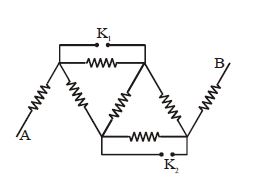
- 7All wires have same resistance and equivalent resistance between $A$ and $B$ is $R$. Now keys are closed, then the equivalent resistance will becomeView Solution
- 8Heater of electric kettle is made of a wire of length $L$ and diameter $d$. It takes $4$ minutes to raise the temperature of $0.5 \ kg$ water by $40\ K$. This heater is replaced by a new heater having two wires of the same material, each of length $L$ and diameter $2 d$. The way these wires are connected is given in the options. How much time in minutes will it take to raise the temperature of the same amount of water by $40K$ ?View Solution
$(A)$ $4$ if wires are in parallel
$(B)$ $2$ if wires are in series
$(C)$ $1$ if wires are in series
$(D)$ $0.5$ if wires are in parallel.
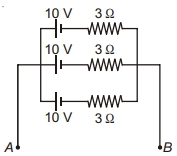
- 9Three identical cells are connected in parallel across $A B$. Net emf across $A B$ is .......... $V$View Solution
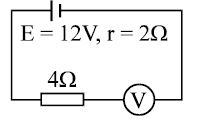
- 10By error, a student places moving-coil voltmeter $V$ (nearly ideal) in series with the resistance in a circuit in order to read the current, as shown. The voltmeter reading will be ............ $V$View Solution