Question
A proton and an a particle are accelerated through the same potential difference. Which one of the two has (i) greater de-Broglie wavelength, and (ii) less kinetic energy? Justify your answer.

Answer

  1. $\lambda =\frac{\text{h}}{\text{p}} =\frac{\text{h}}{\sqrt{2\text{mqV}}}$
$\because(\text{mq}) \text{is more for }\alpha - \text{particle} , \text{we have}$
$\lambda_{proton} > \lambda_{\propto} - particle$
(Also, $\frac{\lambda_{proton}}{\lambda_{\alpha}} =2\sqrt{2}(\text{ or }\sqrt{8} ) $
  1. K.E. = q V
$\because $q is less for proton, we have
$(\text{K.}\text{E} )_{proton} < (\text{K.}\text{E} )_{\alpha - particle}$
$\text{Also},\frac{(\text{K.E.})\propto}{(\text{K.E.})_{\rho}} = 2 ) $.

Need a full question paper?

Generate a complete, print-ready paper with questions like this in minutes — across 16+ boards, with answer keys.

Start Generating Free

Similar questions

Calculate the bulk modulus of air from the following data about a sound wave of wavelength $35\ cm$ travelling in air. The pressure at a point varies between $(1.0\times10^5\pm14)$ Pa and the particles of the air vibrate in simple harmonic motion of amplitude $5.5 \times 10^{-6}m.$
Can a process on an ideal gas be both adiabatic and isothermal?
Three sources of sound $S_1, S_2$ and $S_3$ of equal intensity are placed in a straight line with $S_1S_2 = S_2S_3$ figure. At a point $P,$ far away from the sources, the wave coming from $S$ is $120^\circ$ ahead in phase of that from $S_1.$ Also, the wave coming from $S_3$ is $120^\circ$ ahead of that from $S_2.$ What would be the resultant intensity of sound at $P$?
Calculate the radius of curvature of an equi$-$concave lens of refractive index $1.5,$ when it is kept in a medium of refractive index $1.4,$ to have a power of $-5D?$
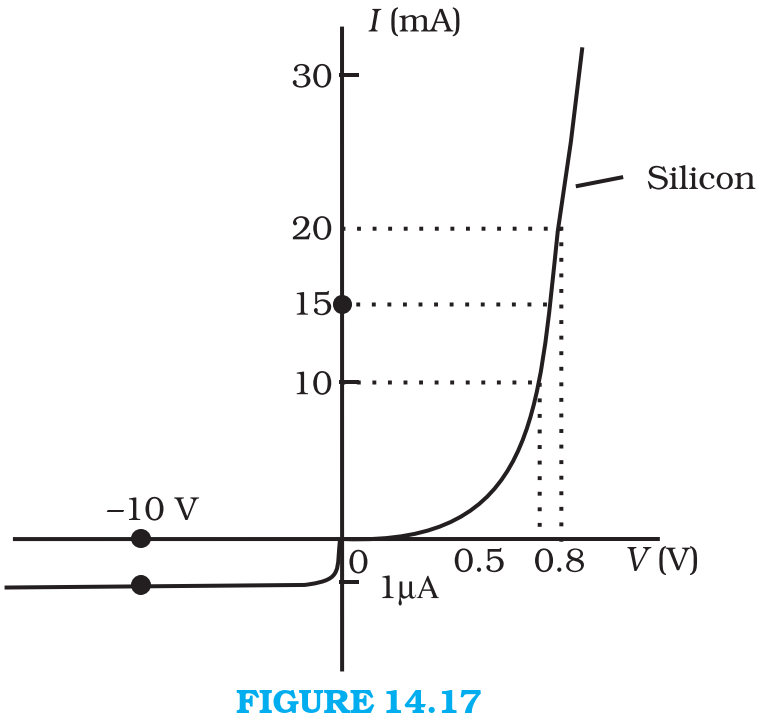
The $V-I$ characteristic of a silicon diode is shown in the Fig. 14.17. Calculate the resistance of the diode at (a) $I_D=15 mA$ and (b) $V_D=-10 V$.
Image
The linewidth of a bright fringe is sometimes defined as the separation between the points on the two sides of the central line where the intensity falls to half the maximum. Find the linewidth of a bright fringe in a Young's double slit experiment in terms of $\lambda$, d and D where the symbols have their usual meanings.
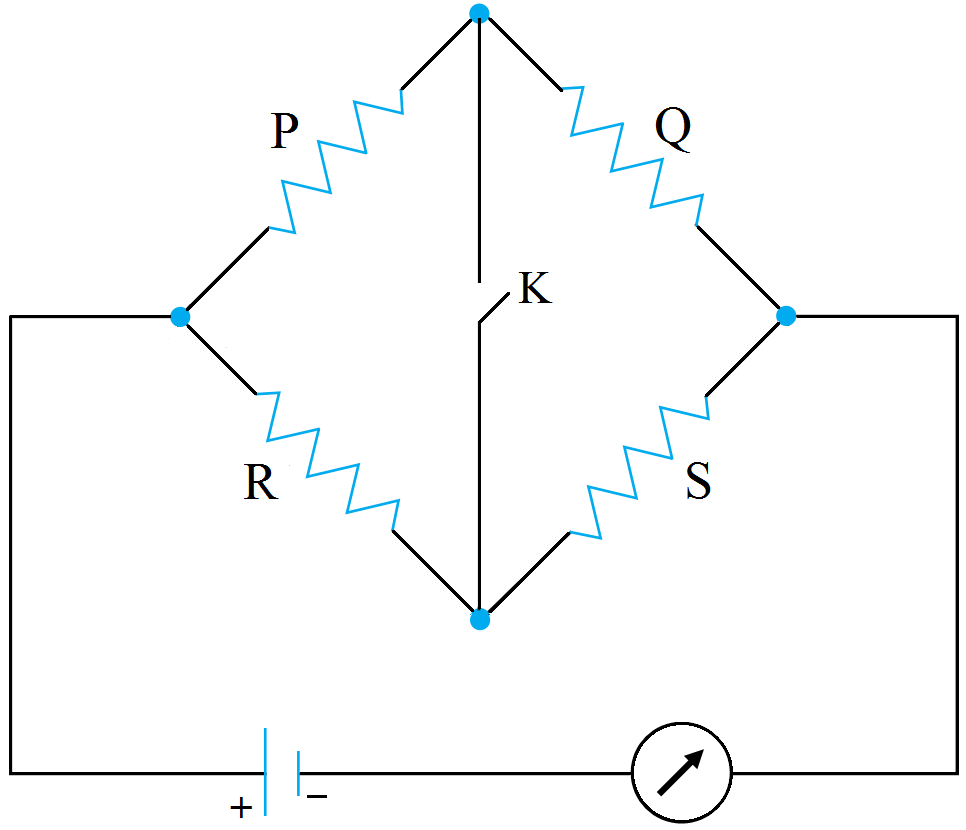
In a Wheatstone’s bridge experiment, a student by mistake, connects key (K) in place of galvanometer and galvanometer (G) in place of key (K). What will be the test for the balance of the bridge?
An inductor is connected to a battery through a switch. Explain why the emf induced in the inductor is much larger when the switch is opened as compared to the emf induced when the switch is closed.
A tuning fork produces $4$ beats per second with another tuning fork of frequency $256\ Hz.$ The first one is now loaded with a little wax and the beat frequency is found to increase to 6 per second. What was the original frequency of the tuning fork?
Find the maximum angular speed of the electron of a hydrogen atom in a stationary orbit.