Question
A proton and an α-particle are accelerated, using the same potential difference. How are the de-Broglie wavelengths λp and λa related to each other?

Answer

Key concept: Hence de-Broglie wavelength:

$\lambda=\frac{\text{h}}{\text{p}}=\frac{\text{h}}{\sqrt{2\text{mE}}}=\frac{\text{h}}{\sqrt{2\text{mqV}}}$

In this problrm since both proton and $\alpha-\text{particle}$ are accelerated through same potential difference,

We know that, $\lambda=\frac{\text{h}}{\sqrt{2\text{mqv}}}$

$\therefore\ \lambda\propto\frac{1}{\sqrt{\text{mq}}}$

$\frac{\lambda_\text{p}}{\lambda_\alpha}=\frac{\sqrt{\text{m}_\alpha\text{q}_\alpha}}{\text{m}_\text{p}\text{q}_\text{p}}=\frac{\sqrt{4\text{m}_\text{p}\times2\text{e}}}{\sqrt{\text{m}_\text{p}\times\text{e}}}=\sqrt{8}$

$\therefore\ \lambda_\text{p}=\sqrt{8}\lambda_\alpha$

i.e., wavelength of proton is times wavelength of $\alpha-\text{particle}$.

Important point:

De-Broglie wavelength associated with the charged particles: The energy of a charged particle acceletated through potential difference V is

$\text{E}=\frac{1}{2}\text{mv}^2=\text{qV}$

Hence de-Broglie wavelength $\lambda=\frac{\text{h}}{\text{p}}=\frac{\text{h}}{\sqrt{2\text{mE}}}=\frac{\text{h}}{\sqrt{2\text{mqV}}}$

$\lambda_\text{Electron}=\frac{12.27}{\sqrt{\text{V}}}\mathring{\text{A}},\lambda_\text{Proton}=\frac{0.286}{\sqrt{\text{V}}}\mathring{\text{A}}$

$\lambda_\text{Deutron}=\frac{0.200}{\sqrt{\text{V}}}\mathring{\text{A}},\lambda_{\alpha-\text{particle}}=\frac{0.101}{\sqrt{\text{V}}}\mathring{\text{A}}$

Need a full question paper?

Generate a complete, print-ready paper with questions like this in minutes — across 16+ boards, with answer keys.
Start Generating Free

Similar questions

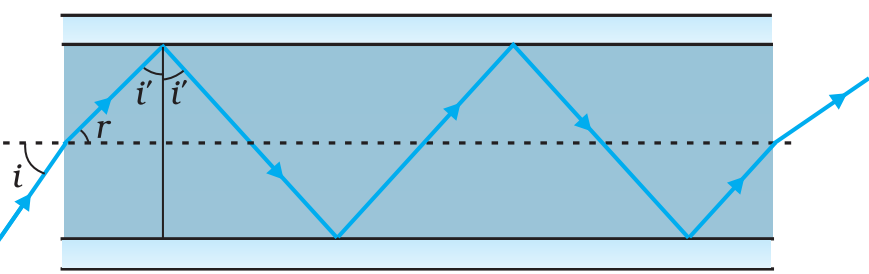
  1. a cross - section of a ‘light pipe’ made of a glass fibre of refractive. The outer covering of the pipe is made of a material of refractive. What is the range of the angles of the incident rays with the axis of the pipe for which total reflections inside the pipe take place, as shown in the figure.
  2. What is the answer if there is no outer covering of the pipe?

The current in a conductor and the potential difference across its ends are measured by an ammeter and a voltmeter. The meters draw negligible currents. The ammeter is accurate but the voltmeter has a zero error (that is, it does not read zero when no potential difference is applied). Calculate the zero error if the readings for two different conditions are 1.75A, 14.4V and 2.75A, 22.4V.
A person is standing on a truck moving with a constant velocity of 14.7m/s on a horizontal road. The man throws a ball in such a way that it returns to the truck after the truck has moved 58.8m. Find the speed and the angle of projection:
  1. As seen from the truck.
  2. As seen from the road.
When a Coolidge tube is operated for some time it becomes hot. Where does the heat come from?
An unsymmetrical double convex thin lens forms the image of a point object on its axis. Will the position of the image change if the lens is reversed?
The mixture a pure liquid and a solution in a long vertical column (i.e, horizontal dimensions < < vertical dimensions) produces diffusion of solute particles and hence a refractive index gradient along the vertical dimension. A ray of light entering the column at right angles to the vertical is deviated from its original path. Find the deviation in travelling a horizontal distance d < < h, the height of the column.
A charge of $1\mu\text{C}$ is given to one plate of a parallel-plate capacitor of capacitance $0.1\mu\text{F}$ and a charge of $2\mu\text{C}$ is given to the other plate. Find the potential difference developed between the plates.
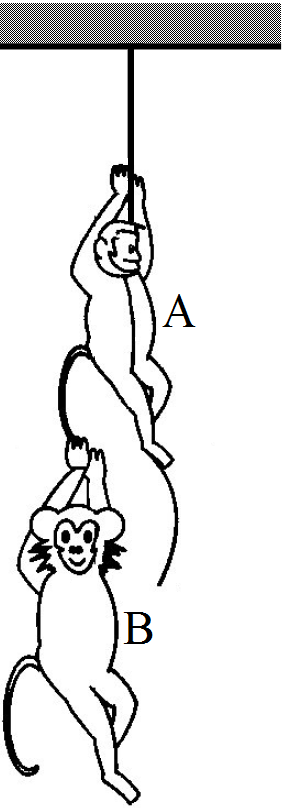
The monkey B shown in figure is holding on to the tail of the monkey A which is climbing up a rope. The masses of the monkeys A and B are 5kg and 2kg respectively. If A can tolerate a tension of 30N in its tail, what force should it apply on the rope in order to carry the monkey B with it? Take g = 10m/s2

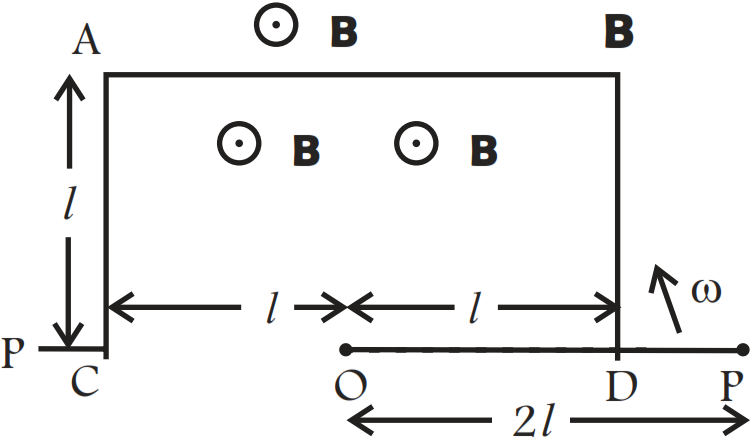
ODBAC is a fixed rectangular conductor of negilible resistance (CO is not connnected) and OP is a conductor which rotates clockwise with an angular velocity $\omega$ (Fig). The entire system is in a uniform magnetic field B whose direction is along the normal to the surface of the rectangular conductor ABDC. The conductor OP is in electric contact with ABDC. The rotating conductor has a resistance of $\lambda$ per unit length. Find the current in the rotating conductor, as it rotates by 180º.

What is the difference between cathode rays and beta rays? When the two are travelling in space, can you make out which is the cathode ray and which is the beta ray?