MCQ
A radio nuclide $A_1$ with decay constant $\lambda_1$  transforms into a radio nuclide $A_2$ with decay constant $\lambda_2$ . If at the initial moment the preparation contained only the radio nuclide $A_1$, then the time interval after which the activity of the radio nuclide $A_2$ reaches its maximum value is :-
  • $\frac{{\ln \left( {{\lambda _2}/{\lambda _1}} \right)}}{{{\lambda _2} - {\lambda _1}}}$
  • B
    $\frac{{\ln \left( {{\lambda _2}/{\lambda _1}} \right)}}{{{\lambda _2} + {\lambda _1}}}$
  • C
    $\ln \left( {{\lambda _2} - {\lambda _1}} \right)$
  • D
    ${e^{ - \left( {{\lambda _1 - }{\lambda _2}} \right)}}$

Answer

Correct option: A.
$\frac{{\ln \left( {{\lambda _2}/{\lambda _1}} \right)}}{{{\lambda _2} - {\lambda _1}}}$
a
Suppose $N_{1}$ and $N_{2}$ are the number of two radionuclides $A_{1}, A_{2}$ at time $t$

Then

$\frac{d N_{1}}{d t}=-\lambda_{1} N_{1}(1)$

$\frac{d N_{2}}{d t}=\lambda_{1} N_{1}-\lambda_{2} N_{2}(2)$

From $(1)$

$N_{1}=N_{10} e^{-\lambda_{1} t}$

where $N_{10}$ is the initial number of nuclides $A_{1}$ at time $t=0$

From $(2)$

$\left(\frac{d N_{2}}{d t}+\lambda_{2} N_{2}\right) e^{\lambda_{2} t}=\lambda_{1} N_{10} e^{-\left(\lambda_{1}-\lambda_{2}\right) t}$

$\operatorname{or}\left(N_{2} e^{\lambda_{2} t}\right)=\operatorname{const} \frac{\lambda_{1} N_{10}}{\lambda_{1}-\lambda_{2}} e^{-\left(\lambda_{1}-\lambda_{2}\right) t}$

since $N_{2}=0$ at $t=0$

constant $N_{2}=\frac{\lambda_{1} N_{10}}{\lambda_{1}-\lambda_{2}}$

Thus $=\frac{\lambda_{1} N_{10}}{\lambda_{1}-\lambda_{2}}\left(e^{-\lambda_{2} t-e^{-\lambda_{1} t}}\right)$

(b) The activity of nuclide $A_{2}$ is $\lambda_{2} N_{2} .$ This is maximum when $N_{2}$ is maximum. That happens when

$\frac{d N_{2}}{d t}=0$

This require $\lambda_{2} e^{-\lambda_{2} t_{m}=\lambda_{1} e^{-\lambda_{2} tm}}$

$\operatorname{or} t_{m}=\frac{\ln \left(\lambda_{1} / \lambda_{2}\right)}{\lambda_{1}-\lambda_{2}}$
Need a full question paper?

Generate a complete, print-ready paper with questions like this in minutes — across 16+ boards, with answer keys.

Start Generating Free

Similar questions

What physical quantities may X and Y represent ? (Y represents the first mentioned quantity)


The unit of intensity of electric field is
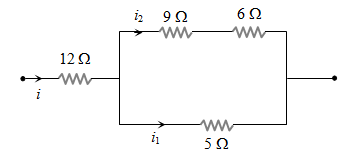
In the following circuit, 5W resistor develops 45 J/s due to current flowing through it. The power developed per second across 12 W resistor is
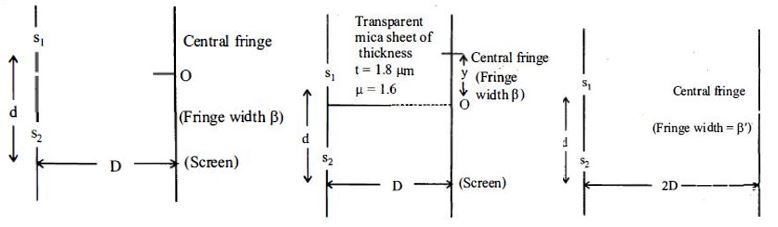
Using monochromatic light of wavelength $\lambda $, an experimentalist sets up the Young 's double slit experiment in three ways as shown. If she observes that $y = \beta '$, the wavelength of light used is.....$nm$
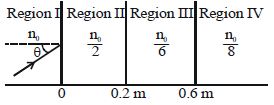
A light beam is travelling from Region $I$ to Region $IV$ (refer figure). The refractive index in Region $I, II, III$ and $IV$ are ${n_0},\frac{{{n_0}}}{2},\frac{{{n_0}}}{6}$ and $\frac{{{n_0}}}{8}$, respectively. The angle of incidence $\theta $ for which he beam just misses entering Region $IV$ is
Assertion : A red object appears dark in the yellow light
Reason : A red colour is scattered less
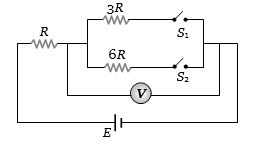
In the circuit shown in figure reading of voltmeter is $V_1$ when only $S_1$ is closed, reading of voltmeter is $ V_2$ when only $S_2$ is closed and reading of voltmeter is $V_3$ when both $S_1$ and $S_2$ are closed. Then
Assertion : If the speed of charged particle increases both the mass as well as charge increases.
Reason : If $m_0 =$ rest mass and $m$ be mass at velocity $v$ then $m = \frac{{{m_0}}}{{\sqrt {1 - \frac{{{v^2}}}{{{c^2}}}} }}$ where $c =$ speed of light
The binding energy of a nucleus is equivalent to:
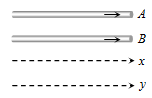
A and B are two conductors carrying a current i in the same direction. x and y are two electron beams moving in the same direction