MCQ 11 Mark
${ }_{82}^{290} X \xrightarrow{\alpha} Y \xrightarrow{e^{+}} Z \xrightarrow{\beta^{-}} P \xrightarrow{e^{-}} Q$
In the nuclear emission stated above, the mass number and atomic number of the product $Q$ respectively, are
- A
$286,80$
- B
$288,82$
- ✓
$286,81$
- D
$280,81$
AnswerCorrect option: C. $286,81$
c
${ }_{82}^{290} X \xrightarrow{\alpha}{ }_{80}^{286} Y \xrightarrow{e^{+}}{ }_{79}^{286} Z \xrightarrow{\beta^{-}}{ }_{80}^{286} P \xrightarrow{e^{-}}{ }_{81}^{286} Q$
$A \rightarrow 286$
$ Z=81$
View full question & answer→MCQ 21 Mark
The half life of a radioactive substance is $20$ minutes. In $........\,minutes$ time,the activity of substance drops to $\left(\frac{1}{16}\right)^{ th }$ of its initial value.
Answera
Half life $T=20 min$
Left fraction of activity $\frac{1}{16}$
$\because \frac{ R }{ R _0} =\left(\frac{1}{2}\right)^{ t / T }$
$\frac{1}{16} =\left(\frac{1}{2}\right)^{ t / 20}$
$\left(\frac{1}{2}\right)^4 =\left(\frac{1}{2}\right)^{ t / 20}$
$4 =\frac{ t }{20}$
$t =80\,min$
View full question & answer→MCQ 31 Mark
A nucleus of mass number $189$ splits into two nuclei having mass number $125$ and $64$ . The ratio of radius of two daughter nuclei respectively is:
- A
$4: 5$
- ✓
$5: 4$
- C
$25: 16$
- D
$1: 1$
AnswerCorrect option: B. $5: 4$
b
Nuclear Radius :
$R=R_{0}(A)^{1 / 3}$
$\frac{R(125)}{R(64)}=\frac{R_{0}(125)^{1 / 3}}{R_{0}(64)^{1 / 3}}=\frac{5}{4}$
View full question & answer→MCQ 41 Mark
Given below are two statements :
Statement $I:$ The law of radioactive decay states that the number of nuclei undergoing the decay per unit time is inversely proportional to the total number of nuclei in the sample.
Statement $II:$ The half life of a radionuclide is the sum of the life time of all nuclei, divided by the initial concentration of the nuclei at time $t =0$.
In the light of the above statements, choose the most appropriate answer from the options given below :
- A
Both Statement $I$ and Statement $II$ are correct
- ✓
Both Statement $I$ and Statement $II$ are incorrect
- C
Statement $I$ is correct but Statement $II$ is incorrect
- D
Statement $I$ is incorrect but Statement $II$ is correct
AnswerCorrect option: B. Both Statement $I$ and Statement $II$ are incorrect
b
Since, $dN =-\lambda Ndt$ $( dN \propto N )$ statement $I$ is wrong.
$T _{1 / 2}=$ time in which active no. of nuclei becomes half therefore statement $II$ is wrong.
View full question & answer→MCQ 51 Mark
In the given nuclear reaction, the element $X$ is :
${ }_{11}^{22} Na \rightarrow X + e ^{+}+v$
- A
${ }_{10}^{23}\,Ne$
- ✓
${ }_{10}^{22}\,Ne$
- C
${ }_{12}^{22}\,Mg$
- D
${ }_{11}^{23}\,Na$
AnswerCorrect option: B. ${ }_{10}^{22}\,Ne$
b
${ }_{11}^{22} Na \longrightarrow X +e^{+}+v$
This is $\beta^{+}$- decay
${ }_{11}^{22} Na \longrightarrow{ }_{10}^{22} Ne + e ^{+}+ v$
View full question & answer→MCQ 61 Mark
A nucleus with mass number $240$ breaks into two fragments each of mass number $120 ,$ the binding energy per nucleon of unfragmented nuclei is $7.6 \,\mathrm{MeV}$ while that of fragments is $8.5\, \mathrm{MeV}$. The total gain in the Binding Energy in the process is : (In $\mathrm{MeV}$)
Answerd
$\mathrm{X}^{240} \rightarrow \mathrm{Y}^{120} \rightarrow \mathrm{Z}^{120}$
given binding energy per nucleon of $X, Y \& Z$ are
$7.6\, \mathrm{MeV}, 8.5\, \mathrm{MeV} \,\&\, 8.5\, \mathrm{MeV}$ respectively.
Gain in binding energy is:
$\mathrm{Q}=$ Binding Energy of products $-$ Binding energy of reactants
$=(120 \times 8.5 \times 2)-(240 \times 7.6)\, \mathrm{MeV}$
$=216\, \mathrm{MeV}$
View full question & answer→MCQ 71 Mark
A radioactive nucleus ${ }_{\mathrm{Z}}^{\mathrm{A}} \mathrm{X}$ undergoes spontaneous decay in the sequence
${ }_{\mathrm{Z}}^{\mathrm{A}} \mathrm{X} \rightarrow {}_{\mathrm{Z}-1}{\mathrm{B}} \rightarrow {}_{\mathrm{Z}-3 }\mathrm{C} \rightarrow {}_{\mathrm{Z}-2} \mathrm{D}$, where $\mathrm{Z}$ is the atomic number of element $X.$ The possible decay particles in the sequence are :
- A
$\alpha, \beta^{-}, \beta^{+}$
- B
$\alpha, \beta^{+}, \beta^{-}$
- ✓
$\beta^{+}, \alpha, \beta^{-}$
- D
$\beta^{-}, \alpha, \beta^{+}$
AnswerCorrect option: C. $\beta^{+}, \alpha, \beta^{-}$
c
$\beta^{+}$decreases atomic number by $1$
$\alpha$ decreases atomic number by $2$
$\beta^{-}$increases atomic number by $1$
View full question & answer→MCQ 81 Mark
The half-life of a radioactive nuclide is $100 \,hours.$ The fraction of original activity that will remain after $150\, hours$ would be :
- A
$\frac{1}{2}$
- ✓
$\frac{1}{2 \sqrt{2}}$
- C
$\frac{2}{3}$
- D
$\frac{2}{3 \sqrt{2}}$
AnswerCorrect option: B. $\frac{1}{2 \sqrt{2}}$
b
$\frac{A}{A_{0}}=\left(\frac{1}{2}\right)^{\mathrm{t} / T_{\mathrm{H}}}=\left(\frac{1}{2}\right)^{150 / 100}=\frac{1}{2 \sqrt{2}}$
View full question & answer→MCQ 91 Mark
The half life of a radioactive sample undergoing $\alpha$ - decay is $1.4 \times 10^{17}$ s. If the number of nuclei in the sample is $2.0 \times 10^{21}$, the activity of the sample is nearly
- A
$10^{3} \;Bq$
- ✓
$10^{4}\;Bq$
- C
$10^{5}\;Bq$
- D
$10^{6}\;Bq$
AnswerCorrect option: B. $10^{4}\;Bq$
b
The activity (A) is defined as the rate of decay of radioactive substance.
$A=-\frac{d N}{d t}=N \lambda$
$A = N \times \frac{0.693}{ T } \quad[ T$ is half life $]$
$A=2 \times 10^{21} \times \frac{0.693}{1.4 \times 10^{17}}$
$A=10^{4} B q$
View full question & answer→MCQ 101 Mark
The energy equivalent of $0.5\, g$ of a substance is$........J$
- A
$0.5 \times 10^{13}$
- B
$4.5 \times 10^{16}$
- ✓
$4.5 \times 10^{13}$
- D
$1.5 \times 10^{13}$
AnswerCorrect option: C. $4.5 \times 10^{13}$
c
$E=m c^{2}$
$=0.5 \times 10^{-3} \times 9 \times 10^{16}$
$=4.5 \times 10^{13} J$
View full question & answer→MCQ 111 Mark
When a uranium isotope ${ }_{92}^{235} U$ is bombarded with a neutron, it generates ${ }_{36}^{89} Kr$, three neutrons and:
- A
${ }_{36}^{103}\, Kr$
- ✓
${ }_{56}^{144}\, Ba$
- C
${ }_{91}^{40} \,Zr$
- D
${ }_{36}^{101} Kr$
AnswerCorrect option: B. ${ }_{56}^{144}\, Ba$
b
${ }_{92}^{235} U +{ }_{0}^{1} n \rightarrow{ }_{36}^{89} Kr +{ }_{56}^{144} Ba +3{ }_{0}^{1} n + Q$
View full question & answer→MCQ 121 Mark
What happens to the mass number and atomic number of an element when it emits $\gamma$-radiation?
- A
Mass number increases by four and atomic number increases by two.
- B
Mass number decreases by four and atomic number decreases by two.
- ✓
Mass number and atomic number remain unchanged.
- D
Mass number remains unchanged while atomic number decreases by one.
AnswerCorrect option: C. Mass number and atomic number remain unchanged.
c
$z x^{A} \stackrel{y \text { decay }}{\longrightarrow} z x^{A}$
Hence due to gamma emission, there is no change in mass number and atomic number.
View full question & answer→MCQ 131 Mark
The rate of radioactive disintegration at an instant for a radioactive sample of half life $2.2 \times 10^9 \;s$ is $10^{10}\; s ^{-1}$. The number of radioactive atoms in that sample at that instant is,
- A
$3.17 \times 10^{20}$
- ✓
$3.17 \times 10^{19}$
- C
$3.17 \times 10^{17}$
- D
$3.17 \times 10^{18}$
AnswerCorrect option: B. $3.17 \times 10^{19}$
b
$T _{1 / 2}=\frac{\ln 2}{\lambda}=\frac{0.693}{\lambda}$
$2.2 \times 10^9=\frac{0.693}{\lambda}$
$\lambda=\frac{0.693}{2.2 \times 10^9}=3.15 \times 10^{-10}$
$R =\lambda N$
$N =\frac{ R }{\lambda}=\frac{10^{10}}{3.15 \times 10^{-10}}=3.17 \times 10^{19}$
View full question & answer→MCQ 141 Mark
$\alpha$ -particle consists of
- ✓
$2$ protons and $2$ neutrons only
- B
$2$ electrons, $2$ protons and $2$ neutrons
- C
$2$ electrons and $4$ protons only
- D
$2$ protons only
AnswerCorrect option: A. $2$ protons and $2$ neutrons only
a
$\alpha=_2^4 \mathrm{He}^{2+}=$ Helium Nuclei
$2$ protons and $2$ neutrons
View full question & answer→MCQ 151 Mark
For a radioactive material, half-life is $10$ minutes. If initially there are $600$ number of nuclei, the time taken (in minutes) for the disintegration of $450$ nuclei is
Answera
Number of nuclei remaining,
$N=600-450=150$
According to the law of radioactive decay,
$\frac{N}{N_{0}}=\left(\frac{1}{2}\right)^{\frac{t}{T_{1 / 2}}} ;$ where $N_{0}$ is the number of nuclei initially.
$\therefore \quad \frac{150}{600}=\left(\frac{1}{2}\right)^{\frac{t}{T_{1 / 2}}} ;$ where $T_{1 / 2}=$ half life.
or $\quad\left(\frac{1}{2}\right)^{2}=\left(\frac{1}{2}\right)^{\frac{t}{T_{1 / 2}}}$
$\Rightarrow t=2 T_{10}=2 \times 10$ minutes $=20$ minutes
View full question & answer→MCQ 161 Mark
The energy liberated per nuclear fission is $200 \;MeV$. If $10^{20}$ fissions occur per/second the amount of power produced will be
- ✓
$32 \times 10^8\; W$
- B
$16 \times 10^8 \; W$
- C
$5 \times 10^{11}\; W$
- D
$2 \times 10^{22} \; W$
AnswerCorrect option: A. $32 \times 10^8\; W$
a
nuclea fission $=200 MeV=200 \times 10^{6} \times 1.6 \times 10^{-19} J$
$=3.2 \times 10^{-11} J$
Then for $10^{20}$ fisssion/sec
$P=10^{20} \times 3 \cdot 2 \times 10^{-11} J / s$
$P=3.2 \times 10^{9} W$
$P=32 \times 10^{8} W$
View full question & answer→MCQ 171 Mark
Radioactive material $'A'$ has decay constant $8 \lambda$ and material $'B'$ has decay constant $ ' \lambda '$. Initially they have same number of nuclei . After what time, the ratio of number of nuclei of material $'B'$ to that $'A'$ will be $\frac{1}{e}$ ?
- A
$\frac{1}{{\lambda }}$
- B
$\frac{1}{{9\lambda }}$
- C
$\frac{1}{{8\lambda }}$
- ✓
$\frac{1}{{7\lambda }}$
AnswerCorrect option: D. $\frac{1}{{7\lambda }}$
d
The number of radioactive nuclei $'N'$ at any time $t$ is given as
$N(t)=N_{0} e^{-\lambda t}$
where $N_{0}$ is number of radioactive nuclei in the sample at some aribitrary time $t=0$ and $\lambda$ is the radioactive decay constant.
Given: $\lambda_{A}=8 \lambda, \lambda_{B}=\lambda, N_{0 A}=N_{0 B}=N_{0}$
$ \therefore \quad \frac{N_{B}}{N_{A}} =\frac{e^{-\lambda t}}{e^{-8 \lambda t}} $
$\frac{1}{e}=e^{-\lambda t} e^{8 \lambda t}=e^{7 \lambda t}$
$\Rightarrow-1=7 \lambda t$ or $t=\frac{-1}{7 \lambda}$
View full question & answer→MCQ 181 Mark
The half-life of a radioactive substance is $30$ minutes. The times (in minutes ) taken between $40\%$ decay and $85\%$ decay of the same radioactive substance is
Answerb
$N_{0}=$ Nuclei at time $t=0$
$N_{\mathrm{1}}=$ Remaining nuclei after $40 \%$ decay
$=(1-0.4) N_{0}=0.6 N_{0}$
$N_{2}=$ Remaining nuclei after $85 \%$ decay
$=(1-0.85) N_{0}=0.15 N_{0}$
$\therefore$ $\frac{N_{2}}{N_{1}}=\frac{0.15 N_{0}}{0.6 N_{0}}=\frac{1}{4}=\left(\frac{1}{2}\right)^{2}$
Hence, two half life is required between $40 \%$ decay and $85 \%$ decay of a radioactive substance.
$\therefore$ Time taken $=2 \tau_{1 / 2}=2 \times 30 \mathrm{min}=60 \mathrm{min}$
View full question & answer→MCQ 191 Mark
Size of nucleus is of the order of
- A
${10^{ - 10}}m$
- ✓
${10^{ - 15}}m$
- C
${10^{ - 12}}m$
- D
${10^{ - 19}}m$
AnswerCorrect option: B. ${10^{ - 15}}m$
b
(b) Size of nucleus, $R=R_{o} A^{1 / 3}$
where $R_{o}=1.5 \mathrm{fm}=1.5 \times 10^{-15} \mathrm{m}$
and $A$ is the mass no.
$A^{1 / 3}$ is of order $1$
hence $R$ is of order $10^{-15} \mathrm{m}$
View full question & answer→MCQ 201 Mark
Radius of $_2H{e^4}$ nucleus is $3 \,Fermi.$ The radius of $_{82}P{b^{206}}$ nucleus will be..........$fermi$
AnswerCorrect option: C. $11.16$
c
(c) We have $r \propto {A^{1/3}} \Rightarrow \frac{{{r_2}}}{{{r_1}}} = {\left( {\frac{{{A_2}}}{{{A_1}}}} \right)^{1/3}} = {\left( {\frac{{206}}{4}} \right)^{1/3}}$
$\therefore {r_2} = 3{\left( {\frac{{206}}{4}} \right)^{1/3}} = 11.6\;Fermi$.
View full question & answer→MCQ 211 Mark
If the mass number of an atom is $A = 40$ and its electron configuration is $1{s^2},\;2{s^2},\;2{p^6},\;3{s^2},\;3{p^6}$, the number of neutrons and protons in its nucleus will be
Answera
(a)Number of protons $= 2 + 2 + 6 + 2 + 6 = 18$
Number of neutrons $= 40 -18 = 22.$
View full question & answer→MCQ 221 Mark
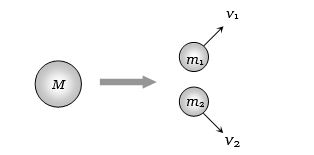
A heavy nucleus at rest breaks into two fragments which fly off with velocities in the ratio $8 : 1$. The ratio of radii of the fragments is
- ✓
$1 : 2 $
- B
$1 : 4$
- C
$4 : 1 $
- D
$2:1$
AnswerCorrect option: A. $1 : 2 $
a
(a) By conservation of momentum $m_1v_1 = m_2v_2$
==> $\frac{{{v_1}}}{{{v_2}}} = \frac{8}{1} = \frac{{{m_2}}}{{{m_1}}}$…… $(i) $
Also from $r \propto {A^{1/3}}$
==> $\frac{{{r_1}}}{{{r_2}}} = {\left( {\frac{{{A_1}}}{{{A_2}}}} \right)^{1/3}} = {\left( {\frac{1}{8}} \right)^{1/3}} = \frac{1}{2}$.
View full question & answer→MCQ 231 Mark
The ratio of radii of nuclei $_{13}A{l^{27}}$ and $_{52}{X^A}$ is $3 : 5$. The number of neutrons in the nuclei of $X$ will be
Answerb
(b) $r \propto {A^{1/3}}$ ==> $\frac{{{r_1}}}{{{r_2}}} = {\left( {\frac{{{A_1}}}{{{A_2}}}} \right)^{1/3}}$
==> $\frac{3}{5} = {\left( {\frac{{27}}{A}} \right)^{1/3}}$
==> $\frac{{27}}{{125}} = \frac{{27}}{A}$
==> $A = 125$
Number of nuclei in atom $X = A - 52 = 125 - 52 = 73.$
View full question & answer→MCQ 241 Mark
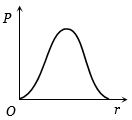
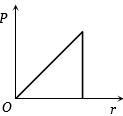
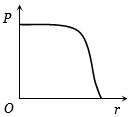
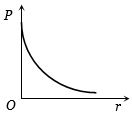
The charge density in a nucleus varies with distance from the centre of the nucleus according to the curve in Fig.
Answerc
(c)Charge density is uniform inside and then falls rapidly near the surface of the nucleus.
View full question & answer→MCQ 251 Mark
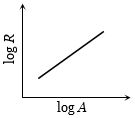
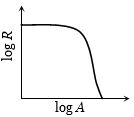
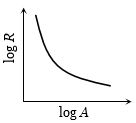
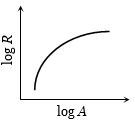
The graph between $log\, R$ and $log\, A$ where $R$ is the nuclear radius and $A$ is the mass number is
Answera
(a) $R = {R_0}{A^{1/3}};$ where ${R_0} = 1.2 \times {10^{ - 15}}m.$
==> $log_e \,R = log_e\, R_0 + \frac{1}{3}{\log _e}A$
This is the equation of a straight line with positive slope.
View full question & answer→MCQ 261 Mark
Highly energetic electrons are bombarded on a target of an element containing $30$ neutrons. The ratio of radii of nucleus to that of Helium nucleus is ${14^{1/3}}$. The atomic number of nucleus will be
Answerb
(b) By using $R = {R_0}\;{A^{1/3}} \Rightarrow \frac{{{R_1}}}{{{R_2}}} = {\left( {\frac{{{A_1}}}{{{A_2}}}} \right)^{1/3}}$
$ \Rightarrow \frac{R}{{{R_{He}}}} = {\left( {\frac{A}{4}} \right)^{1/3}} \Rightarrow {(14)^{1/3}} = {\left( {\frac{A}{4}} \right)^{1/3}}$
==> $A = 56$ so $Z = 56 -30 = 26.$
View full question & answer→MCQ 271 Mark
Radius of the second Bohr obit of singly ionised helium atom is ......... $Å$
- A
$0.53$
- ✓
$1.06$
- C
$0.265 $
- D
$0.132$
AnswerCorrect option: B. $1.06$
b
Radius of nth Bohr orbit $r _{ n }=\frac{0.529 n ^2}{ Z } A ^{\circ}$
For ionised Helium atom $Z =2$
Second Bohr orbit $n =2$
$\Rightarrow r _2=\frac{0.529 \times 2^2}{2}=1.06\, \mathring A$
View full question & answer→MCQ 281 Mark
When the atomic number $A$ of the nucleus increases
AnswerCorrect option: D. $(A)$ and $(C)$ both
View full question & answer→MCQ 291 Mark
An alpha nucleus of energy $\frac{1}{2}m{v^2}$ bombards a heavy nuclear target of charge $Ze$. Then the distance of closest approach for the alpha nucleus will be proportional to
- A
$\frac{1}{{Ze}}$
- B
$v^2$
- C
$\frac{1}{m^2}$
- ✓
$\frac{1}{{{v^2}}}$
AnswerCorrect option: D. $\frac{1}{{{v^2}}}$
d
Work done to stop the $\alpha$ particle is equal to $K.E.$
$\therefore q V=\frac{1}{2} m v^{2} \Rightarrow q \times \frac{K(Z e)}{r}=\frac{1}{2} m v^{2}$
$\Rightarrow r=\frac{2(2 e) K(Z e)}{m v^{2}}=\frac{4 K Z e^{2}}{m v^{2}}$
$\Rightarrow r \propto \frac{1}{v^{2}}$ and $r \propto \frac{1}{m}$
View full question & answer→MCQ 301 Mark
A scientist claims to have a perfect technique in which he can spontaneously convert an electron completely into energy in the laboratory without any other material required. What is the conclusion about this claim from our current understanding of physics?
- A
This is possible because Einstein's equation says that mass and energy are equivalent... it is just very difficult to achieve with electrons
- B
This is possible and it is done all the time in the high-energy physics labs.
- C
The scientist is almost correct... except that in converting the electron to energy, an electron's anti-particle is produced in the process as well
- ✓
This is not possible because charge conservation would be violated.
AnswerCorrect option: D. This is not possible because charge conservation would be violated.
d
Charge is conserved. In order to fully convert an electron into energy, a positron (the electron's antiparticle must be involved). That is, electron + positron -> energy, $NOT$ electron -> positron + energy.]
View full question & answer→MCQ 311 Mark
Assume that the nuclear binding energy per nucleon $(B/A)$ versus mass number $(A)$ is as shown in the figure. Use this plot to choose the correct choice $(s)$ given below
$(A)$ Fusion of two nuclei with mass numbers lying in the range of $1 < A < 50$ will release energy
$(B)$ Fusion of two nuclei with mass numbers lying in the range of $51 < A < 100$ will release energy
$(C)$ Fission of a nucleus lying in the mass range of $100 < A < 200$ will release energy when broken into two equal fragments
$(D)$ Fission of a nucleus lying in the mass range of $200 < A < 260$ will release energy when broken into two equal fragments
- A
$A$ and $B$
- B
$A$ and $D$
- ✓
$B$ and $D$
- D
$C$ and $D$
AnswerCorrect option: C. $B$ and $D$
c
$(1)$ For $1 < {\rm{A}} < 50,$ on fusion mass number for compound nucleus is less than $100$
$\Rightarrow$ Binding energy per nucleon remains same $\Rightarrow$ No energy is released
$(2)$ For $51 < {\rm{A}} < 100,$ on fusion mass number for compound nucleus is between $100$ and $200$
$\Rightarrow$ Binding energy per nucleon increases
$\Rightarrow$ Energy is released.
$(3)$ For $100 < {\rm{A}} < 200,$ on fission, the mass number of product nuclei will be between $50 $ and $ 100$
$\Rightarrow$ Binding energy per nucleon decreases
$\Rightarrow$ No energy is released
$(4)$ For $200 < {\rm{A}} < 260,$ on fission, the mass number of product nuclei will be between $100 $ and $130$
$\Rightarrow$ Binding energy per nucleon increases
$\Rightarrow$ Energy is released.
View full question & answer→MCQ 321 Mark
The ratio of radii of nuclei $_{13}Al^{27}$ and $_{52}X^A$ is $3:5.$ The number of neutrons in the nuclei of $X$ will be
Answerb
$\mathrm{r} \propto \mathrm{A}^{1 / 3} \Rightarrow \frac{\mathrm{r}_{1}}{\mathrm{r}_{2}}=\left(\frac{\mathrm{A}_{1}}{\mathrm{A}_{2}}\right)^{1 / 3}$
$\Rightarrow \frac{3}{5}=\left(\frac{27}{\mathrm{A}}\right)^{1 / 3} \Rightarrow \frac{27}{125}=\frac{27}{\mathrm{A}} \Rightarrow \mathrm{A}=125$
Number of neutrons in atom $\mathrm{X}$
$=A-52=125-52=73$
View full question & answer→MCQ 331 Mark
If $r_1$ and $r_2$ are the radii of the atomic nuclei of mass number $64$ and $125$ respectively, then the ratio $(r_1/r_2)$ is
AnswerCorrect option: D. $\frac{4}{5}$
d
$\mathrm{r}=\mathrm{r}_{0} \mathrm{A}^{1 / 3}$
$\frac{\mathrm{r}_{1}}{\mathrm{r}_{2}}=\left(\frac{\mathrm{A}_{1}}{\mathrm{A}_{2}}\right)^{1 / 3}=\left(\frac{64}{125}\right)^{1 / 3}=\frac{4}{5}$
View full question & answer→MCQ 341 Mark
An alpha particle is projected towards a stationary ${}_{92}^{235}U$ nucleus with $KE$ kinetic energy find distance of closest approach
- A
$\frac{{K{e^2}}}{{\left( {KE} \right)}}$
- ✓
$\frac{{92\,K{e^2}}}{{\left( {KE} \right)}}$
- C
$\frac{{K{e^2}}}{{92\,\left( {KE} \right)}}$
- D
$\frac{{KE}}{{K{e^2}}}$
AnswerCorrect option: B. $\frac{{92\,K{e^2}}}{{\left( {KE} \right)}}$
b
Energy conservation
Total Energy initial $=$ Total energy final
Hence $\mathrm{KE}=\frac{\mathrm{K}(\mathrm{ze}) \mathrm{e}}{\mathrm{d}}=\mathrm{PE}$
as $z = 92$ $\boxed{d = 92\frac{{{\text{K}}{{\text{e}}^2}}}{{({\text{KE}})}}}$
View full question & answer→MCQ 351 Mark
Atomic power station at Tarapore has a generating capacity of $200\, MW.$ The energy generated in a day by this station is
AnswerCorrect option: D. $1728 \times {10^{10}}\,J$
d
(d) Energy / day $ = 200 \times {10^6} \times 24 \times 3600$
$ = 2 \times 2.4 \times 3.6 \times {10^{12}} = 1728 \times {10^{10}}J$
View full question & answer→MCQ 361 Mark
One microgram of matter converted into energy will give
- A
$90 J$
- B
$9 \times {10^3}\,J$
- ✓
$9 \times {10^{7}}\,J$
- D
$9 \times {10^5}\,J$
AnswerCorrect option: C. $9 \times {10^{7}}\,J$
c
(c) $E = \Delta m{c^2} = {10^{ - 9}} \times {(3 \times {10^8})^2} = 9 \times {10^{7}}J$
View full question & answer→MCQ 371 Mark
The rest energy of an electron is
- ✓
$510\, KeV$
- B
$931\, KeV$
- C
$510 \,MeV$
- D
$931\, MeV$
AnswerCorrect option: A. $510\, KeV$
a
(a) Rest energy of an electron ${r_n} \propto {n^2}$
Here ${m_e} = 9.1 \times {10^{ - 31}}kg$ and $c =$ velocity of light
$\therefore $Rest energy $ = 9.1 \times {10^{ - 31}} \times {(3 \times {10^8})^2}joule$
$ = \frac{{9.1 \times {{10}^{ - 31}} \times {{(3 \times {{10}^8})}^2}}}{{1.6 \times {{10}^{ - 19}}}}eV = 510\;keV$
View full question & answer→MCQ 381 Mark
In a fission reaction $_{92}^{236}U{ \to ^{117}}X{ + ^{117}}Y + n + n$, the binding energy per nucleon of $X$ and $Y$ is $8.5\, MeV$ whereas of $^{236}U$ is $7.6\, MeV$. The total energy liberated will be about _______ $MeV$
Answerc
$\Delta E = 8.5 \times 234 - 7.6 \times 236 = 195.4\;MeV = 200\;MeV$.
View full question & answer→MCQ 391 Mark
The mass and energy equivalent to $1\, a.m.u.$ respectively
- A
$1.67 \times {10^{ - 27}}\,gm,\,\,9.30\,\,MeV$
- ✓
$1.67 \times {10^{ - 27}}\,kg,\,\,930\,\,MeV$
- C
$1.67 \times {10^{ - 27}}kg,\,\,1\,\,MeV$
- D
$1.67 \times {10^{ - 34}}\,kg,\,\,1\,\,MeV$
AnswerCorrect option: B. $1.67 \times {10^{ - 27}}\,kg,\,\,930\,\,MeV$
b
(b) $1$ amu
It is defined as one twelfth of the mass of an unbound neutral atom of carbon$-12$ in its nuclear and electronic ground state.
Mass of $1$ mole $C$ atoms $= 12gms$
$1 \mathrm{amu}=\frac{12}{12 \times 6.023 \times 10^{23}}=1.66 \times 10^{-27} \mathrm{kg}$
Energy equivalent, $E=m c^{2}=1.66 \times 10^{-27} \mathrm{kg} \times\left(3 \times 10^{8}\right)^{2}=930 \mathrm{MeV}$
View full question & answer→MCQ 401 Mark
The mass defect in a particular nuclear reaction is $0.3\, grams$. The amount of energy liberated in kilowatt hours is
(Velocity of light = $3 \times {10^8}\,m/s$)
- A
$1.5 \times {10^6}$
- B
$2.5 \times {10^6}$
- C
$3 \times {10^6}$
- ✓
$7.5 \times {10^6}$
AnswerCorrect option: D. $7.5 \times {10^6}$
d
(d) $E = \Delta m.{c^2}$ $ \Rightarrow E = \frac{{0.3}}{{1000}} \times {(3 \times {10^8})^2} = 2.7 \times {10^{13}}J$
$ = \frac{{2.7 \times {{10}^{13}}}}{{3.6 \times {{10}^6}}} = 7.5 \times {10^6}kWh$.
View full question & answer→MCQ 411 Mark
When $_{92}{U^{235}}$ undergoes fission, $0.1\%$ of its original mass is changed into energy. How much energy is released if $1\,kg$ of $_{92}{U^{235}}$ undergoes fission
- A
$9 \times {10^{10}}J$
- B
$9 \times {10^{11}}J$
- C
$9 \times {10^{12}}J$
- ✓
$9 \times {10^{13}}J$
AnswerCorrect option: D. $9 \times {10^{13}}J$
d
(d)$E = \Delta m{c^2},\;\Delta m = \frac{{0.1}}{{100}} = {10^{ - 3}}kg$
$\therefore E = {10^{ - 3}} \times {(3 \times {10^8})^2} = {10^{ - 3}} \times 9 \times {10^{16}} = 9 \times {10^{13}}J$.
View full question & answer→MCQ 421 Mark
If $200\, MeV$ energy is released in the fission of a single ${U^{235}}$nucleus, the number of fissions required per second to produce $1\, kilo\,watt$ power shall be (Given $1\;eV = 1.6 \times {10^{ - 19}}J$)
- ✓
$3.125 \times {10^{13}}$
- B
$3.125 \times {10^{14}}$
- C
$3.125 \times {10^{15}}$
- D
$3.125 \times {10^{16}}$
AnswerCorrect option: A. $3.125 \times {10^{13}}$
a
(a) $P = n\,\left( {\frac{E}{t}} \right) $
$\Rightarrow 1000 = \frac{{n \times 200 \times {{10}^6} \times 1.6 \times {{10}^{ - 19}}}}{t}$
$\Rightarrow \frac{n}{t}=3.125\times {{10}^{13}}.$
View full question & answer→MCQ 431 Mark
$1\, g$ of hydrogen is converted into $0.993 \,g$ of helium in a thermonuclear reaction. The energy released is
- A
$63 \times {10^7}J$
- ✓
$63 \times {10^{10}}J$
- C
$63 \times {10^{14}}J$
- D
$63 \times {10^{20}}J$
AnswerCorrect option: B. $63 \times {10^{10}}J$
b
(b) $\Delta m = 1 - 0.993 = 0.007\;gm$
$\therefore E = (\Delta m){c^2} = (0.007 \times {10^{ - 3}}){(3 \times {10^8})^2}$$ = 63 \times {10^{10}}J$.
View full question & answer→MCQ 441 Mark
If a proton and anti-proton come close to each other and annihilate, how much energy will be released
AnswerCorrect option: B. $3 \times {10^{ - 10}}J$
b
(b) Mass of proton = mass of antiproton
$ = 1.67 \times {10^{ - 27}}kg = 1amu$
Energy equivalent to $1\;amu = 931\;MeV$
So energy equivalent to $2\, amu = 2 \times 931\;MeV$
$ = 1862 \times {10^6} \times 1.6 \times {10^{ - 19}}$$ = 2.97 \times {10^{ - 10}}J$$ = 3 \times {10^{ - 10}}J$.
View full question & answer→MCQ 451 Mark
Energy released in fusion of $1\, kg$ of deuterium nuclei
AnswerCorrect option: D. $8 \times {10^{23}}\,MeV$
d
(d)Fusion reaction of deuterium is
$_1{H^2}{ + _1}{H^2}{ \to _2}H{e^3}{ + _0}{n^1} + 3.27\;MeV$
So $E = \frac{{6.02 \times {{10}^{23}} \times {{10}^3} \times 3.27 \times 1.6 \times {{10}^{ - 13}}}}{{2 \times 2}}$$ = 7.8 \times {10^{13}}J$
$ = 8 \times {10^{13}}J$.
View full question & answer→MCQ 461 Mark
If in a nuclear fission, piece of uranium of mass $0.5\, g$ is lost, the energy obtained in $kWh$ is
- ✓
$1.25 \times {10^7}$
- B
$2.25 \times {10^7}$
- C
$3.25 \times {10^7}$
- D
$0.25 \times {10^7}$
AnswerCorrect option: A. $1.25 \times {10^7}$
a
(a) $E = \Delta m{c^2} = 0.5 \times {10^{ - 3}} \times {(3 \times {10^8})^2} = 4.5 \times {10^{13}}j$
$ \Rightarrow E = \frac{{4.5 \times {{10}^{13}}}}{{3.6 \times {{10}^6}}} = 1.25 \times {10^7}kWH.$
View full question & answer→MCQ 471 Mark
A nucleus of mass $218\, amu$ in free state decays to emit an $\alpha$- particle. Kinetic energy of the $\alpha$- particle emitted is $6.7\, MeV$. The recoil energy (in $MeV$) of the daughter nucleus is
- A
$1$
- B
$0.5$
- C
$0.25$
- ✓
$0.125$
AnswerCorrect option: D. $0.125$
d
(d) Using conservation of momentum ${P_{daughter}} = {P_\alpha }$
==>$\frac{{{E_d}}}{{{E_\alpha }}} = \frac{{{m_\alpha }}}{{{m_d}}}$
==>${E_d} = \frac{{{E_\alpha } \times {m_\alpha }}}{{{m_d}}}$
$ = \frac{{6.7 \times 4}}{{214}} = 0.125\,MeV$
View full question & answer→MCQ 481 Mark
The rest energy of an electron is $0.511 \, MeV$. The electron is accelerated from rest to a velocity $0.5\, c$. The change in its energy will be ............ $MeV$
- A
$0.026$
- B
$0.051$
- ✓
$0.079 $
- D
$0.105$
AnswerCorrect option: C. $0.079 $
c
(c) $\Delta = m{c^2} - {m_0}{c^2}$
$= \frac{{{m_0}{c^2}}}{{\sqrt {1 - ({v^2}/{c^2})} }} - {m_0}{c^2}$
$ = {m_0}{c^2}\left( {\frac{1}{{\sqrt {1 - ({v^2}/{c^2})} }} - 1} \right) $
$= 0.511\,\left( {\frac{1}{{\sqrt {0.75} }} - 1} \right)$
$=0.079\, MeV$
View full question & answer→MCQ 491 Mark
Excitation energy of a hydrogen like ion in its first excitation state is $40.8 \,eV$. Energy needed to remove the electron from the ion in ground state is ........$eV$
- ✓
$54.4 $
- B
$13.6$
- C
$40.8$
- D
$27.2$
AnswerCorrect option: A. $54.4 $
a
(a) Excitation energy $\Delta E = {E_2} - {E_1}$
$ = 13.6\;{Z^2}\left[ {\frac{1}{{{1^2}}} - \frac{1}{{{2^2}}}} \right]$
$ \Rightarrow 40.8 = 13.6 \times \frac{3}{4} \times {Z^2} \Rightarrow Z = 2.$
Now required energy to remove the electron from ground state
$ = \frac{{ + 13.6{Z^2}}}{{{{(1)}^2}}} = 13.6{(Z)^2} = 54.4\,eV.$
View full question & answer→MCQ 501 Mark
The first excited state of hydrogen atom is $10.2 \,eV$ above its ground state. The temperature is needed to excite hydrogen atoms to first excited level, is
- ✓
$7.9 \times {10^4}K$
- B
$3.5 \times {10^4}K$
- C
$5.8 \times {10^4}K$
- D
$14 \times {10^4}K$
AnswerCorrect option: A. $7.9 \times {10^4}K$
a
(a) According to kinetic interpretation of temperature
$K.E. = \left( {\frac{1}{2}m{v^2}} \right) = \frac{3}{2}kT.$
$ \Rightarrow 10.2 \times 1.6 \times {10^{ - 19}} = \frac{3}{2} \times (1.38 \times {10^{ - 23}})T$
==> $T = 7.9 ×10^4K.$
View full question & answer→