MCQ
A radioactive material undergoes decay by ejecting electrons. The electron ejected in this process is:
  • The electron from the decay of a neutron.
  • B
    The electron present in the nucleus.
  • C
    The resulting from the conversion of $\gamma\ \text{photon}.$
  • D
    An orbital electron.

Answer

Correct option: A.
The electron from the decay of a neutron.

Need a full question paper?

Generate a complete, print-ready paper with questions like this in minutes — across 16+ boards, with answer keys.

Start Generating Free

Similar questions

The potential difference that must be applied to stop the fastest photoelectrons emitted by a nickel surface, having work function $5.01\,\, eV,$ when ultraviolet light of $200 \,\,nm$ falls on it, must be ............... $V$
The ionisation potential of hydrogen atom is 13.6 volt. The energy required to remove an electron in the n = 2 state of the hydrogen atom is
Although we can know with great precision the pattern formed by huge numbers of photons passing through the lines on a diffraction grating, we cannot know at all where one single photon will go when it passes through the diffraction grating.
This statement describes the truth revealed by what theory?
An N-type and P-type silicon can be obtained by doping pure silicon with
In a Young’s double slit experiment, the separation of the two slits is doubled. To keep the same spacing of fringes, the distance D of the screen from the slits should be made 
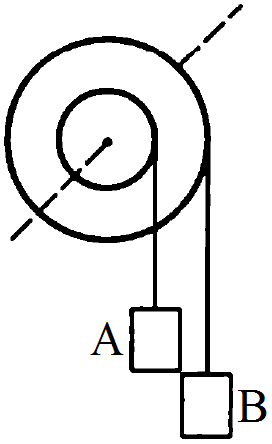
Figure shows a small wheel fixed coaxially on a bigger one of double the radius. The system rotates about the common axis. The strings supporting A and B do not slip on the wheels. If x and y be the distance travelled by A and B in the same time interval, then:
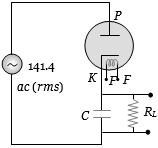
An alternating voltage of $141.4\,V$ (rms) is applied to a vacuum diode as shown in the figure. The maximum potential difference across the condenser will be......$V$
Two large vertical and parallel metal plates having a separation of $1 \ cm$ are connected to a $DC$ voltage source of potential difference $X$. A proton is released at rest midway between the two plates. It is found to move at $45^{\circ}$ to the vertical $JUST$ after release. Then $X$ is nearly
A uniform heating wire of resistance $36\, \Omega$ is connected across a potential difference of $240\, {V}$ The wire is then cut into half and potential difference of $240\, {V}$ is applied across each half separately. The ratio of power dissipation in first case to the total power dissipation in the second case would be $1: {x}$, where ${x}$ is........... .
Assertion : Basic difference between an electric line and magnetic line of force is that former is discontinuous and the latter is continuous or endless.
Reason : No electric lines of forces exist inside a charged body but magnetic lines do exist inside a magnet.