MCQ
A random variable has the following probability distribution:
$X = x_i$ $0$ $1$ $2$ $3$ $4$ $5$ $6$ $7$
$P(X = X_i)$ $0$ $2p$ $2p$ $3p$ $p^2$ $2p^2$ $7p^2$ $2p$
  • $\frac{1}{10}$
  • B
    $-1$
  • C
    $-\frac{1}{10}$
  • D
    $\frac{1}{5}$

Answer

Correct option: A.
$\frac{1}{10}$

We know that the sum of probabilities in a probability distribution is always $1.$
$\therefore P(X = 1) + P(X = 2) + P(X = 3) + P(X = 4) + P(X = 5) +P(X = 6) + P(X = 7) +P(X = 8) = 1$
$\Rightarrow 0 + 2p + 2p + 3p + p^2 + 2p^2 + 7p^2 + 2p = 1$
$\Rightarrow 10p^{2 }+ 9p - 1 = 0$
$\Rightarrow (10p - 1)(p + 1) = 0$
$\Rightarrow\text{p}=\frac{1}{10}\text{ or }-1 ($Negleting $-1$ as the value of the probability cannot be negative$)$

Need a full question paper?

Generate a complete, print-ready paper with questions like this in minutes — across 16+ boards, with answer keys.

Start Generating Free

Similar questions

If two events are independent, then.
  1. They must be mutually exclusive.
  2. The sum of their probabilities must be equal to 1.
  3. (a) and (b) both are correct.
  4. None of the above is correctIf two. events are independent, then.
If A has $3 \times 3$ order square matrix and $| A |=-5$, then $|\operatorname{adj} A |$ is :
Let R be the relation on the set A = {1, 2, 3, 4} given by R = {(1, 2), (2, 2), (1, 1), (4, 4), (1, 3), (3, 3), (3, 2)}. Then,
  1. R is reflexive and symmetric but not transitive.
  2. R is reflexive and transitive but not symmetric.
  3. R is symmetric and transitive but not reflexive.
  4. R is an equivalence relation.
Choose the correct answer from the given four options.
The area of the quadrilateral ABCD, where A(0, 4, 1), B(2, 3, -1), C(4, 5, 0) and D(2, 6, 2), is equal to:
  1. 9 sq. units.
  2. 18 sq. units.
  3. 27 sq. units.
  4. 81 sq. units.
The eqution of the plane which cute equal intercepts of unit length on the coordinate axes is:
  1. x + y + z = 1
  2. x + y + z = 0
  3. x + y - z = 1
  4. x + y + z = 2
The Convex Polygon Theorem states that the optimum (maximum or minimum) solution of a LPP is attained at atleastone of the ______ of the convex set over which the solution is feasible.
  1. Origin
  2. Corner points
  3. Centre
  4. Edge
The maximum value of Z = 3x + 4y subjected to constraints $\text{x}+\text{y}\leq4,\text{x}\geq0$ and $\text{y}\geq0$ is:
  1. 12
  2. 14
  3. 16
  4. None of the above
The value of the determinant $\begin{vmatrix}\text{x}&\text{x}+\text{y}&\text{x}+2\text{y}\\\text{x}+2\text{y}&\text{x}&\text{x}+\text{y}\\\text{x}+\text{y}&\text{x}+2\text{y}&\text{x}\end{vmatrix}$ is:
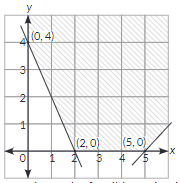
A linear programming problem (LPP) along with the graph of its constraints is shown below. The corresponding objective function is
Minimize: $Z=3 x+2 y$. The minimum value of the objective function is obtained at the corner point ( 2 , 0).
The optimal solution of the above linear programming problem $\qquad$
Image
If $y=x^x$, then the value of $\frac{d y}{d x}$ will be