MCQ
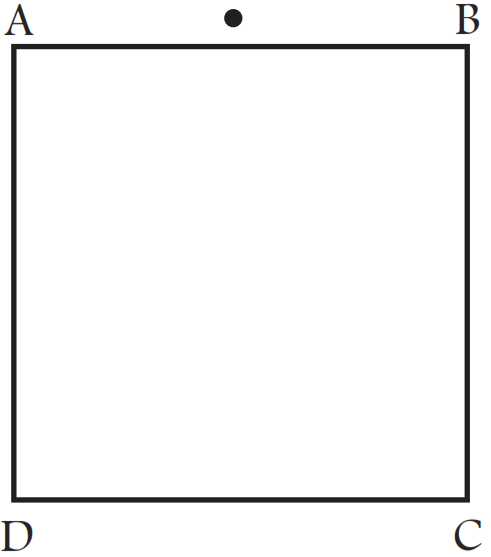
A rectangular block of glass $\text{ABCD}$ has a refractive index $1.6.$ A pin is placed midway on the face $AB ($Fig$)$. When observed from the face $AD$, the pin shall:
  • A
    Appear to be near $A.$
  • B
    Appear to be near $D.$
  • C
    Appear to be at the centre of $AD.$
  • Not be seen at all.

Answer

Correct option: D.
Not be seen at all.
We know that, $\Box=\frac{1}{\sin\text{C}}$ Substituting $\Box=1.6$, we get $C = 38.7^\circ$ As long as angle of incidence on $AD$ of the ray emanating from pin is greater than the critical angle, the light suffers from total internal reflection and the pin cannot be seen through $AD.$

Need a full question paper?

Generate a complete, print-ready paper with questions like this in minutes — across 16+ boards, with answer keys.

Start Generating Free

Similar questions

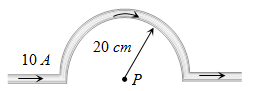
A current of 10A is passing through a long wire which has semicircular loop of the radius 20cm as shown in the figure. Magnetic field produced at the centre of the loop is
Kinetic energy of an electron accelerated in a potential difference of $100\, V$ is
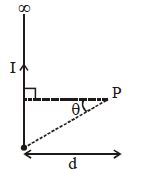
Magnetic field due to semi infinite length wire at point $P$ 
The period of oscillation of a magnet in vibration magnetometer is 2 sec. The period of oscillation of a magnet whose magnetic moment is four times that of the first magnet is
A galvanometer having a resistance of 8 ohm is shunted by a wire of resistance 2 ohm. If the total current is 1 amp, the part of it passing through the shunt will be
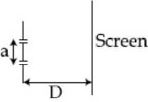
The figure shows a Young’s double slit experimental setup. It is observed that when a thin transparent sheet of thickness $t$ and refractive index $\mu $ is put in front of one of the slits, the central maximum gets shifted by a distance equal to $n$ fringe widths. If the wavelength of light used is $\lambda ,\,t$ will be
The arrangement fo two magnetic poles of equal and opposite strengths separated by a finite distance is called:
The energy needed to break a nucleus into its individual nucleons in a nuclear reaction is called:
The alternating current is given by

${i}=\left\{\sqrt{42} \sin \left(\frac{2 \pi}{{T}} {t}\right)+10\right\} {A}$

The $r.m.s.$ value of this current is ${A}$

Match the nuclear processes given in column $I$ with the appropriate option$(s)$ in column $II$
column $I$ column $II$
$(A.)$Nuclear fusion $(P.)$ Absorption of thermal neutrons by ${ }_{92}^{213} U$
$(B.)$Fission in a nuclear reactor $(Q.)$ ${ }_{27}^{60} Co$ nucleus
$(C.)$ $\beta$-decay $(R.)$ Energy production in stars via hydrogen conversion to helium
$(D.)$ $\gamma$-ray emission $(S.)$ Heavy water
  $(T.)$ Neutrino emission