A rectangular block of mass $5\,kg$ attached to a horizontal spiral spring executes simple harmonic motion of amplitude $1\,m$ and time period $3.14\,s$. The maximum force exerted by spring on block is $.......N$.
Experience the future of education. Simply download our apps or reach out to us for more information. Let's shape the future of learning together!No signup needed.*
In an experiment for determining the gravitational acceleration $g$ of a place with the help of a simple pendulum, the measured time period square is plotted against the string length of the pendulum in the figure. What is the value of $g$ at the place? ...... $m/s^2$
A spring block system in horizontal oscillation has a time-period $T$. Now the spring is cut into four equal parts and the block is re-connected with one of the parts. The new time period of vertical oscillation will be
If $A$ is the area of cross-section of a spring $L$ is its length $E$ is the Young's modulus of the material of the spring then time period and force constant of the spring will be respectively
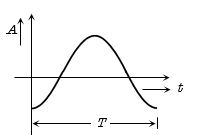
A particle starts with $S.H.M.$ from the mean position as shown in the figure. Its amplitude is $A$ and its time period is $T$. At one time, its speed is half that of the maximum speed. What is this displacement?
A mass $m$ is attached to two springs of same force constant $K$, as shown in following four arrangements. If $T_1, T_2, T_3$ and $T_4$ respectively be the time periods of oscillation in the following arrangements, in which case time period is maximum?
Two pendulums have time periods $T$ and $5T/4.$ They start $SHM$ at the same time from the mean position. After how many oscillations of the smaller pendulum they will be again in the same phase :
A coin is placed on a horizontal platform which undergoes vertical simple harmonic motion of angular frequency $\omega $. The amplitude of oscillation is gradually increased. The coin will leave contact with the platform for the first time