MCQ
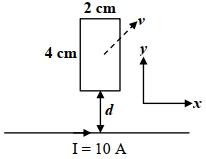
A rectangular conducting loop of length $4 \mathrm{~cm}$ and width $2 \mathrm{~cm}$ is in the $x y$-plane, as shown in the figure. It is being moved away from a thin and long conducting wire along the direction $\frac{\sqrt{3}}{2} \hat{x}+\frac{1}{2} \hat{y}$ with a constant speed $v$. The wire is carrying a steady current $\mathrm{I}=10 \mathrm{~A}$ in the positive $x$-direction. A current of $10 \mu \mathrm{A}$ flows through the loop when it is at a distance $d=4 \mathrm{~cm}$ from the wire. If the resistance of the loop is $0.1 \Omega$, then the value of $v$ is. . . . . . .$\mathrm{ms}^{-1}$.

[Given: The permeability of free space $\mu_0=4 \pi \times 10^{-7} \mathrm{NA}^{-2}$ ]
  • $4$
  • B
    $5$
  • C
    $7$
  • D
    $10$

Answer

Correct option: A.
$4$
a
$\mathrm{R}=0.1 \Omega$

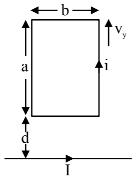
$\varepsilon=\left(\mathrm{B}_1-\mathrm{B}_2\right) \mathrm{bv}_y$

(image)

$\mathrm{i}=\frac{\varepsilon}{\mathrm{R}}=\frac{\mu_0 \mathrm{I}}{2 \pi \mathrm{R}}\left(\frac{1}{\mathrm{~d}}-\frac{1}{\mathrm{~d}+\mathrm{a}}\right) \mathrm{bv}_y$

$\Rightarrow 10^{-5}=\frac{2 \times 10^{-7} \times 10}{0.1}\left[\frac{1}{4}-\frac{1}{8}\right] \times 2 . \mathrm{v}_y$

$\therefore \mathrm{v}_{\mathrm{y}}=2$

$\tan \theta=\frac{\mathrm{v}_z}{\mathrm{v}_z}=\frac{1}{\sqrt{3}}$

(image)

$\therefore \mathrm{v}_{\mathrm{x}}=2 \sqrt{3}$

$\therefore \mathrm{v}=\sqrt{\mathrm{v}_x^2+\mathrm{v}_z^2}=4$

Need a full question paper?

Generate a complete, print-ready paper with questions like this in minutes — across 16+ boards, with answer keys.

Start Generating Free

Similar questions

An electron and a proton enter region of uniform magnetic field in a direction at right angles to the field with the same kinetic energy. They describe circular paths of radius $r_e$ and $r_p$ respectively. Then
The ratio of radii of nuclei $_{13}Al^{27}$ and $_{52}X^A$ is $3:5.$ The number of  neutrons in the nuclei of $X$ will be 
The kinetic energy of the electron in an orbit of radius r in hydrogen atom is (e = electronic charge)
 
A person cannot see objects clearly beyond $2.0 \,m$. The power of lens required to correct his vision will be
The radiation corresponding to $3 \rightarrow 2$ transition of a hydrogen atom falls on a gold surface to generate photoelectrons. These electrons are passed through a magnetic field of $5 \times 10^{-4} \,{T}$. Assume that the radius of the largest circular path followed by these electrons is $7\, {mm}$, the work function of the metal is $.....\,{eV}$

(Mass of electron $=9.1 \times 10^{-31} \,{kg}$ )

The work functions of metals A and B are in the ratio 1 : 2. If light of frequencies f and 2f are incident on the surfaces of A and B respectively, the ratio of the maximum kinetic energies of photoelectrons emitted is (f is greater than threshold frequency of A, 2f is greater than threshold frequency of B)
Kinetic energy with the electrons are emitted from the metal surface due to photoelectric effect is:
The insulated spheres of radii ${R_1}$ and ${R_2}$ having charges ${Q_1}$and ${Q_2}$ respectively are connected to each other. There is
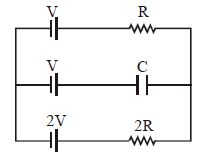
In the given circuit, with steady current, the potential drop across the capacitor must be
$C^{14}$ has half life 5700 years. At the end of 11400 years, the actual amount left is