MCQ
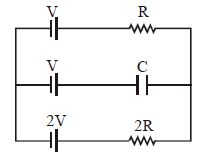
In the given circuit, with steady current, the potential drop across the capacitor must be
  • A
    $V$
  • B
    $V/2$
  • $V/3$
  • D
    $2V/3$

Answer

Correct option: C.
$V/3$
c
in sleady state

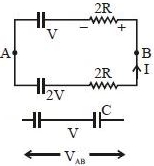
$I=\frac{2 V-V}{2 R+R}=\frac{V}{3 R}$

Potential differnce across $"\mathrm{R}"$ $=\frac{\mathrm{V}}{3 \mathrm{R}} \times \mathrm{R}=\frac{\mathrm{V}}{3}$

$\therefore \mathrm{V}_{\mathrm{AB}}=\mathrm{V}+\frac{\mathrm{V}}{3}$

and

So potential difference across $\mathrm{C}=\frac{\mathrm{V}}{3}$
Need a full question paper?

Generate a complete, print-ready paper with questions like this in minutes — across 16+ boards, with answer keys.
Start Generating Free

Similar questions

A convex lens forming a real image of magnification $m_1$ on a screen is moved through  a  distance $x$. $A$ new image of magnification $m_2$ is again formed on the screen. The focal  length of the lens is:
A concave mirror is used to focus the image of a flower on a nearby well 120 cm from the flower. If a lateral magnification of 16 is desired, the distance of the flower from the mirror should be
A study of binary stars is most helpful in
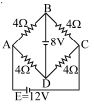
The given figure shows $a$ network of resistances and $a$ battery. Which of the two batteries is getting charged?
When a particle is restricted to move along $x$-axis between $x=0$ and $x=a$, where $a$ is of nanometer dimension, its energy can take only certain specific values. The allowed energies of the particle moving in such a restricted region, correspond to the formation of standing waves with nodes at its ends $x=0$ and $x=a$. The wavelength of this standing wave is related to the linear momentum $p$ of the particle according to the de Broglie relation. The energy of the particle of mass $m$ is related to its linear momentum as $E=\frac{p^2}{2 m}$. Thus, the energy of the particle can be denoted by a quantum number ' $n$ ' taking values $1,2,3, \ldots \quad(n=1$, called the ground state) corresponding to the number of loops in the standing wave.

Use the model described above to answer the following three questions for a particle moving in the line $x=0$ to $x=a$. Take $h=6.6 \times 10^{-34} \mathrm{~J} \mathrm{~s}$ and $e=1.6 \times 10^{-19} \mathrm{C}$.

$1.$ The allowed energy for the particle for a particular value of $n$ is proportional to

$(A)$ $a^{-2}$ $(B)$ $a^{-3 / 2}$ $(C)$ $a^{-1}$ $(D)$ $a^2$

$2.$ If the mass of the particle is $m=1.0 \times 10^{-30} \mathrm{~kg}$ and $a=6.6 \mathrm{~nm}$, the energy of the particle in its ground state is closest to

$(A)$ $0.8 \ \mathrm{meV}$ $(B)$ $8 \ \mathrm{meV}$ $(C)$ $80 \ \mathrm{meV}$ $(D)$ $800 \ \mathrm{meV}$

$3.$ The speed of the particle, that can take discrete values, is proportional to

$(A)$ $n^{-3 / 2}$ $(B)$ $n^{-1}$ $(C)$ $n^{1 / 2}$ $(D)$ $n$

Give the answer question $1, 2$ and $3.$
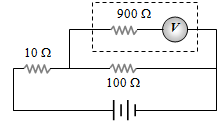
The potential difference across the 100 W resistance in the following circuit is measured by a voltmeter of 900 W resistance. The percentage error made in reading the potential difference is
At absolute zero, $Si$ acts as
An $a.c.$ of frequency $f$ is flowing in a circuit containing only an ideal choke coil of inductance $L$. If $V_0$ and $i_0$ represent peak values of the voltage and the current respectively, the average power given by the source to the choke coil is equal to
A solution containing active cobalt ${}_{27}^{60}Co$ having activity of $0.8\,\mu Ci$ and decay constant $\lambda $ is injected in an animal's body. If $1 \,cm^3$ of blood is drawn from the animal's body after $10\, hrs$ of injection, the activity found was $300\, decays$ per minute. What is the volume of blood that is flowing in the body?..........$litres$ ( $ICi = 3.7 \times 10^{10}$ decay per second and at $t = 10\, hrs$ ${e^{ - \lambda t}} = 0.84$ )
A capacitor of capacity $C$ has charge $Q$ and stored energy is $W$. If the charge is increased to $2Q$, the stored energy will be