Question
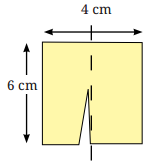
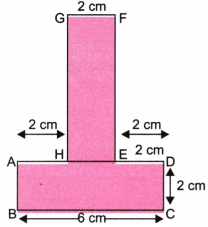
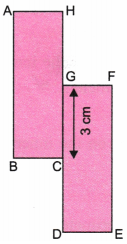
A rectangular paper chit of dimension 6 cm × 4 cm is cut as shown into two equal pieces. These two pieces are joined in different ways.
Image
Image
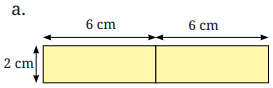
For example, the arrangement a. has a perimeter of 28 cm.
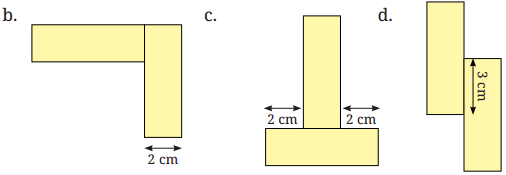
Find out the length of the boundary (i.e., the perimeter) of each of the other arrangements below.
Image

Answer

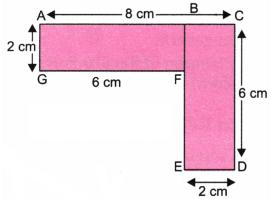
(b)
Image
∴ Length of boundary = AB + BC + CD + DE + EF + FG + GA
= 6 + 2 + 6 + 2 + 4 + 6 + 2
= 28 cm
(c)
Image
Total length of boundary = AB + BC + CD + DE +EF + FG + GH + HA
= 2 + 6 + 2 + 2 + 6 + 2 + 6 + 2
= 28 cm
(d)
Image
Total length of boundary = AB + BC + CD + DE + EF + FG + GH + HA
= 6 + 2 + 3 + 2 + 6 + 2 + 3 + 2
= 26 cm

Need a full question paper?

Generate a complete, print-ready paper with questions like this in minutes — across 16+ boards, with answer keys.

Start Generating Free

Similar questions

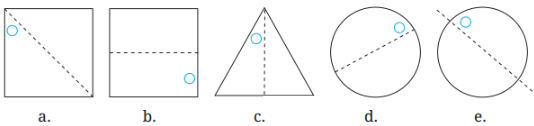
Given the line(s) of symmetry, find the other hole(s).
Image
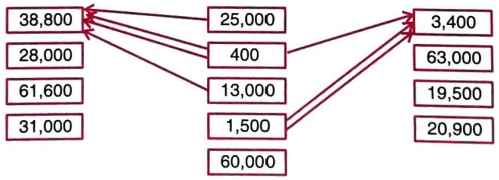
In the following figure numbers are written in the boxes in three columns. Arrows are directed towards the first and third columns from the boxes in the second column. The number in the box in first or third column is sum of the numbers in the middle row from which arrows originate.
For example,
$\begin{array}{l}3,400=1,500+1,500+400 \\ 38,800=25,000+400+400+13,000\end{array}$
Image
Similarly, draw arrows from the boxes in the middle column to the numbers on the side columns to obtain the following sums: $14,000,\ 25,000,\ 16,000$
Can we make 1,000 using the numbers in the middle column?
Draw any angle with vertex $O.$ Take a point $A$ on one of its arms and $B$ on another such that $OA = OB.$ Draw the perpendicular bisectors of $\overline{\text{OA}}$ and $\overline{\text{OB}}$. Let them meet at $P$. Is $PA = PB ?$
Fill in the missing fraction: $\square+\frac5{27}\;=\;\frac{12}{27}$
Katrina rode her bicycle $6\frac12 \ km$ in the morning and $8\frac34 \ km$ in the evening. Find the distance travelled by her altogether on that day.
Match the following:
Measures of Triangle Type of Triangle
$(a)$ $3$ sides of equal length $(i)$ Scalene
$(b)$ $2$ sides of equal length $(ii)$ Isosceles right angled
$(c)$ All sides are of different length $(iii)$ Obtuse angled
$(d)$ $3$ acute angles $(iv)$ Right angled
$(e)$ $1$ right angle $(v)$ Equilateral
$(f)$ $1$ obtuse angle $(vi)$ Acute angled
$(g)$$1$ right angle with two sides of equal length $(vii)$ Isosceles
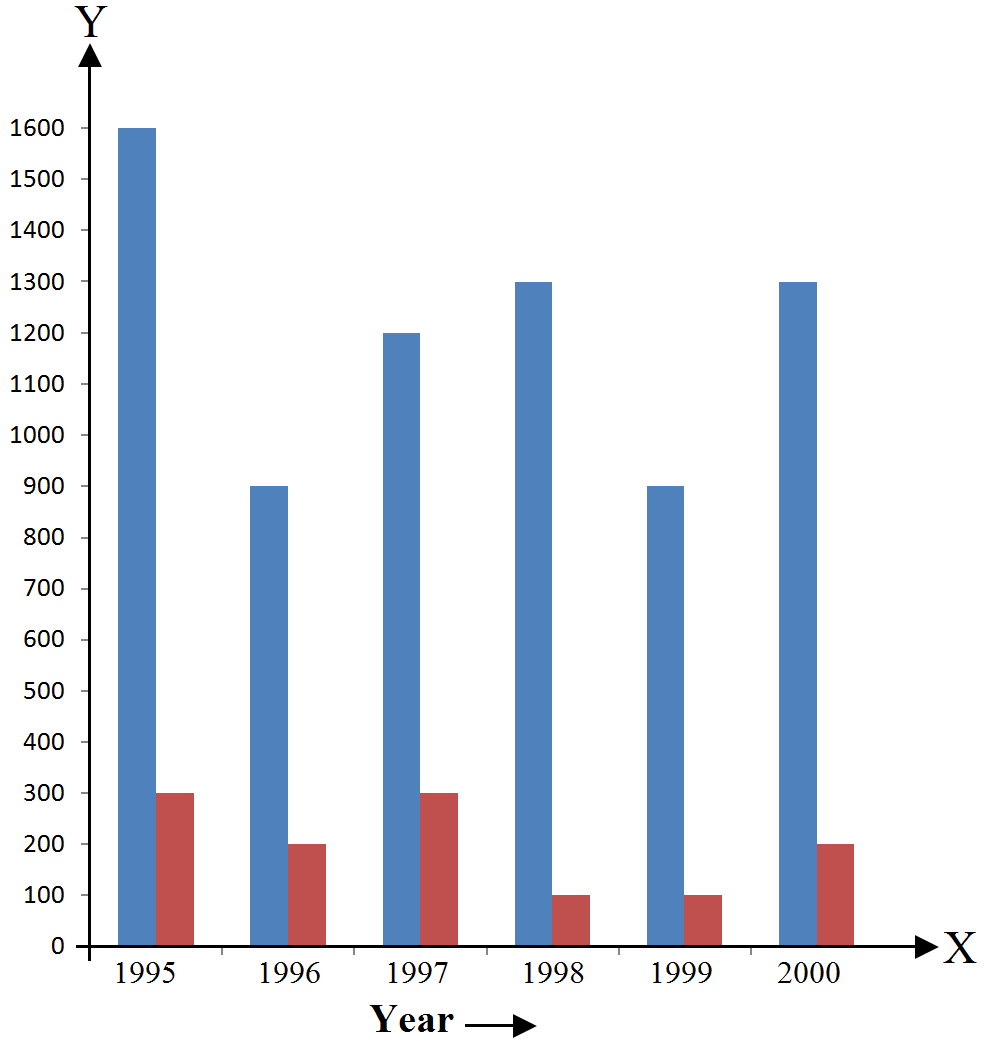
The following bar graph shows the number of persons killed in industrial accidents in a country for some years.
Read the bar graph and choose the correct alternative in each of the following:
$i.\ $The year which shows the maximum percentage increase in the number of persons killed in coal mines over the precending year is:
$a.\1996$
$b.\ 1997$
$c.\ 1999$
$d.\ 2000$
$ii.\ $The year which shows the maximum decrease in the number of persons killed in industrial accidents over the precending year is:
$a.\ 1996$
$b.\ 1997$
$c.\ 1998$
$d.\ 1999$
$iii.\ $The year in which the maximum number of persons were killed in industrial accidents other than those killed in coal mines is:
$a.\ 1995$
$b.\ 1997$
$c.\ 1998$
$d.\ 1999$
Using ruler and compasses only, draw a right angle.
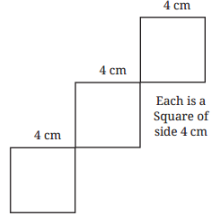
Construct the ‘Falling Squares” figure shown below:
Image
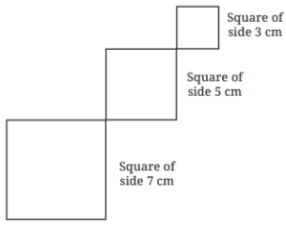
Make sure that the squares are aligned the way they are shown. Now, try this.
Image
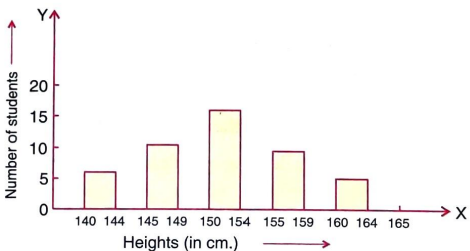
The following bar graph Fig. represents the heights (in cm) of 50 students of Class XI of a particular school. Study the graph and answer the following questions:
Image
(i) What percentage of the total number of students have their heights more than 149 cm?
(ii) How many students in the class are in the range of maximum height of the class?
(iii) The school wants to provide a particular type of tonic to each student below the height of 150 cm to improve his height. If the cost of the tonic for each student comes out to be ₹55, how much amount of money is required?
(iv) How many students are in the range of shortest height of the class?
(v) State whether true or false:
(a) There are 9 students in the class whose heights are in the range of 155-159 cm.
(b) Maximum height (in cm) of a student in the class is 17.
(c) There are 29 students in the class whose heights are in the range of 145-154 cm.
(d) Minimum height (in cm) of a student is the class is in the range of 140-144 cms.
(e) The number of students in the class having their heights less than150 cm is 12.
(f) There are 14 students each of whom has height more than 154 cm.