A resistor develops $300 \,J$ of thermal energy in $15 \,s$, when a current of $2\, A$ is passed through it. If the current increases to $3 \,A$, the energy developed in $10\,\,s$ is........$J.$
JEE MAIN 2022, Medium
Download our app for free and get started
$H =i^{2} Rt$
$300=2^{2} \times R \times 15$
$\Rightarrow R =\frac{300}{60}=5 \Omega$
Now, for $i =3 A , t =10 s , R =5 \Omega$
$H =3^{2} \times 5 \times 10=450 \,J$

Download our appand get started for free
Experience the future of education. Simply download our apps or reach out to us for more information. Let's shape the future of learning together!No signup needed.*
Similar Questions
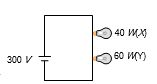
- 1Two bulbs $X$ and $Y$ having same voltage rating and of power $40\, watt$ and $60\, watt$ respectively are connected in series across a potential difference of $300\, volt$, thenView Solution
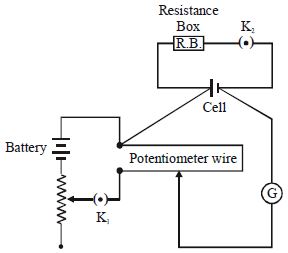
- 2The adjoining figure shows the connections of potentiometer experiment to determine internal resistance of of a leclanche cell. When the cell is on open circuit the balancing length of the potentiometer wire is $3.4\, m$ and on closing the key $K_2$ the balancing length becomes $1.7\, m$ . If the resistance $R$ through which current is drawn is $10\,\Omega $ then the internal resistance of the cell is .............. $\Omega$View Solution
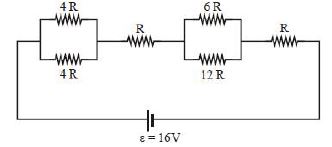
- 3The resistive network shown below is connected to a $D.C.$ source of $16\, V$. The power consumed by the network is $4\, Watt$. The value of $R$ is ............. $\Omega$View Solution
- 4A constant electric current $I$ is passed through a straight conductor of length $l$. If $S$ in specific charge of electron then the total momentum of electrons isView Solution
- 5A current of $10 \,A$ is maintained in a conductor of cross-section $1 \,cm ^2$. If the number density of free electrons be $9 \times 10^{28} \,m ^{-3}$, the drift velocity of free electrons is .......... $m / s$View Solution
- 6At room temperature $\left(27^{\circ} \mathrm{C}\right)$, the resistance of a heating element is $50 \Omega$. The temperature coefficient of the material is $2.4 \times 10^{-4}{ }^{\circ} \mathrm{C}^1$. The temperature of the element, when its resistance is $62 \Omega$, is $\qquad$ ${ }^{\circ} \mathrm{C}$.View Solution
- 7A steady current $i$ is flowing through a conductor of uniform cross-section. Any segment of the conductor hasView Solution
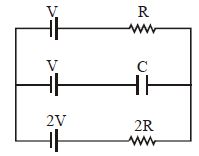
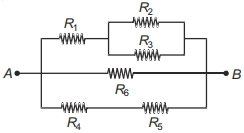
- 8View SolutionConsider the combination of resistors as shown in figure and pick out the correct statement
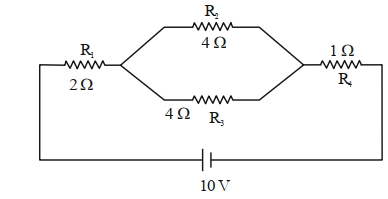
- 9In the given circuit, the current in resistance $\mathrm{R}_3 $ is :View Solution
- 10View SolutionIn the given circuit, with steady current, the potential drop across the capacitor must be