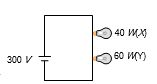
Two bulbs $X$ and $Y$ having same voltage rating and of power $40\, watt$ and $60\, watt$ respectively are connected in series across a potential difference of $300\, volt$, then
Easy


Download our appand get started for free
Experience the future of education. Simply download our apps or reach out to us for more information. Let's shape the future of learning together!No signup needed.*
Similar Questions
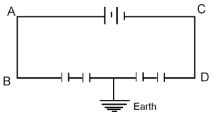
- 1Four equal capacitors are connected to a battery as shown in the adjoining figure. The potential of $A$ and $B$ areView Solution
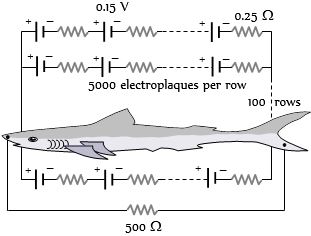
- 2Eels are able to generate current with biological cells called electroplaques. The electroplaques in an eel are arranged in $100$ rows, each row stretching horizontally along the body of the fish containing $5000$ electroplaques. The arrangement is suggestively shown below. Each electroplaques has an emf of $0.15\, V$ and internal resistance of $0.25 \,\Omega$ The water surrounding the eel completes a circuit between the head and its tail. If the water surrounding it has a resistance of $500 \,\Omega$, the current an eel can produce in water is about .............. $A$View Solution
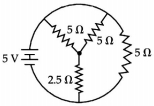
- 3The total current supplied to the circuit as shown in figure by the $5 V$ battery is $A$View Solution
- 4A cell can be balanced against $110\,\, cm$ and $100\,\, cm$ of potentiometer wire, respectively with and without being short circuited through a resistance of $10 \,\,\Omega$. Its internal resistance is ............... $\Omega$View Solution
- 5When a potential difference $V$ is applied across a wire of resistance $R$, it dissipates energy at a rate $W$. If the wire is cut into two halves and these halves are connected mutually parallel across the same supply, the same supply, the energy dissipation rate will become:View Solution
- 6In given arrangement $E_1 = 5\, volts$ $E_2 = 7\, volt$ balancing length is $6\,m$ if terminals of $E_2$ are reversed then new balancing length will beView Solution
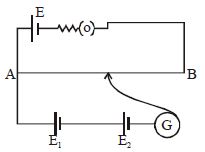
- 7A $10\, m$ long wire of $20\,\Omega$ resistance is connected with a battery of $3\, volt$ $e.m.f.$ (negligible internal resistance) and a $10 \,\Omega$ resistance is joined to it is series. Potential gradient along wire in volt per meter isView Solution
- 8View SolutionA potentiometer is an ideal device of measuring potential difference because
- 9A coil takes $15\,\min$ to boil a certain amount of water, another coil takes $20\,\min$ for the same process. Time taken to boil the same amount of water when both coil are connected in series ........... $min$View Solution
- 10What equal length of an iron wire and a copper-nickel alloy wire, each of $2 \; {mm}$ diameter connected parallel to give an equivalent resistance of $3 \Omega ?$View Solution
(Given resistivities of iron and copper-nickel alloy wire are $12 \;\mu \Omega {cm}$ and $51\; \mu \Omega {cm}$ respectively) (in ${m}$)