Question
✓
Answer
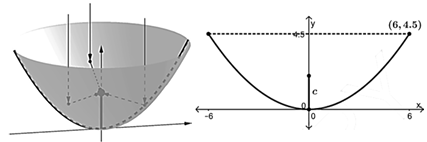
i. Given curve is a parabola
Equation of parabola is $x^2=4 a y$
It passes through the point (6, 4.5)
$\begin{array}{l}\Rightarrow 36=4 \times a \times 4.5 \\ \Rightarrow 36=18 a \\ \Rightarrow a=2\end{array}$
Equation of parabola is $x^2=8 y$
ii. Distance between focus and vertex is $= a =\sqrt{(4-4)^2+(5-3)^2}=2$
Equation of parabola is $(y-k)^2=4 a(x-h)$
where (h, k) is vertex
$\Rightarrow$ Equation of parabola with vertex $(3,4) \& a=2$
$\Rightarrow(y-4)^2=8(x-3)$
iii. Equation of parabola with axis along x - axis
$y ^2=4 ax$
which passes through (2, 3)
$\begin{array}{l}\Rightarrow 9=4 a \times 2 \\ \Rightarrow 4 a =\frac{9}{2}\end{array}$
hence required equation of parabola is
$y^2=\frac{9}{2} x$
$\Rightarrow 2 y^2=9 x$
Hence length of latus rectum = 4a = 4.5
OR
$x^2=8 y$
a = 2
Focus of parabola is (0, 2)
length of latus rectum is $4 a=4 \times 2=8$
Equation of directrix y + 2 = 0
Equation of parabola is $x^2=4 a y$
It passes through the point (6, 4.5)
$\begin{array}{l}\Rightarrow 36=4 \times a \times 4.5 \\ \Rightarrow 36=18 a \\ \Rightarrow a=2\end{array}$
Equation of parabola is $x^2=8 y$
ii. Distance between focus and vertex is $= a =\sqrt{(4-4)^2+(5-3)^2}=2$
Equation of parabola is $(y-k)^2=4 a(x-h)$
where (h, k) is vertex
$\Rightarrow$ Equation of parabola with vertex $(3,4) \& a=2$
$\Rightarrow(y-4)^2=8(x-3)$
iii. Equation of parabola with axis along x - axis
$y ^2=4 ax$
which passes through (2, 3)
$\begin{array}{l}\Rightarrow 9=4 a \times 2 \\ \Rightarrow 4 a =\frac{9}{2}\end{array}$
hence required equation of parabola is
$y^2=\frac{9}{2} x$
$\Rightarrow 2 y^2=9 x$
Hence length of latus rectum = 4a = 4.5
OR
$x^2=8 y$
a = 2
Focus of parabola is (0, 2)
length of latus rectum is $4 a=4 \times 2=8$
Equation of directrix y + 2 = 0
Need a full question paper?
Generate a complete, print-ready paper with questions like this in minutes — across 16+ boards, with answer keys.
Explore more
Similar questions
A class teacher Mamta Sharma of class XI write three sets A, Band Care such that A = {1, 3, 5, 7, 9}, B = {2, 4, 6, 8} and C = {2, 3, 5, 7, 11}.
Answer the following questions which are based on above sets.
→Answer the following questions which are based on above sets.
- Find $\text{A}\cap\text{B}.$
- {3, 5, 7}
- $\phi$
- {1, 5, 7}
- {2, 5, 7}
- Find $\text{A}\cap\text{C}.$
- {3, 5, 7}
- {1, 5, 7}
- $\phi$
- {3, 4, 7}
- Which of the following is correct for two sets A and B to be disjoint?
- $\text{A}\cap\text{B}=\phi$
- $\text{A}\cap\text{B}\neq\phi$
- $\text{A}\cup\text{B}=\phi$
- $\text{A}\cup\text{B}\neq\phi$
- Which of the following is correct for two sets A and C to be intersecting?
- $\text{A}\cap\text{C}=\phi$
- $\text{A}\cap\text{C}\neq\phi$
- $\text{A}\cup\text{C}=\phi$
- $\text{A}\cup\text{C}\neq\phi$
- Write the n[P(B)].
- 8
- 4
- 16
- 12
Shweta was teaching "method to solve a linear inequality in one variable" to her daughter.
Step I Collect all terms involving the variable (x) on one side and constant terms on other side with the help of above rules and then reduce it in the form $\mathbf{a x}<\mathbf{b}$ or $\mathbf{a x} \leq \mathbf{b}$ or $\mathbf{a x}>\mathbf{b}$ or $\mathbf{a x} \geq \mathbf{b}$.
Step II Divide this inequality by the coefficient of variable (x). This gives the solution set of given inequality.
Step III Write the solution set.
Based on above information, answer the following questions.
(i) The solution set of $\mathbf{2 4 x}<\mathbf{1 0 0}$, when $\mathrm{x}$ is a natural number is
(a) $\{1,2,3,4\}$ (b) $(1,4)$ (c) $[1,4]$ (d) None of these
(ii) The solution set of $24100 \mathrm{x}<$, when $\mathrm{x}$ is an integer is
(a) $\{\ldots \ldots-4,-3,-2,-1,0,1,2,3,4\}$ (b) $(-\infty, 4]$ (c) $[4, \infty]$ (d) None of the above
(iii) The solution set of $-\mathbf{5 x}+\mathbf{2 5}>0$ is
(a) $[5, \infty)$ (b) $(-\infty, 5]$ (c) $(5, \infty)$ (d) $(-\infty, 5)$
(iv) The solution set of $\mathbf{3 x}-\mathbf{5}<\mathbf{x + 7}$ is
(a) $(6, \infty)$ (b) $[6, \infty)$ (c) $(-\infty, 6)$ (d) $(-\infty, 6]$
(v) The solution set of $x+\frac{x}{2}+\frac{x}{3}<11$ is
(a) $(-\infty, 6]$ (b) $(-\infty, 6)$ (c) $[6, \infty)$ (d) None of these
→→Step I Collect all terms involving the variable (x) on one side and constant terms on other side with the help of above rules and then reduce it in the form $\mathbf{a x}<\mathbf{b}$ or $\mathbf{a x} \leq \mathbf{b}$ or $\mathbf{a x}>\mathbf{b}$ or $\mathbf{a x} \geq \mathbf{b}$.
Step II Divide this inequality by the coefficient of variable (x). This gives the solution set of given inequality.
Step III Write the solution set.
Based on above information, answer the following questions.
(i) The solution set of $\mathbf{2 4 x}<\mathbf{1 0 0}$, when $\mathrm{x}$ is a natural number is
(a) $\{1,2,3,4\}$ (b) $(1,4)$ (c) $[1,4]$ (d) None of these
(ii) The solution set of $24100 \mathrm{x}<$, when $\mathrm{x}$ is an integer is
(a) $\{\ldots \ldots-4,-3,-2,-1,0,1,2,3,4\}$ (b) $(-\infty, 4]$ (c) $[4, \infty]$ (d) None of the above
(iii) The solution set of $-\mathbf{5 x}+\mathbf{2 5}>0$ is
(a) $[5, \infty)$ (b) $(-\infty, 5]$ (c) $(5, \infty)$ (d) $(-\infty, 5)$
(iv) The solution set of $\mathbf{3 x}-\mathbf{5}<\mathbf{x + 7}$ is
(a) $(6, \infty)$ (b) $[6, \infty)$ (c) $(-\infty, 6)$ (d) $(-\infty, 6]$
(v) The solution set of $x+\frac{x}{2}+\frac{x}{3}<11$ is
(a) $(-\infty, 6]$ (b) $(-\infty, 6)$ (c) $[6, \infty)$ (d) None of these
 i
iFor a group of 200 candidates, the mean and the standard deviation of scores were found to be 40 and 15 , respectively. Later on it was discovered that the scores of 43 and 35 were misread as 34 and 53, respectively.
i. Find the correct variance. (1)
ii. What is the formula of variance. (1)
iii. Find the correct mean. (2)
OR
Find the sum of correct scores. (2)
| Student | English | Hindi | S.st | Science | Maths |
| Ramu | 39 | 59 | 84 | 80 | 41 |
| Rajitha | 79 | 92 | 68 | 38 | 75 |
| Komala | 41 | 60 | 38 | 71 | 82 |
| Patil | 77 | 77 | 87 | 75 | 42 |
| Pursi | 72 | 65 | 69 | 83 | 67 |
| Gayathri | 46 | 96 | 53 | 71 | 39 |
ii. What is the formula of variance. (1)
iii. Find the correct mean. (2)
OR
Find the sum of correct scores. (2)

Consider the data
i. Find the standard deviation. (1)
ii. Find the variance. (1)
iii. Find the mean. (2)
OR
Write the formula of variance? (2)
→| $x_i$ | 4 | 8 | 11 | 17 | 20 | 24 | 32 |
| $f _{ i }$ | 3 | 5 | 9 | 5 | 4 | 3 | 1 |
ii. Find the variance. (1)
iii. Find the mean. (2)
OR
Write the formula of variance? (2)
Ordered Pairs The ordered pair of two elements a and 3 is denoted by (a, b) : a is first element (or first component) and d is second element (or second component). Two ordered pairs are equal if their corresponding elements are equal. ie. (a, b) = (c, d)
→→⇒ a = c and b = d
Cartesian Product of Two Sets For two non-empty sets A and B, the cartesian product A . B is the set of all ordered pairs of elements from sets Aand B. In symbolic form, it can be written as
$\text{A}\cdot\text{B}=\{(\text{a},\text{b}):\text{a}\in\text{A},\text{b}\in\text{B}\}$
Based on the above topics, answer the following questions.
If (a - 3, 6 + 7) = (3, 7), then the value of aand d are:
6, 0
3, 7
7, 0
3, -7
If (x + 6, y - 2) = (0, 6), then the value of x and y are:
6, 8
-6, -8
-6, 8
6, -8
If (x + 2, 4) = (5, 2x + y), then the value of x and y are:
-3, 2
3, 2
-3, -2
Let A and B be two sets such that A . B consists of 6 elements. If three elements of A . B are (1, 4), (2, 6) and (3, 6), then
(A . B) = (B . A)
$(\text{A}\cdot\text{B})\neq(\text{B}\cdot\text{A})$
A . B = {(1, 4), (1, 6), (2, 4)}
None of the above
If m(A . B) = 45, then n(A) cannot be
15
17
5
9
The logarithmic function expressed as $\log _e R^{+} \rightarrow R$ and given by $\log _e x=y$ iff $e^y=x$. The graph of the function is given below :
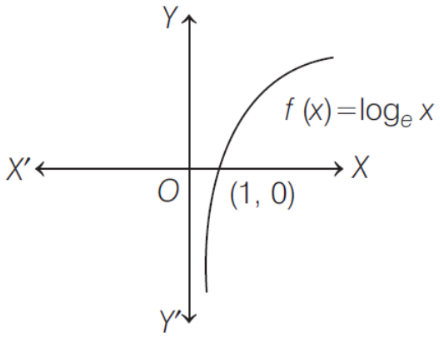
(i) Domain of $f(x)=(0, \infty)$ or $R^{+}$
(ii) Range of $f(x)=(-\infty, \infty)$ or $R$
To find the limit of functions involving logarithmic function, we use the following theorem Theorem $\lim _{x \rightarrow 0} \frac{\log _e(1+x)}{x}=1$
Based on above information, answer the following questions.
(i) $\lim _{x \rightarrow 0} \frac{\log _e(1+5 x)}{x}$ is equal to
(a) 5 (b) 4 (c) 3 (d) 1
(ii) $\lim _{x \rightarrow 0} \frac{\log _e(1+6 x)-5 x^2}{x}$ is equal to
(a) 1 (b) 2 (c) 3 (d) 6
(iii) $\quad \lim _{x \rightarrow 0} \frac{\sqrt{1+x}-1}{\log (1+x)}$ is equal to
(a) 1 (b) $\frac{1}{2}$ (c) $\frac{1}{3}$ (d) $\frac{3}{2}$
(iv) $\quad \lim _{x \rightarrow 5} \frac{\log x-\log 5}{x-5}$ is equal to
(a) $\frac{1}{5}$ (b) $\frac{3}{5}$ (c) $\frac{1}{4}$ (d) $\frac{2}{3}$
(v) $\quad \lim _{x \rightarrow 0} \frac{\log (5+x)-\log (5-x)}{x}$ is equal to
(a) $\frac{1}{5}$ (b) $\frac{2}{5}$ (c) $\frac{3}{5}$ (d) $\frac{4}{5}$
→(i) Domain of $f(x)=(0, \infty)$ or $R^{+}$
(ii) Range of $f(x)=(-\infty, \infty)$ or $R$
To find the limit of functions involving logarithmic function, we use the following theorem Theorem $\lim _{x \rightarrow 0} \frac{\log _e(1+x)}{x}=1$
Based on above information, answer the following questions.
(i) $\lim _{x \rightarrow 0} \frac{\log _e(1+5 x)}{x}$ is equal to
(a) 5 (b) 4 (c) 3 (d) 1
(ii) $\lim _{x \rightarrow 0} \frac{\log _e(1+6 x)-5 x^2}{x}$ is equal to
(a) 1 (b) 2 (c) 3 (d) 6
(iii) $\quad \lim _{x \rightarrow 0} \frac{\sqrt{1+x}-1}{\log (1+x)}$ is equal to
(a) 1 (b) $\frac{1}{2}$ (c) $\frac{1}{3}$ (d) $\frac{3}{2}$
(iv) $\quad \lim _{x \rightarrow 5} \frac{\log x-\log 5}{x-5}$ is equal to
(a) $\frac{1}{5}$ (b) $\frac{3}{5}$ (c) $\frac{1}{4}$ (d) $\frac{2}{3}$
(v) $\quad \lim _{x \rightarrow 0} \frac{\log (5+x)-\log (5-x)}{x}$ is equal to
(a) $\frac{1}{5}$ (b) $\frac{2}{5}$ (c) $\frac{3}{5}$ (d) $\frac{4}{5}$
We have, $i=\sqrt{-1}$. So, we can write the higher powers of $i$ as follows
(i) $i^2=-1$
(ii) $i^3=i^2 \cdot i=(-1) \cdot i=-i$
(iii) $i^4=\left(i^2\right)^2=(-1)^2=1$
(iv) $i^5=i^{4+1}=i^4 \cdot i=1 \cdot i=i$
(v) $i^6=i^{4+2}=i^4 \cdot i^2=1 \cdot i^2=-1$
In order to compute $i^n$ for $n>4$, write $i^n=i^{4 q+r}$ for some $q, r \in N$ and $0 \leq r \leq 3$. Then, $i^n=$ $i^{4 q} \cdot i^r=\left(i^4\right)^q \cdot i^r=(1)^q \cdot i^r=i^r$.
In general, for any integer $k, i^{4 k}=1, i^{4 k+1}=i, i^{4 k+2}=-1$ and $i^{4 k+3}=-i$.
On the basis of above information, answer the following questions.
(i) The value of $i^{37}$ is equal to
(a) $i$ (b) $-i$ (c) 1 (d) -1
(ii) The value of $i^{-30}$ is equal to
(a) $i$ (b) 1 (c) -1 (d) $-i$
(iii) If $z=i^9+i^{19}$, then $z$ is equal to
(a) $0+0 i$ (b) $1+0 i$ (c) $0+i$ (d) $1+2 i$
(iv) The value of $\left[i^{19}+\left(\frac{1}{i}\right)^{25}\right]^2$ is equal to
(a) -4 (b) 4 (c) $\mathrm{i}$ (d) 1
(v) If $z=i^{-39}$, then simplest form of $z$ is equal to
(a) $1+0 i$ (b) $0+i$ (c) $0+0 i$ (d) $1+i$
→(i) $i^2=-1$
(ii) $i^3=i^2 \cdot i=(-1) \cdot i=-i$
(iii) $i^4=\left(i^2\right)^2=(-1)^2=1$
(iv) $i^5=i^{4+1}=i^4 \cdot i=1 \cdot i=i$
(v) $i^6=i^{4+2}=i^4 \cdot i^2=1 \cdot i^2=-1$
In order to compute $i^n$ for $n>4$, write $i^n=i^{4 q+r}$ for some $q, r \in N$ and $0 \leq r \leq 3$. Then, $i^n=$ $i^{4 q} \cdot i^r=\left(i^4\right)^q \cdot i^r=(1)^q \cdot i^r=i^r$.
In general, for any integer $k, i^{4 k}=1, i^{4 k+1}=i, i^{4 k+2}=-1$ and $i^{4 k+3}=-i$.
On the basis of above information, answer the following questions.
(i) The value of $i^{37}$ is equal to
(a) $i$ (b) $-i$ (c) 1 (d) -1
(ii) The value of $i^{-30}$ is equal to
(a) $i$ (b) 1 (c) -1 (d) $-i$
(iii) If $z=i^9+i^{19}$, then $z$ is equal to
(a) $0+0 i$ (b) $1+0 i$ (c) $0+i$ (d) $1+2 i$
(iv) The value of $\left[i^{19}+\left(\frac{1}{i}\right)^{25}\right]^2$ is equal to
(a) -4 (b) 4 (c) $\mathrm{i}$ (d) 1
(v) If $z=i^{-39}$, then simplest form of $z$ is equal to
(a) $1+0 i$ (b) $0+i$ (c) $0+0 i$ (d) $1+i$