MCQ
A scientist says that the efficiency of his heat engine which operates at source temperature $127°C$ and sink temperature $27°C$ is $26\%$, then
  • It is impossible
  • B
    It is possible but less probable
  • C
    It is quite probable
  • D
    Data are incomplete

Answer

Correct option: A.
It is impossible
a
(a) ${\eta _{\max }} = 1 - \frac{{{T_2}}}{{{T_1}}} = 1 - \frac{{300}}{{400}} = \frac{1}{4} = 25\% $
So $26\%$ efficiency is impossible

Need a full question paper?

Generate a complete, print-ready paper with questions like this in minutes — across 16+ boards, with answer keys.
Start Generating Free

Similar questions

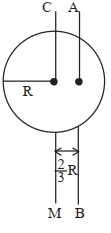
$I _{ CM }$ is moment of inertia of a circular disc about an axis $( CM )$ passing through its center and perpendicular to the plane of disc. $I _{ AB }$ is it's moment of inertia about an axis $A B$ perpendicular to plane and parallel to axis $CM$ at a distance $\frac{2}{3} R$ from center. Where $R$ is the radius of the disc. The ratio of $I _{ AB }$ and $I _{ CM }$ is $x: 9$. The value of $x$ is $........$
What is the number of significant figures in $ 0.310\times 10^3$
A thin uniform rod of length $2\,m$. cross sectional area ' $A$ ' and density ' $d$ ' is rotated about an axis passing through the centre and perpendicular to its length with angular velocity $\omega$. If value of $\omega$ in terms of its rotational kinetic energy $E$ is $\sqrt{\frac{\alpha E}{ Ad }}$ then the value of $\alpha$ is $...........$
A block of mass m is oscillating on smooth between two light springs of spring constant K separated by a distance I colliding elastically with the spring.If the velocity of the blocks is increased by an external impulse when it is not touching either of the spring then time period.
A wave is represented by the equation$y = 7\sin \left( {7\pi t - 0.04\,x\pi + \frac{\pi }{3}} \right)$ $x$ is in metres and $ t$ is in seconds. The speed of the wave is
$A$ reversible engine converts one-sixth of the heat input into work. When the temperature of the sink is reduced by $ 62^oC$, the efficiency of the engine is doubled. The temperatures of the source and sink are
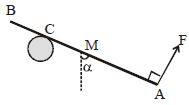
A uniform rod $AB$ of weight $100\, N$ rests on a rough peg at $C$ and $a$ force $F$ acts at $A$ as shown in figure. If $BC = CM$ and tana $= 4/3$. The minimum coefficient of friction at $C$ is
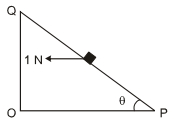
A small block of mass of $0.1 \ kg$ lies on a fixed inclined plane $P Q$ which makes an angle $\theta$ with the horizontal. A horizontal force of $1 \ N$ on the block through its center of mass as shown in the figure. The block remains stationary if (take $g =10 \ m / s ^2$ ) $Image$

$(A)$ $\theta=45^{\circ}$

$(B)$ $\theta>45^{\circ}$ and a frictional force acts on the block towards $P$.

$(C)$ $\theta>45^{\circ}$ and a frictional force acts on the block towards $Q$.

$(D)$ $\theta<45^{\circ}$ and a frictional force acts on the block towards $Q$.
A particle which is constrained to move along the $x-$axis, is subjected to a force in the same direction which varies with the distance $x$ of the particle from the origin as $F(x) = - kx + a{x^3}$. Here k and a are positive constants. For $x \ge 0$, the functional from of the potential energy $U(x)$ of the particle is
Water falls down a $500.0 \,m$ shaft to reach a turbine which generates electricity. ................ $m^3$ water must fall per second in order to generate $1.00 \times 10^9 \,W$ of power ? (Assume $50 \%$ efficiency of conversion and $\left.g=10 \,ms ^{-2}\right)$