- 500N throughout the journey.
- Less than 500N throughout the journey.
- More than 500N throughout the journey.
- > 500N for time $\triangle\text{t}_1$ and $\triangle\text{t}_3$ and 500N for $\triangle\text{t}_2.$
Explanation:
During the time interval $\triangle\text{t}_2,$ the scooter is moving with a constant velocity, which implies that the force exerted by the seat on the man is 500N (for balancing the weight of the man).
During the time interval $\triangle\text{t}_1$ and $\triangle\text{t}_3,$ the scooter is moving with constant acceleration and deceleration, which implies that a frictional force is also applied. Therefore, the net force exerted by the seat on the man should be > 500N.
Generate a complete, print-ready paper with questions like this in minutes — across 16+ boards, with answer keys.
The ratio of de-Broglie wavelengths of molecules of hydrogen and helium which are at temperature 27oC and 127oC respectively is
|
(a) |
(b) |
(c) |
(d) 1 |
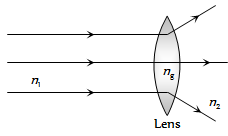
The ray diagram could be correct

|
(a) If |
(b) If |
|
(c) If |
(d) Under no circumstances |
A fuse wire with radius 1 mm blows at 1.5 amp. The radius of the fuse wire of the same material to blow at 3A will be
|
(a) |
(b) |
(c) |
(d) |
A capacitor of 20 μF is charged to 500 volts and connected in parallel with another capacitor of 10 μF and charged to 200 volts. The common potential is
|
(a) 200 volts |
(b) 300 volts |
(c) 400 volts |
(d) 500 volts |
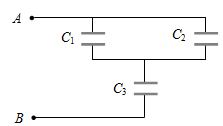
In the given network capacitance,
and
. What is the resultant capacitance between A and B

|
(a) 2.2 μF |
(b) 3.2 μF |
(c) 1.2 μF |
(d) 4.7 μF |
The half-life of a radioactive substance against a-decay is 1.2
. What is the decay rate for 4
atoms of the substance
|
(a) 4.6 |
(b) 2.3 |
|
(c) 4.6 |
(d) 2.3 |