Question
A semiconductor has equal electron and hole concentration of $2 \times 10^8/m^3$.
On doping with a certain impurity, the hole concentration increases to $4 \times 10^{10}/m^3$.
  1. What type of semiconductor is obtained on doping?
  2. Calculate the new electron and hole concentration of the semiconductor.
  3. How does the energy gap vary with doping?
Answer

Given $n_e = 2 \times 10^8/m^3, n_h = 4 \times 10^{10}/m^3$
  1. The majority charge carriers in doped semiconductor are holes, so semiconductor obtained is $p-$type semiconductor.
$\text{n}_\text{e}\text{n}_h=\text{n}^2_\text{i}$
$\Rightarrow\text{n}_\text{h}=\frac{\text{n}^2_\text{i}}{\text{n}_\text{h}}$
$=\frac{(2\times10^8)^2}{4\times10^{10}}=10^6/\text{m}^3$
  1. New electron concentration $= 10^6/m^3$
Hole concentration $= 4 \times 10^{10}/m^3$
  1. Energy gap decreases on doping.
​​​​​​​

Need a full question paper?

Generate a complete, print-ready paper with questions like this in minutes — across 16+ boards, with answer keys.

Start Generating Free

Similar questions

Calculate the ratio of energies of photons produced due to transition of electron of hydrogen atom from its$;$
  1. Second permitted energy level to the first level.
  2. Highest permitted energy level to the second permitted level.
When a charged comb is brought near a small piece of paper, it attracts the piece. Does the paper become charged when the comb is brought near it?
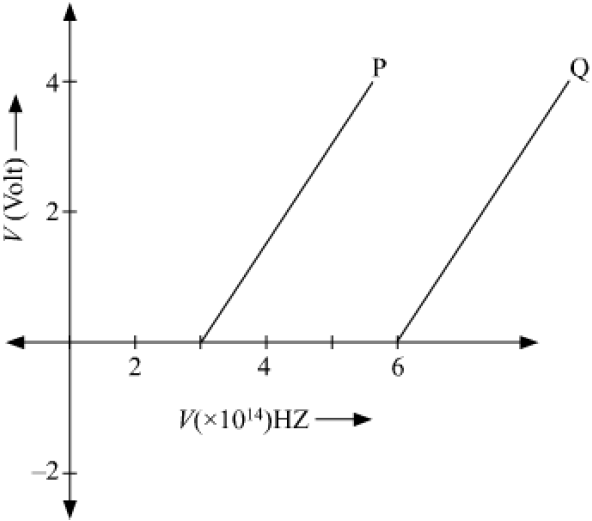
In the study of a photoelectric effect the graph between the stopping potential $V$ and frequency $v$ of the incident radiation on two different metals $P$ and $Q$ is shown below
  1. Which one of the two metals has higher threshold frequency?
  2. Determine the work function of the metal which has greater value.
  3. Find the maximum kinetic energy of electron emitted by light of frequency $8 \times 10^{14} Hz$ for this metal.
  1. A radioactive nucleus $'A\ '$ undergoes a series of decays as given below:
  1. $\text{A}\xrightarrow\alpha\text{A}_1\xrightarrow\beta\text{A}_2\xrightarrow\alpha\text{A}_3\xrightarrow\gamma\text{A}_4$
    The mass number and atomic number of $A_2$ are $176$ and $71$ respectively. Determine the mass and atomic numbers of $A_4$ and $A$.
  2. Write the basic nuclear process underlying $\beta+$ and $\beta-$ decays.
Explain the refraction of a plane wave by
(a) a thin prism
(b) a convex lens and
(c) reflection of a plane wave by a concave mirror.
Calculate the maximum kinetic energy of the beta particle emitted in the following decay scheme:
$\text{ }^{12}\text{N}\rightarrow{ }^{12}\text{C}^*+\text{e}^++\text{v}$
$\text{ }^{12}\text{C}^*\rightarrow\text{ }^{12}\text{C}+\gamma(4.43\text{MeV}).$
The atomic mass of $^{12}N$ is $12.018613u.$
A beam of light consisting of two wavelengths, $650 \ nm$ and $520 \ nm$, is used to obtain interference fringes in a Young’s double-slit experiment.
  1. Find the distance of the third bright fringe on the screen from the central maximum for wavelength $650 \ nm.$
  2. What is the least distance from the central maximum where the bright fringes due to both the wavelengths coincide?
Consider a head $-$ on collision between two particles of masses $m_1$ and $m_2$. The initial speeds of the particles are $u_1$ and $u_2$ in the same direction. The collision starts $2$ at $t = 0$ and the particles interact for a time interval $\triangle\text{t}.$ During the collision, the speed of the first particle varies as.$\text{v}(\text{t})=\text{u}_1+\frac{\text{t}}{\triangle\text{t}}(\text{v}_1-\text{u}_1).$
Find the speed of the second particle as a function of time during the collision.
Prove that a closed equipotential surface with no charge within itself must enclose an equipotential volume.
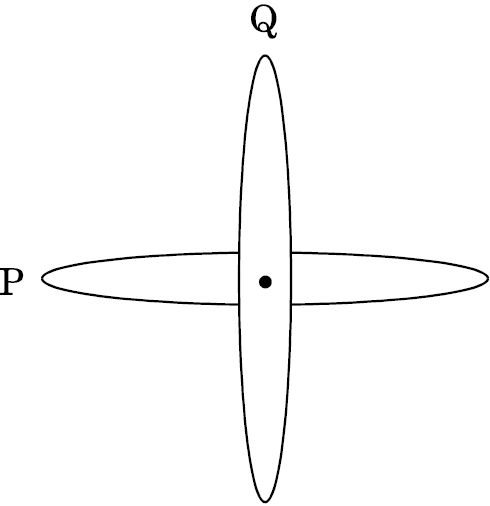
Two identical loops P and Q each of radius 5 cm are lying in perpendicular planes such that they have a common centre as shown in the figure. Find the magnitude and direction of the net magnetic field at the common centre of the two coils, if they carry currents equal to 3 A and 4 A respectively.