Question
Prove that a closed equipotential surface with no charge within itself must enclose an equipotential volume.

Answer

Let us assume that in a closed equipotential surface with no charge the potential is changing from position to position. Let the potential just inside the surface is different to that of the surface causing in a potential gradient $\Big(\frac{\text{dV}}{\text{dr}}\Big)$ It means $\text{E}\neq0$ electric field comes into existence, which is given by as $\text{E}=-\frac{\text{dV}}{\text{dr}}$ It means there will be field lines pointing inwards or outwards from the surface. These lines cannot be again on the surface, as the surface is equipotential. It is possible only when the other end of the field lines are originated from the charges inside. This contradicts the original assumption. Hence, the entire volume inside must be equipotential.

Need a full question paper?

Generate a complete, print-ready paper with questions like this in minutes — across 16+ boards, with answer keys.
Start Generating Free

Similar questions

It is sometimes heard that inertial frame of reference is only an ideal concept and no such inertial frame actually exists. Comment.
Two wires A and B of the same material and having same length, have their cross sectional areas in the ratio 1 : 6. What would be the ratio of heat produced in these wires when same voltage is applied across each?
What is meant by pure and impure spectrum?
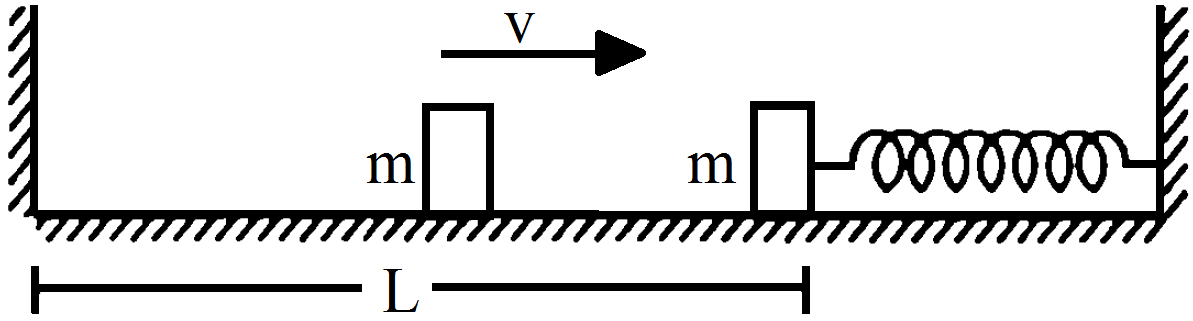
The left block in figure moves at a speed v towards the right block placed in equilibrium. All collisions to take place are elastic and the surfaces are frictionless. Show that the motions of the two blocks are periodic. Find the time period of these periodic motions. Neglect the widths of the blocks.
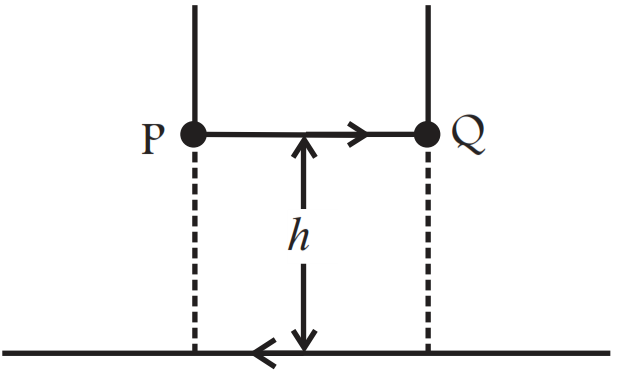
A long straight wire carrying current of 25A rests on a table as shown in Fig. Another wire PQ of length 1m, mass 2.5g carries the same current but in the opposite direction. The wire PQ is free to slide up and down. To what height will PQ rise?
An electric bulb is marked $220 V, 100 W$. Calculate : (i) resistance of the bulb (ii) peak voltage of the source (iii) rms current flowing through the bulb.
Find the charges on the three capacitors connected to a battery as shown in figure. Take $\text{C}_1=2.0\mu\text{F},\ \text{C}_2=4.0\mu\text{F},\ \text{C}_3=6.0\mu\text{F}$ and V = 12 volts.
Define the term wavefront. State Huygen's principle. Consider a plane wavefront incident on a thin convex lens. Draw a proper diagram to show how the incident wavefront traverses through the lens and after refraction focusses on the focal point of the lens, giving the shape of the emergent wavefront.
The diameter of the sun is $1.4 \times 10^9m$ and its distance from the earth is $1.5 \times 10^{11}m.$ Find the radius of the image of the sun formed by a lens of focal length $20\ cm.$
Do all the thermocouples have a neutral temperature?