A series combination of two resistors $1\,\Omega $ each is connected to a $12\,V$ battery of internal resistance $0.4\,\Omega $. The current flowing through it will be ............... $A$
Easy


Download our appand get started for free
Experience the future of education. Simply download our apps or reach out to us for more information. Let's shape the future of learning together!No signup needed.*
Similar Questions
- 1A charged particle having drift velocity of $7.5 \times 10^{-4}\, ms ^{-1}$ is an electric field of $3 \times 10^{-10}\, Vm ^{-1}$ has a mobility in $m ^{2} V ^{-1} s ^{-1}$ ofView Solution
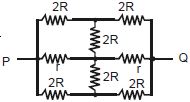
- 2The effective resistance between points $P$ and $Q$ of the electrical circuit shown in the figure isView Solution
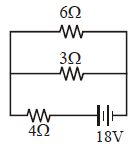
- 3The total power dissipated (in $watt$ ) in the circuit shown isView Solution
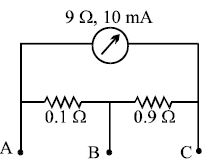
- 4A milliammeter of range $10\, mA$ and resistance $9\, \Omega$ is joined in a circuit as shown. The meter gives full-scale deflection for current $I$ when $A$ and $B$ are used as its terminals, i.e., current enters at $A$ and leaves at $B$ ($C$ is left isolated). The value of $I$ isView Solution
- 5An electric bulb of $100\, watt$ is connected to a supply of electricity of $220\, V$. Resistance of the filament is ............. $\Omega$View Solution
- 6View SolutionIf an observer is moving with respect to a stationary electron, then he observes
- 7By using only two resistance coils-singly, in series, or in parallel one should be able to obtain resistances of $3$, $4$, $12$ and $16\, ohms$. The separate resistances of the coil areView Solution
- 8A resistance of $2\,\Omega $ is connected across one gap of a meter-bridge and unknown resistance, greater than $2\,\Omega $ , is connected a cross the other gap. When these resistances are interchanged, the balance point shifts by $20\ cm$ , neglecting any end correction, the unknown resistance is ................ $\Omega$View Solution
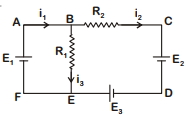
- 9For the circuit given below, the Kirchoff's loop rule for the loop $BCDEB$ is given by the equationView Solution
- 10We have two wires $A$ and $B$ of same mass and same material. The diameter of the wire $A$ is half of that $B$. If the resistance of wire $A$ is $24\, ohm$ then the resistance of wire $B$ will be ................ $Ohm$View Solution