MCQ
A shell initially at rest explodes into two pieces of equal mass, then the two pieces will
  • A
    Be at rest
  • B
    Move with different velocities in different directions
  • Move with the same velocity in opposite directions
  • D
    Move with the same velocity in same direction
Answer

Correct option: C.
Move with the same velocity in opposite directions
c
(c)According to law of conservation of linear momentum both pieces should possess equal momentum after explosion. As their masses are equal therefore they will possess equal speed in opposite direction.

Need a full question paper?

Generate a complete, print-ready paper with questions like this in minutes — across 16+ boards, with answer keys.

Start Generating Free

Similar questions

A diatomic gas follows equation $PV^m =$ constant, during a process. What should be the value of $m$ such that its molar heat capacity during process $= R$
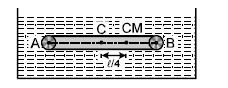
A non uniform cylinder of mass $m$ , length $l$ and radius $r$ is having its cetnre of mass at a distance $l/4$ from the centre and lying on the axis of the cylinder. The cylinder is kept in a liquid of uniform density $\rho $ . The moment of inertia of the rod about the centre of mass is $I$ . The angular acceleration of point $A$ relative to point $B$ just after the rod is released from the position shown in figure is
A ball is thrown at different angles with the same speed $u$ and from the same point. It has the same range in both cases. If $y_1$ and $y_2$ be the heights attained in the two cases, then $y_1+y_2$ equals to
A particle of unit mass is moving along the $x$-axis under the influence of a force and its total energy is conserved. Four possible forms of the potential energy of the particle are given in column $I$ (a and $U _0$ are constants). Match the potential energies in column $I$ to the corresponding statement$(s)$ in column $II.$

column $I$ column $II$
$(A)$ $U _1( x )=\frac{ U _0}{2}\left[1-\left(\frac{ x }{ a }\right)^2\right]^2$ $(P)$ The force acting on the particle is zero at $x = a$.
$(B)$ $U _2( x )=\frac{ U _0}{2}\left(\frac{ x }{ a }\right)^2$ $(Q)$ The force acting on the particle is zero at $x=0$.
$(C)$ $U _3( x )=\frac{ U _0}{2}\left(\frac{ x }{ a }\right)^2 \exp \left[-\left(\frac{ x }{ a }\right)^2\right]$ $(R)$ The force acting on the particle is zero at $x =- a$.
$(D)$ $U _4( x )=\frac{ U _0}{2}\left[\frac{ x }{ a }-\frac{1}{3}\left(\frac{ x }{ a }\right)^3\right]$ $(S)$ The particle experiences an attractive force towards $x =0$ in the region $| x |< a$.
  $(T)$ The particle with total energy $\frac{ U _0}{4}$ can oscillate about the point $x=-a$.


When water boils or freezes, during these processes its temperature:
A thin walled cylindrical metal vessel of linear coefficient of expansion $10^{-3} $ $^o C^{-1}$ contains benzenr of volume expansion coefficient $10^{-3}$ $^o C^{-1}$. If the vessel and its contents are now heated by $10^o C,$ the pressure due to the liquid at the bottom.
A beaker containing a liquid is kept inside a big closed jar. If the air inside the jar is continuously pumped out the pressure in the liquid near the bottom of the liquid will:
  1. Increase
  2. Decrease
  3. Remain constant
  4. First decrease and then increase.
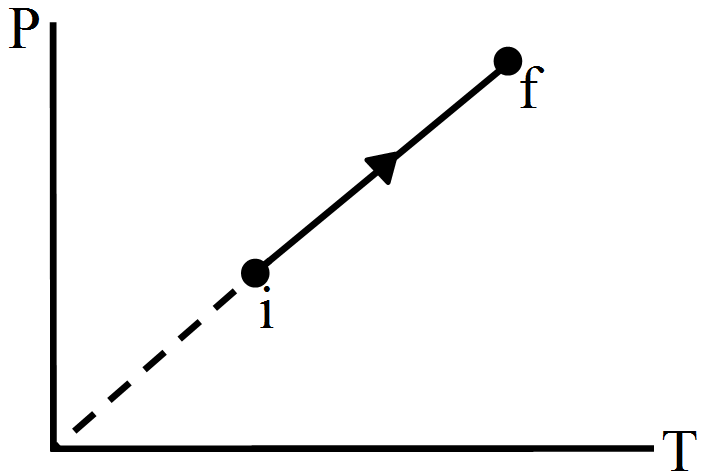
An ideal gas goes from the state i to the state fas shown in figure. The work done by the gas during the process:
  1. Is positive.
  2. Is negative.
  3. Is zero.
  4. Cannot be obtained from this information.

The foundations of dimensional analysis were laid down by
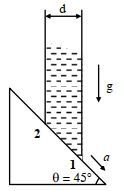
A cylindrical tube, with its base as shown in the figure, is filled with water. It is moving down with a constant acceleration $a$ along a fixed inclined plane with angle $\theta=45^{\circ} . P_1$ and $P_2$ are pressures at points 1 and 2 , respectively, located at the base of the tube. Let $\beta=\left(P_1-P_2\right) /(\rho g d)$, where $\rho$ is density of water, $d$ is the inner diameter of the tube and $g$ is the acceleration due to gravity. Which of the following statement($s$) is(are) correct?

$(A)$ $\beta=0$ when $a= g / \sqrt{2}$

$(B)$ $\beta>0$ when $a= g / \sqrt{2}$

$(C)$ $\beta=\frac{\sqrt{2}-1}{\sqrt{2}}$ when $a= g / 2$

$(D)$ $\beta=\frac{1}{\sqrt{2}}$ when $a= g / 2$