A simple pendulum has time period 't'. Its time period in a lift which is moving upwards with acceleration $3 ms ^{-2}$ is
Easy


Download our appand get started for free
Experience the future of education. Simply download our apps or reach out to us for more information. Let's shape the future of learning together!No signup needed.*
Similar Questions
- 1View SolutionWhich of the diagrams shown in figure represents variation of total mechanical energy of a pendulum oscillating in water as function of time ?
- 2For a simple pendulum, a graph is plotted between its kinetic energy $(KE)$ and potential energy $(PE)$ against its displacement $d.$ Which one of the following represents these correctly ? (graphs are schematic and not drawn to scale)View Solution
- 3The potential energy of a particle of mass $1\, kg$ in motion along the $x-$ axis is given by $U = 4\,(1 -cos\,2x)$, where $x$ is in $metres$ . The period of small oscillation (in $second$ ) isView Solution
- 4A particle of mass $m$ performs $SHM$ along a straight line with frequency $f$ and amplitude $A.$View Solution
- 5If $x=5 \sin \left(\pi t+\frac{\pi}{3}\right) \mathrm{m}$ represents the motion of a particle executing simple harmonic motion, the amplitude and time period of motion, respectively, areView Solution
- 6The $K.E.$ and $P.E.$ of a particle executing $SHM$ with amplitude $A$ will be equal when its displacement is-View Solution
- 7The bob of a simple pendulum of mass m and total energy $E$ will have maximum linear momentum equal toView Solution
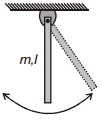
- 8A uniform rod of mass $m$ and length $I$ is suspended about its end, Time period of small angular oscillations is ..........View Solution
- 9For a periodic motion represented by the equation $Y=\sin \omega t+\cos \omega t$ The amplitude of the motion isView Solution
- 10For a body executing $S.H.M. :$View Solution
$(a)$ Potential energy is always equal to its $K.E.$
$(b)$ Average potential and kinetic energy over any given time interval are always equal.
$(c)$ Sum of the kinetic and potential energy at any point of time is constant.
$(d)$ Average $K.E.$ in one time period is equal to average potential energy in one time period.
Choose the most appropriate option from the options given below: