A particle of mass $m$ performs $SHM$ along a straight line with frequency $f$ and amplitude $A.$
Medium
Download our app for free and get started
if $x=$ $Asinwt$ $\Rightarrow v=$ $Awcoswt$ $\Rightarrow v^{2}=A^{2} \times 4 \pi^{2} f^{2} \cos ^{2} \omega t=4 \pi^{2} f^{2} A^{2}(1+\cos 2 \omega t) / 2=$
$2 \pi^{2} f^{2} A^{2}(1+\cos 2 \omega t)$
The average potential energy is equal to average kinetic energy is equal to average of $m v^{2} / 2=\frac{1}{2} m \times 2 \pi^{2} f^{2} A^{2}(1+\cos 2 \omega t)-(1)$
$\Rightarrow m \pi^{2} f^{2} A^{2}$
From $( 1 ),$ angular frequency of oscillation of kinetic energy is $2$ $\omega$ i.e., frequency of oscillation of kinetic energy is $2 f$

Download our appand get started for free
Experience the future of education. Simply download our apps or reach out to us for more information. Let's shape the future of learning together!No signup needed.*
Similar Questions
- 1A simple pendulum of length $1\,m$ is allowed to oscillate with amplitude $2^o$. It collides elastically with a wall inclined at $1^o$ to the vertical. Its time period will be : (use $g = \pi ^2$ )View Solution
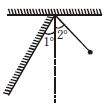
- 2A particle is executing simple harmonic motion with a period of $T$ seconds and amplitude a metre. The shortest time it takes to reach a point $\frac{a}{{\sqrt 2 }}\,m$ from its mean position in seconds isView Solution
- 3A spring has a certain mass suspended from it and its period for vertical oscillation is $T$. The spring is now cut into two equal halves and the same mass is suspended from one of the halves. The period of vertical oscillation is nowView Solution
- 4A particle of mass $m$ executes simple harmonic motion with amplitude $a$ and frequency $v$. The average kinetic energy during its motion from the position of equilibrium to the end isView Solution
- 5Kinetic energy of a particle executing simple harmonic motion in straight line is $pv^2$ and potential energy is $qx^2$, where $v$ is speed at distance $x$ from the mean position. It time period is given by the expressionView Solution
- 6$Y = A \sin \left(\omega t +\phi_{0}\right)$ is the time-displacement equation of a SHM. At $t=0$ the displacement of the particle is $Y =\frac{ A }{2}$ and it is moving along negative $x$ -direction. Then the initial phase angle $\phi_{0}$ will be ...... .View Solution
- 7Consider a one-dimensional potential $V(x)$ as shown in the figure below. A classical particle of mass $m$ moves under its influence and has total energy $E$ as shown below. The motion isView Solution
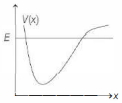
- 8A particle executing a simple harmonic motion of period $2\ s$ . When it is at its extreme displacement from its mean position, it receives an additional energy equal to what it had in its mean position. Due to this , in its subsequent motion,View Solution
- 9A body is moving in a room with a velocity of $20\, m / s$ perpendicular to the two walls separated by $5$ meters. There is no friction and the collisions with the walls are elastic. The motion of the body isView Solution
- 10Equations $y = 2A \cos ^2 \omega \,t$ and $y = A (\sin \omega t + \cos \omega t )$ represent the motion of two particles.View Solution