Question
A simple pendulum is constructed by hanging a heavy ball by a $5.0m$ long string. It undergoes small oscillations.
  1. How many oscillations does it make per second?
  2. What will be the frequency if the system is taken on the moon where acceleration due to gravitation of the moon is $1.67\ m/s^2.$
Answer

$\text{L}=5\text{m}$
  1. $\text{T}=2\pi\sqrt{\frac{\ell}{\text{g}}}=2\pi\sqrt{0.5}=2\pi(0.7)$
$\therefore$ in $2\pi(0.7)\sec$ the body completes $1$ oscillation,
In $1$ second, the body will complete $\frac{1}{2\pi(0.7)}$ oscillation
$\therefore\text{f}=\frac{1}{2\pi(0.7)}=\frac{10}{14\pi}=\frac{0.70}{\pi}$ Times
  1. When it is taken to the moon
$\text{T}=2\pi\sqrt{\frac{\ell}{\text{g'}}}$
where $g\ ' \rightarrow$ Acceleration in the moon.
$=2\pi\sqrt{\frac{5}{1.67}}$
$\therefore\text{f}=\frac{1}{\text{T}}=\frac{1}{2\pi}\sqrt{\frac{1.67}{5}}=\frac{1}{2\pi}(0.577)=\frac{1}{2\pi\sqrt{3}}$ times.

Need a full question paper?

Generate a complete, print-ready paper with questions like this in minutes — across 16+ boards, with answer keys.

Start Generating Free

Similar questions

A card sheet divided into squares each of size $1 \ mm^2$ is being viewed at a distance of $9 \ cm$ through a magnifying glass $(a$ converging lens of focal length $9 \ cm)$ held close to the eye.
  1. What is the magnification produced by the lens ? How much is the area of each square in the virtual image?
  2. What is the angular magnification (magnifying power) of the lens?
  3. Is the magnification in $(a)$ equal to the magnifying power in $(b)$? Explain.
  1. Show that the normal component of electrostatic field has a discontinuity from one side of a charged surface to another given by
$(\text{E}_2-\text{E}_1).\hat{\text{n}}=\frac{\sigma}{\epsilon_0}$
where $\hat{\text{n}}$ is a unit vector normal to the surface at a point and $\sigma$ is the surface charge density at that point. $ ($The direction of $\hat{\text{n}}$ is from side $1$ to side $2.)$ Hence show that just outside a conductor, the electric field is $\sigma \hat{\text{n}} /ε_0.$
  1. Show that the tangential component of electrostatic field is continuous from one side of a charged surface to another.
$[$Hint: For $(a),$ use Gauss’s law. For $, (b)$ use the fact that work done by electrostatic field on a closed loop is zero.$]$
Clear the difference between interference and diffraction.
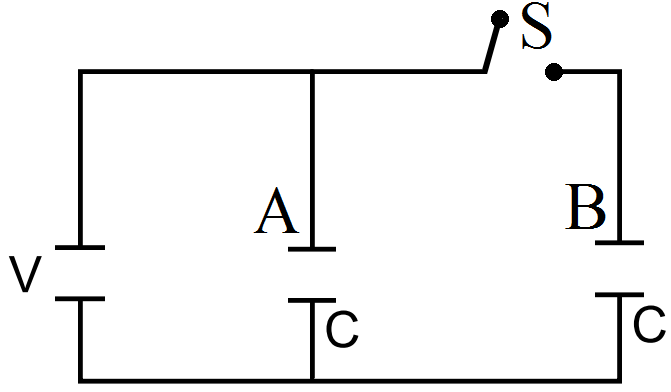
Figure shows two identical parallel plate capacitors connected to a battery through a switch S. Initially, the switch is closed so that the capacitors are completely charged. The switch is now opened and the free space between the plates of the capacitors is filled with a dielectric of dielectric constant 3. Find the ratio of the initial total energy stored in the capacitors to the final total energy stored.
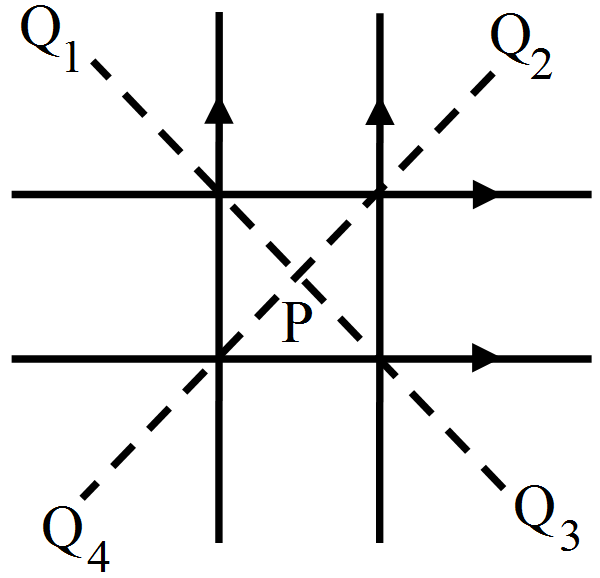
Four long, straight wires, each carrying a current of $5.0A,$ are placed in a plane as shown in figure. The points of intersection form a square of side $5.0\ cm.$
  1. Find the magnetic field at the centre $P$ of the square.
  2. $Q_1, Q_2, Q_3,$ and $Q_4$ are points situated on the diagonals of the liquare and at a distance from $P$ that is equal to the length of the diagonal of the square. Find the magnetic fields at these points.
Find the maximum magnitude of the linear momentum of a photoelectron emitted when light of wavelength 400 run falls on a metal having work function 2.5eV.
Asha’s mother read an article in the newspaper about a disaster that took place at Chernobyl. She could not understand much from the article and asked a few questions from Asha regarding the article. Asha tried to answer her mother’s questions based on what she learnt in Class XII Physics.
  1. What was the installation at Chernobyl where the disaster took place? What, according to you, was the cause of this disaster?
  2. Explain the process of release of energy in the installation at Chernobyl.
  3. What, according to you, were the values displayed by Asha and her mother?
A ball falls on an inclined plane of inclination $\theta$ from a height h above the point of impact and makes a perfectly elastic collision. Where will it hit the plane again?
Two identical balls, each having a charge of $2.00 \times 10^{-7}C$ and a mass of $100g$, are suspended from a common point by two insulating strings each $50\ cm$ long. The balls are held at a separation $5.0\ cm$ apart and then released. Find,
  1. The electric force on one of the charged balls.
  2. The components of the resultant force on it along and perpendicular to the string.
  3. The tension in the string.
  4. The acceleration of one of the balls. Answers are to be obtained only for the instant just after the release.
Find the magnitude of the electric field at a point $4\ cm$ away from a line charge of density $2 \times 10^{-6}Cm^{-1}.$